
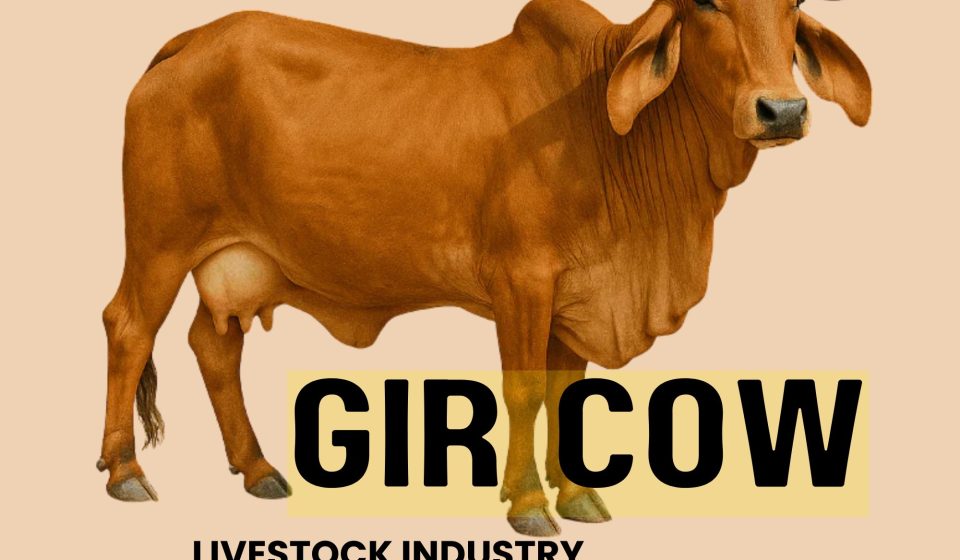
The Gir Cow Everything You Need to Know (From Someone Who’s Actually Raised Them)
I still remember the first time I saw a Gir cow up close. It was at a small farm in Gujarat, and I honestly couldn’t take my eyes off her. That distinctive domed forehead, the long droopy ears, the calm way she stood there chewing cud like she owned the place. There was something almost regal about her. My uncle turned to me and said, “Beta, this one breed has more value than ten ordinary cows.” At the time, I thought he was exaggerating.
He wasn’t.
If you’re thinking about getting into dairy farming — or you’re just curious about this incredible breed — let me walk you through everything about the Gir cow. Not the textbook version. The real version.
Gir Cow Origin: Where Does This Breed Come From?
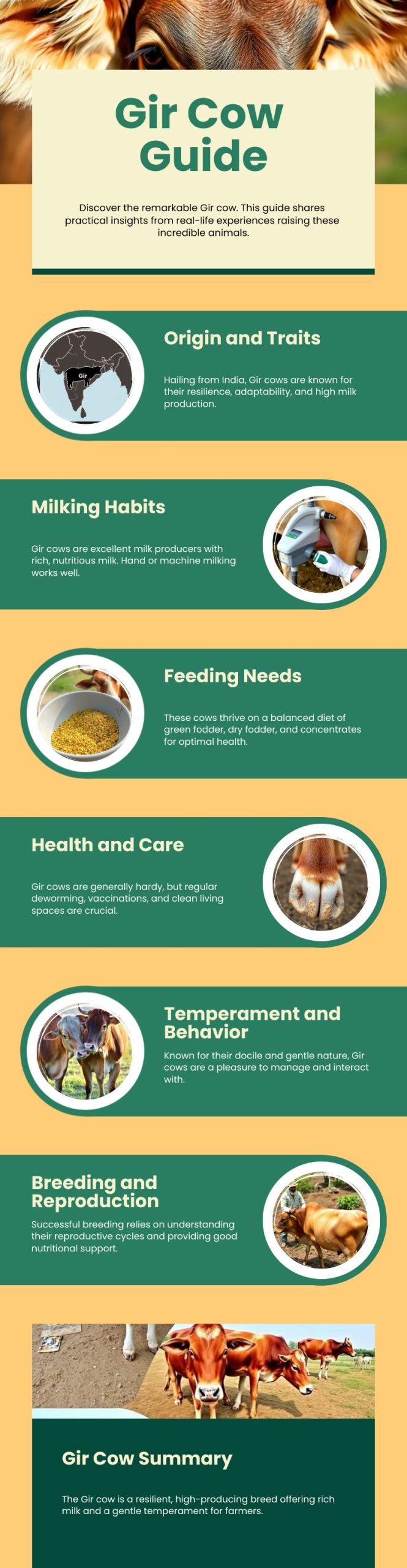
The Gir cow is one of India’s oldest and most celebrated indigenous breeds. She comes from the Gir forest region of Saurashtra in Gujarat — that’s where the name comes from. This area sits in the western part of India, and the breed has been developed over thousands of years in that specific climate and terrain.
What’s fascinating is how far she’s traveled. Gir cattle were exported to Brazil in the early 20th century, and today Brazil has actually become one of the largest breeders of Gir cattle in the world. They call them “Guzerat” over there. You’ll also find significant Gir populations in the USA, Mexico, and Israel. A breed that started in the forests of Gujarat is now making its way across continents. Not bad for a desi cow.
Gir Cow Identification: How to Spot One
Walk into any cattle fair, and you’ll pick out the Gir cow immediately. She’s not subtle.
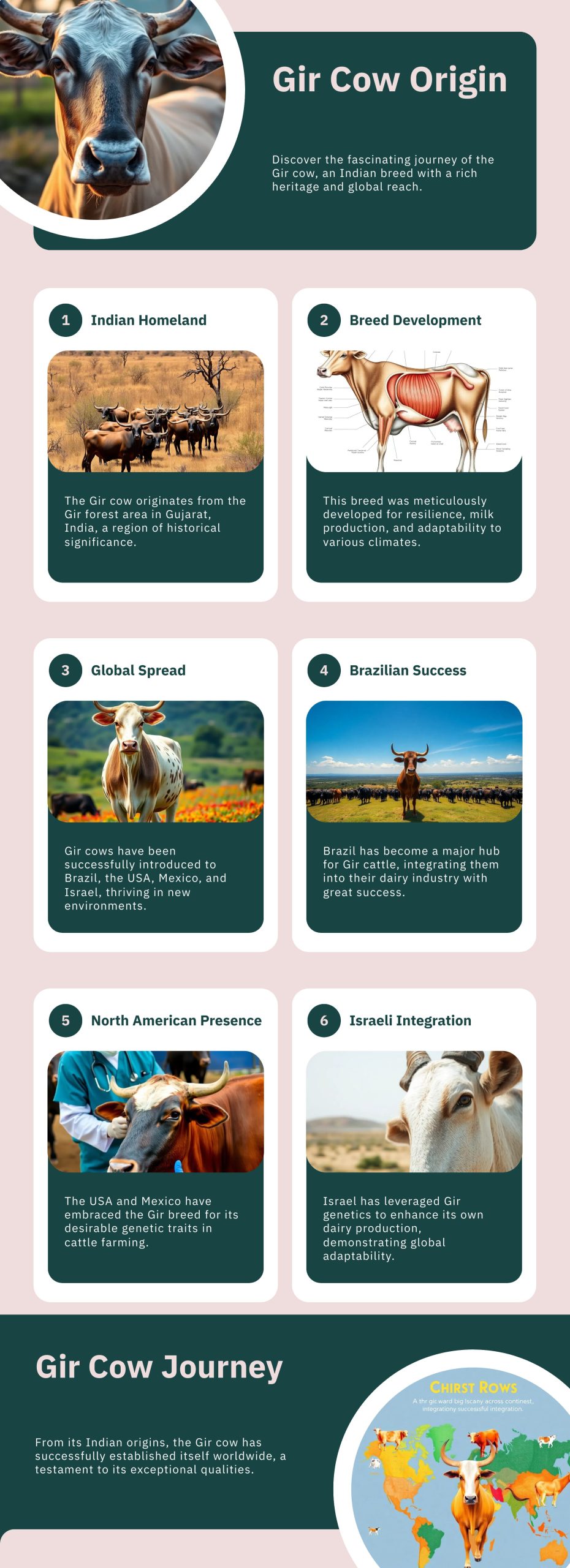
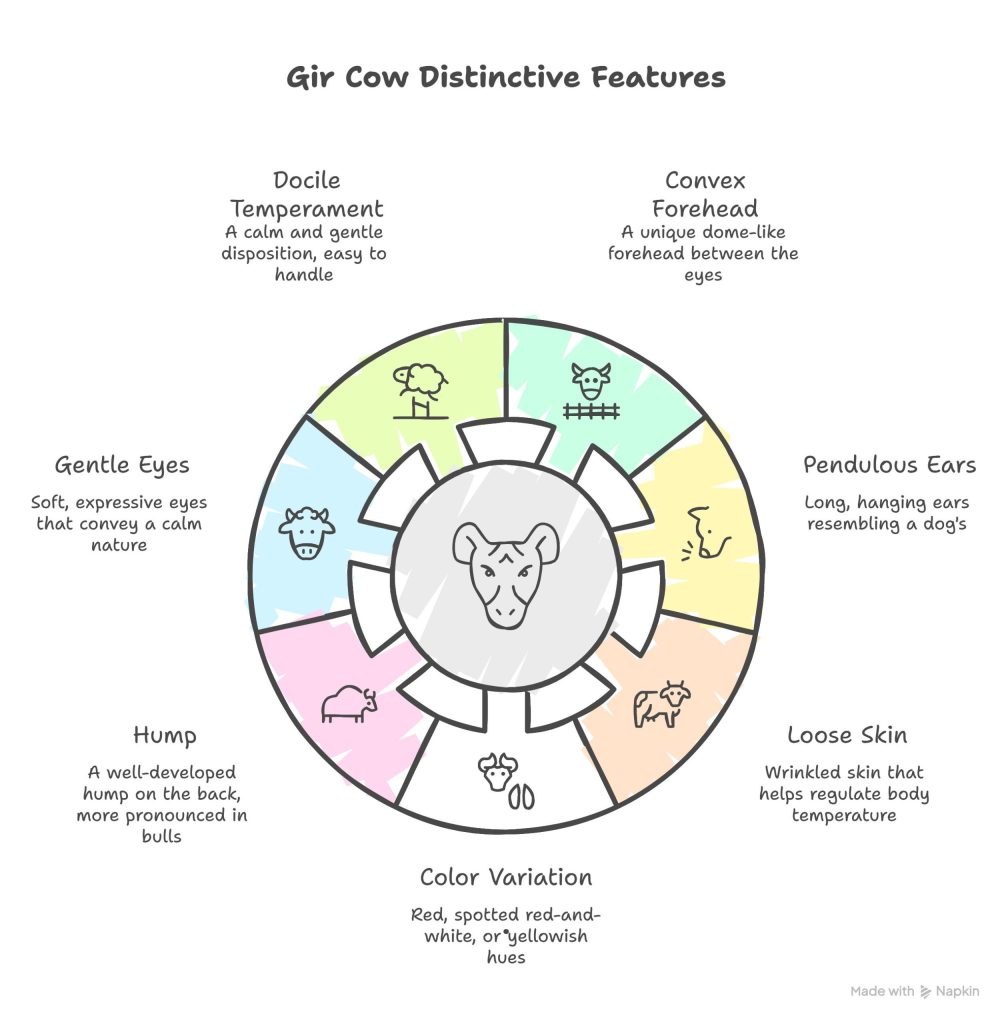
The most obvious feature is that bulging, convex forehead — it’s almost like a dome sitting right between her eyes. No other breed looks quite like this. Then there are the ears, long and pendulous, hanging down almost like a dog’s. The ears are so distinctive that farmers often use them as the first identification marker.
The skin is loose and wrinkled, which actually serves a purpose — it helps regulate body temperature in hot climates. The color ranges from red to spotted red-and-white, though you’ll also see some with a more yellowish tint. The hump on the back (the Brahman-type hump) is well-developed in bulls, a little less pronounced in cows.
The eyes have this gentle, soft expression. People who work with Gir cattle always comment on their temperament. They’re docile. Calm. Not the type to kick you across the barn when you’re trying to milk them at 5 AM.
Gir Cow Characteristics: What Makes Her Special
Let’s talk specifics, because this is where things get really interesting.
The Gir cow is what’s called a Zebu breed, meaning she belongs to the Bos indicus family. This matters because Zebu cattle are naturally adapted to hot, humid, and sometimes harsh conditions. They carry a gene called the SLICK gene (well, a version of it) that makes them far more heat-tolerant than European breeds like Holstein or Jersey.
She has a long, productive life — more on that in a moment. Her milk has a unique fat and protein composition. And she’s disease-resistant in ways that imported breeds simply aren’t.
Here’s something most people don’t tell you: Gir cows are good mothers. When a Gir cow has a calf, she bonds intensely. Some farmers have found that the calf’s presence actually stimulates better milk letdown. You have to work with her nature, not against it.
Gir Cow Weight: How Big Do They Get?
Adult Gir cows typically weigh between 385 to 475 kg. Bulls are considerably heavier, ranging from 550 to 650 kg on average, with well-fed bulls sometimes crossing 700 kg.
At birth, calves weigh around 20 to 25 kg. They grow steadily, and by 18 months, a well-fed heifer will be approaching 250–280 kg.
Compared to some of the massive Holstein-Friesian cattle you see at commercial dairies, the Gir is medium-sized. But don’t let that fool you. She’s sturdy. Dense. Solid muscle and bone. Farmers say she “punches above her weight” when it comes to milk production relative to her body size.
Gir Cow Lifespan: How Long Do They Live?
This is one of the Gir cow’s quiet superpowers. A well-cared-for Gir cow can live 12 to 15 years, and productive cows often continue giving milk well into their 10th or 11th year.
Compare that to a high-production Holstein, which is often considered economically “spent” by age 5 or 6 because the intensive breeding and milking takes such a toll on her body. The Gir doesn’t burn bright and fade fast. She’s more like a slow, steady flame.
I know a farmer in Rajkot who has a Gir cow that completed her 8th lactation cycle. Eight. She’s still healthy, still milking, still calm as ever. That kind of longevity completely changes the economics of dairy farming.
A Gir cow also typically has her first calf at around 3 years of age, with a calving interval of about 15 months. She’ll produce calves regularly for 8 to 10 years in most cases.
Gir Cow Milk Per Day and Yield
Okay, let’s talk about what everyone really wants to know.
A good Gir cow produces anywhere from 8 to 12 liters of milk per day under standard farm conditions. In exceptional cases, with proper nutrition and management, some cows have recorded 15 to 20 liters per day. The total yield per lactation (which lasts about 300 days) comes to roughly 1800 to 3500 liters.
Now here’s the thing — that number alone doesn’t tell the whole story.
Gir cow milk has a fat content of 4.5% to 5.5%, which is significantly higher than what you get from a Holstein (usually around 3.5%). More importantly, Gir milk contains A2 beta-casein protein, which is increasingly in demand because many people find it easier to digest than the A1 protein found in most commercial milk.
A2 milk from Gir cows is currently selling at ₹60 to ₹120 per liter in many Indian cities, compared to ₹40–50 for regular milk. Some premium brands are selling it for even more. So even if your Gir produces 10 liters per day instead of 20, the value per liter is often double.
My neighbor started selling Gir A2 milk directly to apartment residents in the city nearby. Within six months, he had a waiting list. The quality sells itself.
Gir Cow Advantages: Why Farmers Are Going Back to Indigenous Breeds
There’s a reason Gir cattle are having a massive comeback in India after decades of being overshadowed by cross-bred and imported cattle.
Heat tolerance. In the blazing summers of Gujarat or Rajasthan, where temperatures hit 45°C, a Gir cow keeps grazing. European breeds need expensive cooling systems just to survive. Gir doesn’t.
Low maintenance costs. She thrives on locally available fodder — sorghum, bajra, groundnut straw, green grasses. You don’t need imported feeds or fancy supplements for her to perform reasonably well.
Disease resistance. Gir cattle have better natural immunity to tick-borne diseases and tropical infections that devastate imported breeds. Vet bills are lower. Mortality rates are lower.
A2 milk premium. As discussed. This alone has changed the business case for many farmers.
Dung and urine value. This sounds odd if you’re new to it, but Gir cow dung and urine (called “gomutra”) are in high demand for organic farming inputs, biogas production, and in Ayurvedic products. Some farmers have built secondary income streams just from this.
Government support. Various state governments and the central government under schemes like Rashtriya Gokul Mission are actively promoting indigenous breeds including Gir. Subsidies, training, breed improvement programs — there’s real institutional support right now.
Gir Cow Breed Information for Buyers
If you’re looking to purchase Gir cattle, here’s what to keep in mind.
Source matters enormously. The best Gir stock comes from Gujarat — specifically Junagadh, Amreli, Bhavnagar, and Rajkot districts. There are also good breeders in Maharashtra and parts of Rajasthan. Be cautious of sellers who claim purebred Gir but can’t show you the parents or any documentation.
What to look for:
- That characteristic domed forehead and long ears
- Clean, loose skin without obvious lesions
- A calm temperament — if a cow is aggressive or extremely skittish, that’s a flag
- Good udder shape with evenly spaced teats
- No swelling or heat in the udder area
Price range: A quality Gir cow in milk (meaning she’s currently lactating) will cost between ₹40,000 to ₹1,20,000 depending on her production record, pedigree, and age. Pregnant heifers are often in the ₹30,000–₹60,000 range. Don’t go for the cheapest option you find online. Do your homework.
Gir Cow Farming Business Plan: Can You Actually Make Money?
Let’s be real about this. Farming is work. It’s not a get-rich-quick scheme. But Gir cow farming, done right, is a genuinely viable business.
Here’s a rough picture for a small-scale operation with 10 Gir cows:
Initial Investment (approximate):
- 10 cows in milk: ₹6–8 lakhs
- Shed construction (basic): ₹1–2 lakhs
- Equipment (milking, storage, churn): ₹50,000–₹80,000
- Working capital (6 months fodder, labor): ₹1.5–2 lakhs
- Total startup: roughly ₹10–13 lakhs
Monthly Revenue:
- 10 cows × 10 liters/day × 30 days = 3,000 liters/month
- Selling at ₹70/liter (A2, direct to consumer): ₹2,10,000/month
- Calf sales, dung products: ₹10,000–₹20,000/month
- Gross: ~₹2.2–2.3 lakhs/month
Monthly Expenses:
- Fodder and feed: ₹60,000–₹80,000
- Labor (2 workers): ₹20,000–₹30,000
- Vet, medicines, misc: ₹8,000–₹12,000
- Total expenses: ~₹90,000–₹1.2 lakhs/month
Net profit: ₹1 lakh to ₹1.3 lakhs per month, at this scale, with direct-to-consumer A2 milk sales.
If you’re selling to a cooperative or middleman at lower rates, the margins are thinner — maybe ₹40,000–₹60,000 net. Which is why most successful Gir farmers today are building their own customer base. WhatsApp groups, local delivery, subscription models. It works.
A few things I’d tell anyone starting out:
Start small. Three to five cows first. Learn the rhythm of dairy farming before scaling. Understand your local market — is there demand for A2 milk? Are there organic farming cooperatives nearby? Can you sell ghee or paneer directly?
Also, talk to people who are actually doing it. Visit farms. Spend a day or two helping out. No business plan survives first contact with a real cow without some adjustments.
Final Thoughts
The Gir cow isn’t just a dairy animal. For many Indian farmers, she’s a piece of living heritage. She’s adapted over centuries to Indian soil, Indian climate, Indian conditions. And right now, she’s also a pretty smart business investment — especially as the A2 milk market grows and consumers become more conscious about where their food comes from.
Whether you’re a farmer considering a switch from crossbreeds, or someone who just wants to understand what makes indigenous cattle so special, I hope this gives you a real picture. Not the brochure version. The real one.
She’ll test your patience sometimes. But so will any good thing worth keeping.
Q1. Is the Gir cow good for small farmers with limited land?
Absolutely. In fact, many successful Gir cow operations run on just 1–2 acres. She doesn’t need massive pasture land if you’re supplementing with cut fodder. A small shed, a clean water source, and good quality feed is enough to get started. Plenty of small farmers run 3–5 Gir cows profitably from their backyard. The key is direct milk sales — that’s where the margin lives for small operators.
Q2. How many times a day should a Gir cow be milked?
Twice a day is standard — early morning and evening, usually about 10–12 hours apart. Some high-yielding cows benefit from three milkings a day, but that adds labor cost and isn’t always practical for small farms. Consistency matters more than frequency. Milk her at the same times every day. Gir cows are creatures of routine, and disrupting their schedule will actually reduce yield.
Q3. What is the difference between Gir cow milk and regular cow milk?
The big difference is the protein type. Regular commercial milk (mostly from Holstein-Friesian crossbreeds) contains A1 beta-casein protein. Gir cow milk contains A2 beta-casein, which many people find easier on the stomach — especially those who experience bloating or discomfort with regular milk. Beyond that, Gir milk is richer in fat (4.5–5.5%), has more calcium, and contains higher levels of Omega-3 fatty acids. It also has a naturally creamier taste. That’s why it commands a premium price.
Q4. How much fodder does a Gir cow need daily?
A lactating Gir cow needs roughly 25–30 kg of green fodder per day, along with 4–6 kg of dry fodder (like straw) and about 2–4 kg of concentrate feed depending on her milk output. Clean, fresh water — at least 50–60 liters per day — is non-negotiable. If she’s producing well, don’t cut corners on feed. What goes in directly affects what comes out.
Q5. At what age does a Gir cow give her first milk?
A Gir heifer typically reaches sexual maturity around 2.5 to 3 years of age and delivers her first calf shortly after. Milk production begins after calving. So realistically, if you buy a young heifer, expect to wait about 2.5–3 years before she starts milking. That’s why many farmers prefer purchasing a cow already in milk, or one that’s in her second or third pregnancy — you’re paying more upfront, but the return starts immediately.
Q6. Can Gir cows survive in non-Gujarat climates — like UP, MP, or South India?
Yes, they adapt well across most of India. They were built for heat, so states like Madhya Pradesh, Rajasthan, Maharashtra, and even Tamil Nadu report good results. Colder northern states like Himachal or high-altitude regions can be trickier — you’ll need proper shelter during winter months. The breed isn’t fragile, but extreme cold without adequate protection will affect her health and production. Thousands of farmers outside Gujarat are successfully raising Gir cattle, so don’t let geography stop you.
Q7. How do I identify a purebred Gir cow vs. a crossbred?
This is a really common concern, especially when buying from an unknown source. A purebred Gir will have all the classic markers: the pronounced convex forehead, long pendulous ears that often have a slight curl at the tip, loose skin around the dewlap, a well-developed hump, and that characteristic reddish-brown or spotted coat. If the forehead is flat and the ears are short and erect, you’re likely looking at a crossbred. Ideally, ask for the dam and sire’s information, and if possible, buy from a registered breeder or a government Goshala. The National Bureau of Animal Genetic Resources (NBAGR) maintains breed registries that can help.
Q8. How profitable is Gir cow ghee as a business?
Very profitable, if you have the volume and the right market. One liter of A2 Gir cow ghee sells anywhere from ₹1,500 to ₹3,500 depending on the brand, packaging, and channel. It takes roughly 25–30 liters of milk to produce 1 kg of ghee through the traditional bilona method (churning curd). So it’s not cheap to make — but the margins are strong. Many small farmers have shifted a portion of their milk to ghee production and sell it online or through local health stores. It also has a longer shelf life than fresh milk, which reduces pressure on daily sales.
Q9. Do Gir cows need special vaccinations?
They follow the standard cattle vaccination schedule. Key vaccines include FMD (Foot and Mouth Disease), HS (Hemorrhagic Septicemia), BQ (Black Quarter), and Brucellosis for heifers. Your local government veterinary center usually provides these at subsidized or no cost. Even though Gir cows have better natural immunity than exotic breeds, don’t skip vaccinations. Prevention is always cheaper than treatment.
Q10. Is there government support available for Gir cow farming?
Yes, and it’s worth taking advantage of. The Rashtriya Gokul Mission specifically targets indigenous breeds including Gir, offering subsidies on breed improvement, infrastructure, and training. NABARD provides dairy farming loans at favorable interest rates. Many state governments — especially Gujarat, Rajasthan, and UP — have additional schemes for indigenous cattle farmers. Visit your nearest Krishi Vigyan Kendra (KVK) or animal husbandry department office. The paperwork can be tedious, but the financial support is real and can meaningfully reduce your startup costs.


