
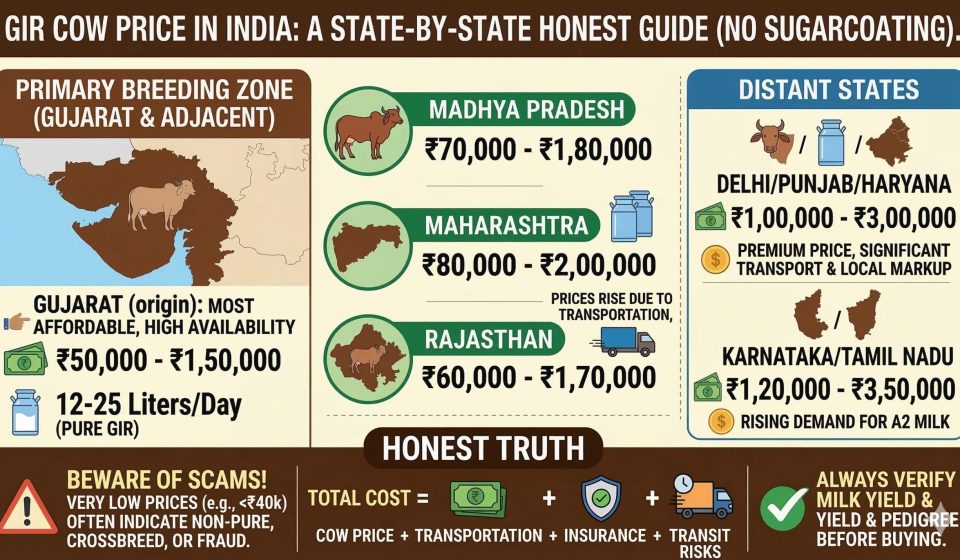
Gir Cow Price in India A State-by-State Honest Guide (No Sugarcoating)
Let me tell you something that took me an embarrassingly long time to figure out.
When I first started looking for a Gir cow, I called up a dealer who quoted me ₹35,000. Sounded reasonable. Then my cousin in Gujarat laughed and said he just bought one for ₹55,000 — and she was worth every rupee. Meanwhile, a friend in Bengaluru told me he paid ₹90,000 for his. Same breed. Wildly different prices.
That’s when I realized — Gir cow pricing in India isn’t one number. It’s a whole map.
Where you buy matters. Who you buy from matters. The cow’s milk record matters. Her age matters. Whether she’s pregnant, lactating, or a dry cow matters. And honestly? Sometimes, the state you’re standing in when you open your wallet matters more than anything else.
So let me break this down properly — state by state, with real numbers and the kind of context that actually helps you make a decision.
Why Gir Cow Prices Vary So Much Across India
Before we get into the state-wise breakdown, it’s worth understanding why prices differ so dramatically.
Think of it like buying mangoes. An Alphonso mango in Ratnagiri costs a fraction of what it costs in Delhi. Same mango. Different location, different logistics, different demand.
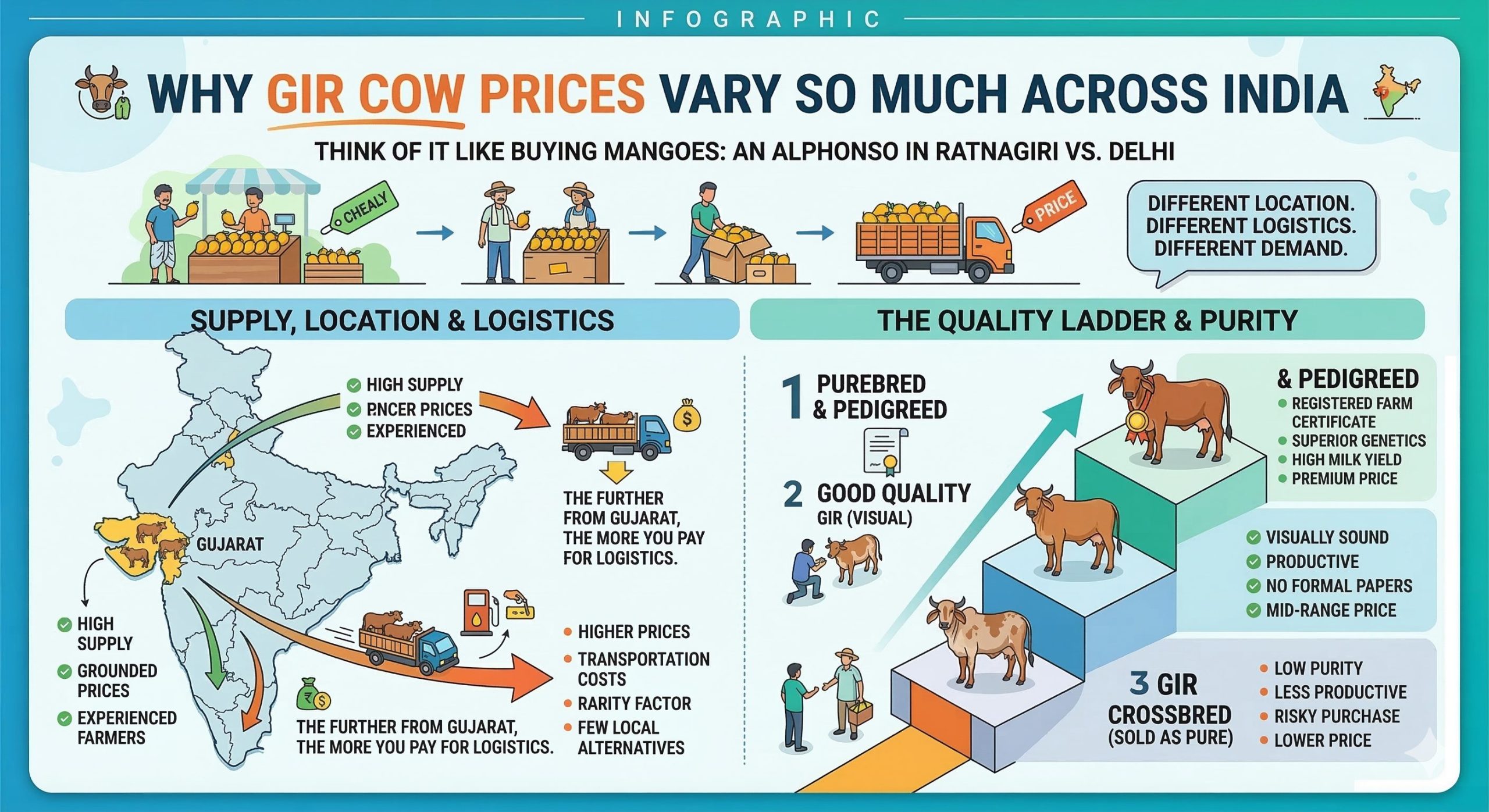
Gir cows work the same way. Gujarat is the origin state — supply is high, competition among sellers keeps prices grounded, and farmers there have decades of experience distinguishing good stock from average stock. The further you move from Gujarat, the more you’re paying for transportation, the rarity factor, and sometimes a seller who knows you don’t have many local alternatives.
There’s also the quality ladder to think about. A Gir cow is not just “a Gir cow.” There are massive differences between:
- A purebred, pedigreed Gir from a registered farm
- A good quality Gir without formal papers but visually and productively sound
- A Gir crossbred being sold as purebred by someone who hopes you won’t notice
Price depends heavily on where on that ladder the animal actually sits — versus where the seller claims she sits.
Gir Cow Price in Gujarat: The Home Ground
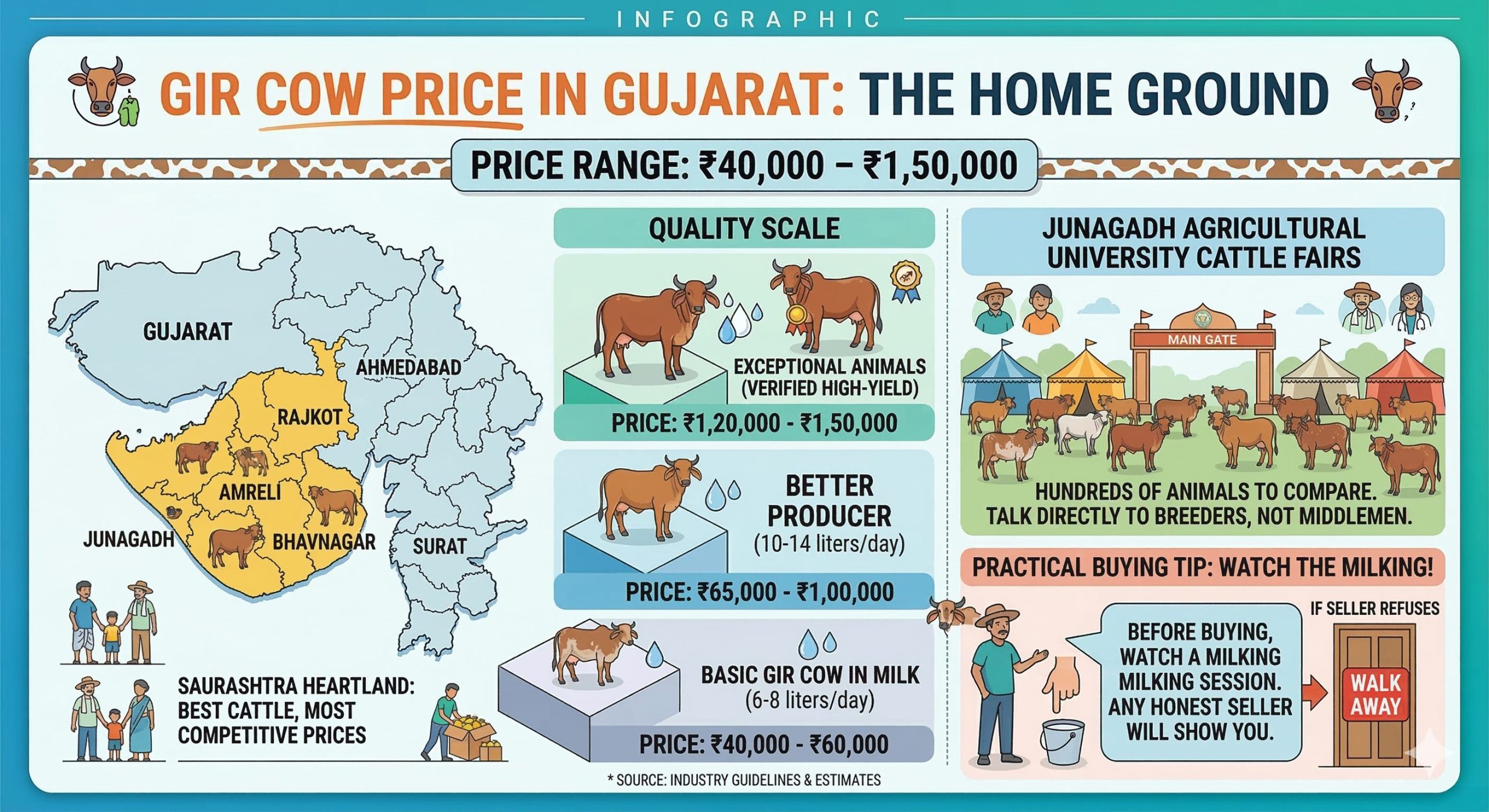
Price Range: ₹40,000 – ₹1,50,000
Gujarat is where you find the best Gir cattle and, relatively speaking, the most competitive prices. The Saurashtra region — Junagadh, Amreli, Bhavnagar, Rajkot — is the heartland. Farmers here have been breeding Gir cattle for generations. When a farmer in Junagadh tells you a cow gives 12 liters a day, he’s probably not lying. His reputation in that community depends on it.
A basic Gir cow in milk (6–8 liters/day) will cost you roughly ₹40,000 to ₹60,000 here. A better producer — say 10–14 liters — expect ₹65,000 to ₹1,00,000. Exceptional animals with verified high-yield pedigrees can cross ₹1,20,000 to ₹1,50,000 easily.
The Junagadh Agricultural University cattle fairs are worth attending if you’re serious. You’ll see hundreds of animals, compare quality side by side, and actually talk to breeders — not middlemen.
Practical tip: If you’re buying in Gujarat and the seller won’t let you watch a milking session, walk away. Any honest seller will show you.
Gir Cow Price in Rajasthan
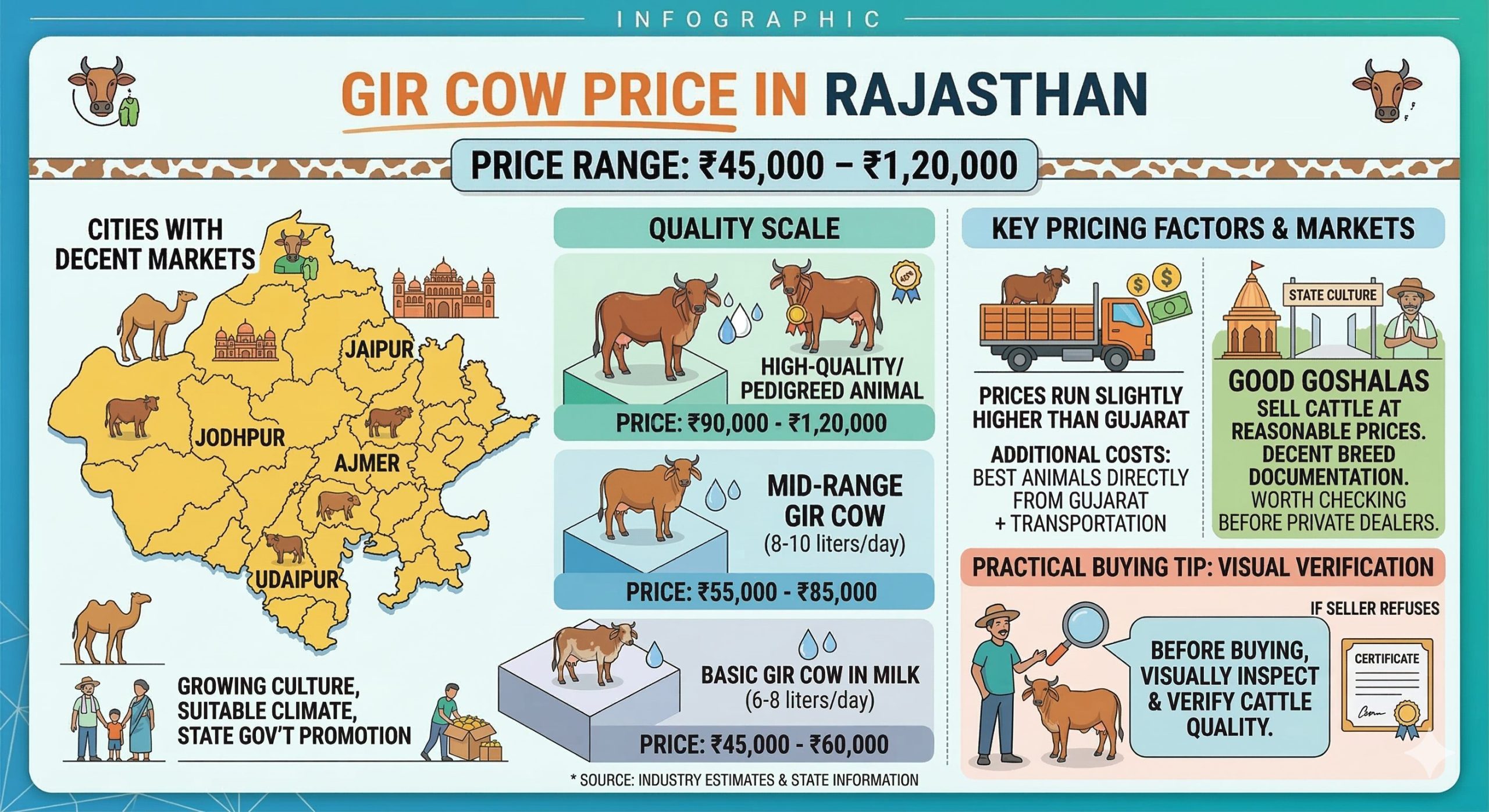
Price Range: ₹45,000 – ₹1,20,000
Rajasthan has a growing Gir cattle culture, partly because the climate suits them well and partly because the state government has been actively promoting indigenous breeds. Cities like Jaipur, Jodhpur, Udaipur, and Ajmer have decent markets.
Prices here run slightly higher than Gujarat for comparable quality — partly because the best animals are usually purchased directly from Gujarat and transported, adding cost. A mid-range Gir cow giving 8–10 liters a day typically falls in the ₹55,000 to ₹85,000 range in Rajasthan.
One thing Rajasthan has going for it — good Goshalas. The state has a strong Goshala culture, and some of them sell cattle at reasonable prices with decent breed documentation. Worth checking before going to private dealers.
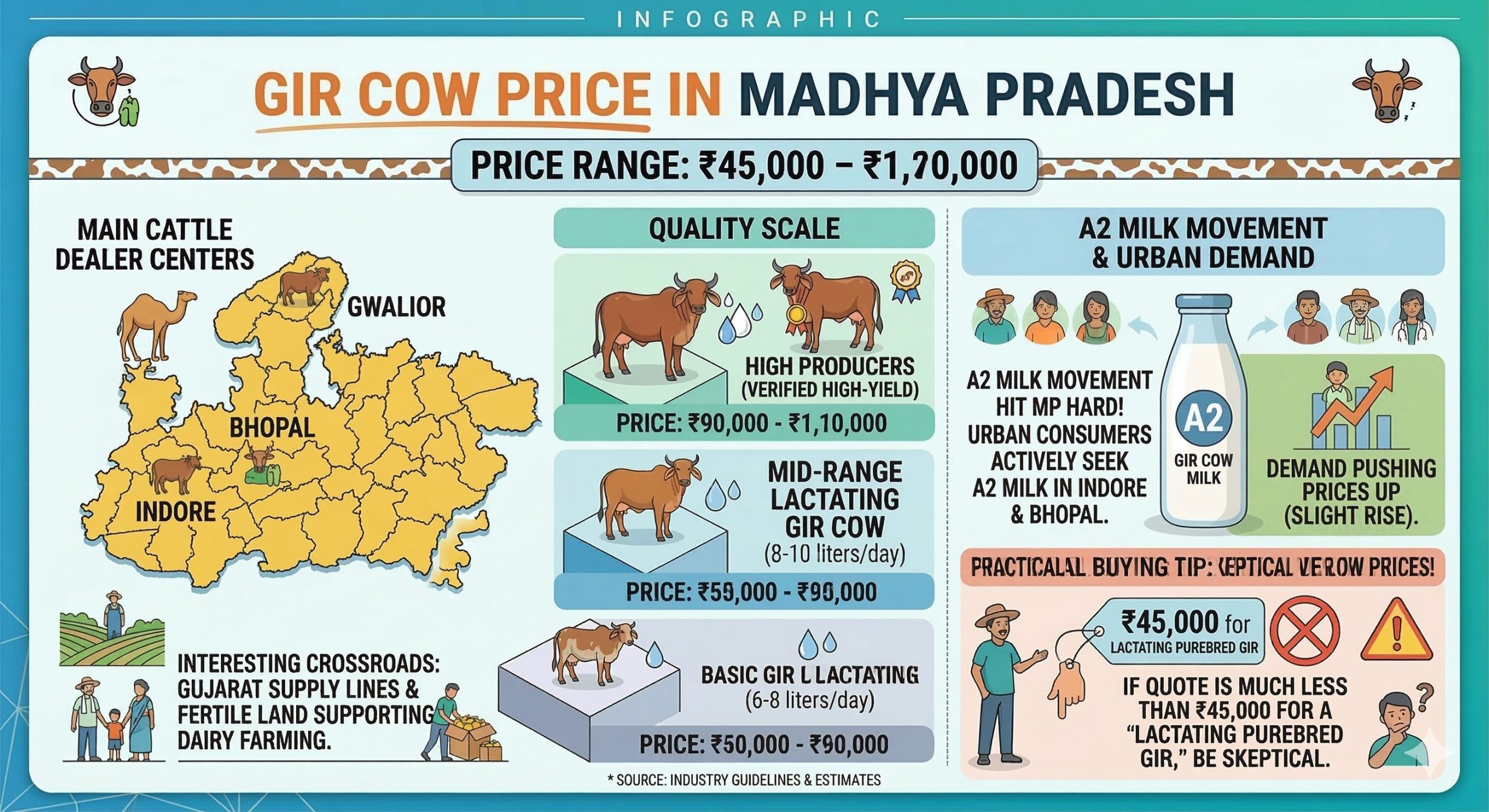
Gir Cow Price in Madhya Pradesh
Price Range: ₹45,000 – ₹1,10,000
MP sits at an interesting crossroads. It’s close enough to Gujarat that supply lines exist, and the state has fertile land that supports good dairy farming. Indore, Bhopal, and Gwalior are the main centers where you’ll find Gir cattle dealers.
The A2 milk movement has hit MP hard — in a good way. Urban consumers in Indore and Bhopal are actively seeking Gir cow A2 milk, which means more farmers are investing in quality animals. That demand has pushed prices up slightly over the last few years.
A lactating Gir cow in MP currently sits around ₹50,000 to ₹90,000 for good mid-range animals. High producers can go up to ₹1,10,000. If someone quotes you much less than ₹45,000 for a “lactating purebred Gir,” be skeptical.
Gir Cow Price in Maharashtra
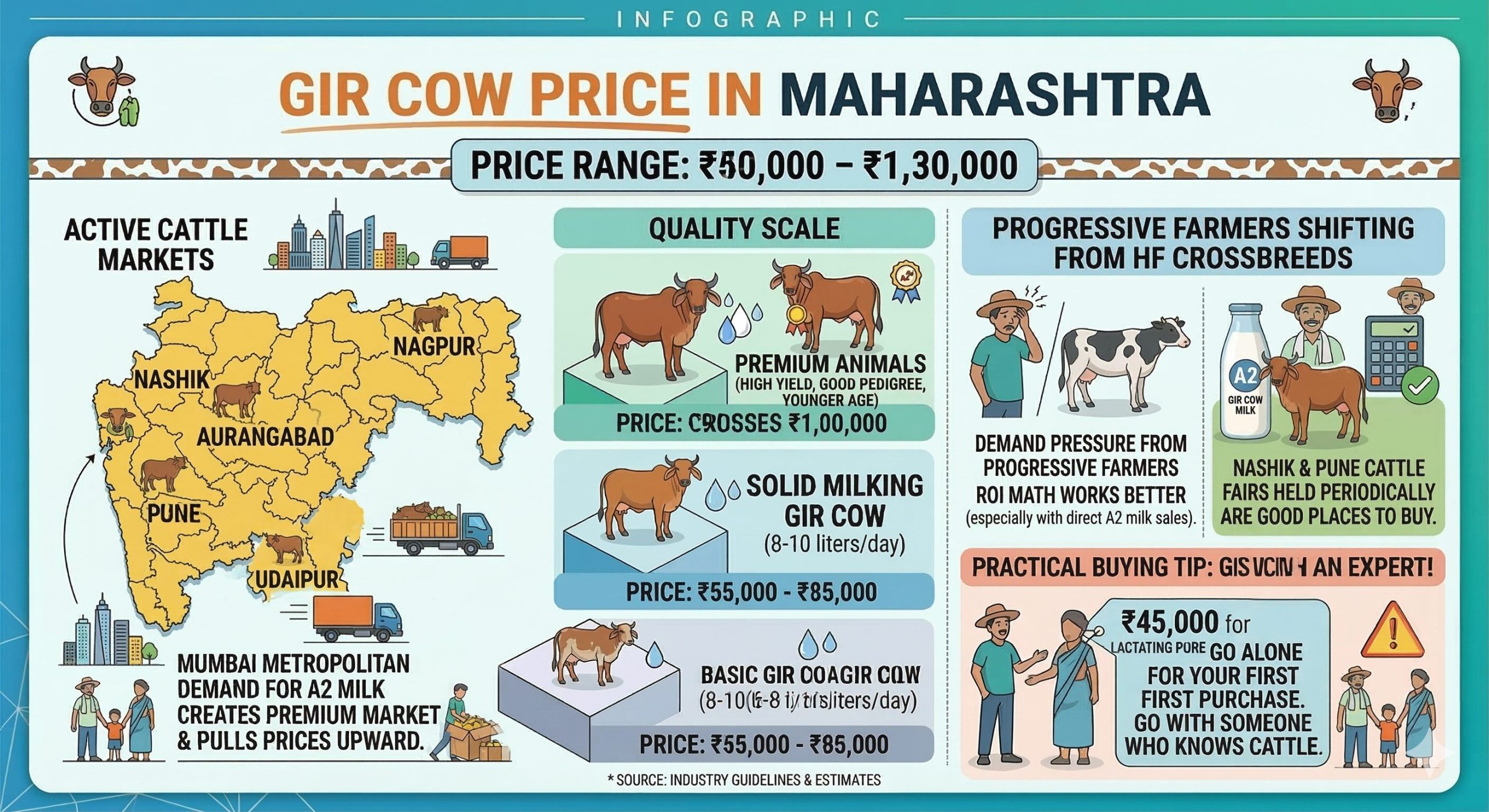
Price Range: ₹50,000 – ₹1,30,000
Maharashtra is one of the bigger markets for Gir cattle outside Gujarat. Pune, Nashik, Nagpur, and Aurangabad all have active cattle markets. The Mumbai metropolitan demand for A2 milk has created a premium market that pulls prices upward.
Here’s something interesting about Maharashtra — many progressive dairy farmers here have shifted entirely from HF crossbreeds to Gir in the last 5 years. The ROI math, especially with direct A2 milk sales, just works better for them. That demand pressure keeps prices firm.
Expect to pay ₹55,000 to ₹85,000 for a solid milking Gir cow in Maharashtra. Premium animals — high yield, good pedigree, younger age — will cross ₹1,00,000 without much negotiation room.
The Nashik and Pune cattle fairs, held periodically, are good places to buy. Just go with someone who knows cattle. Don’t go alone if it’s your first purchase.
Gir Cow Price in Uttar Pradesh
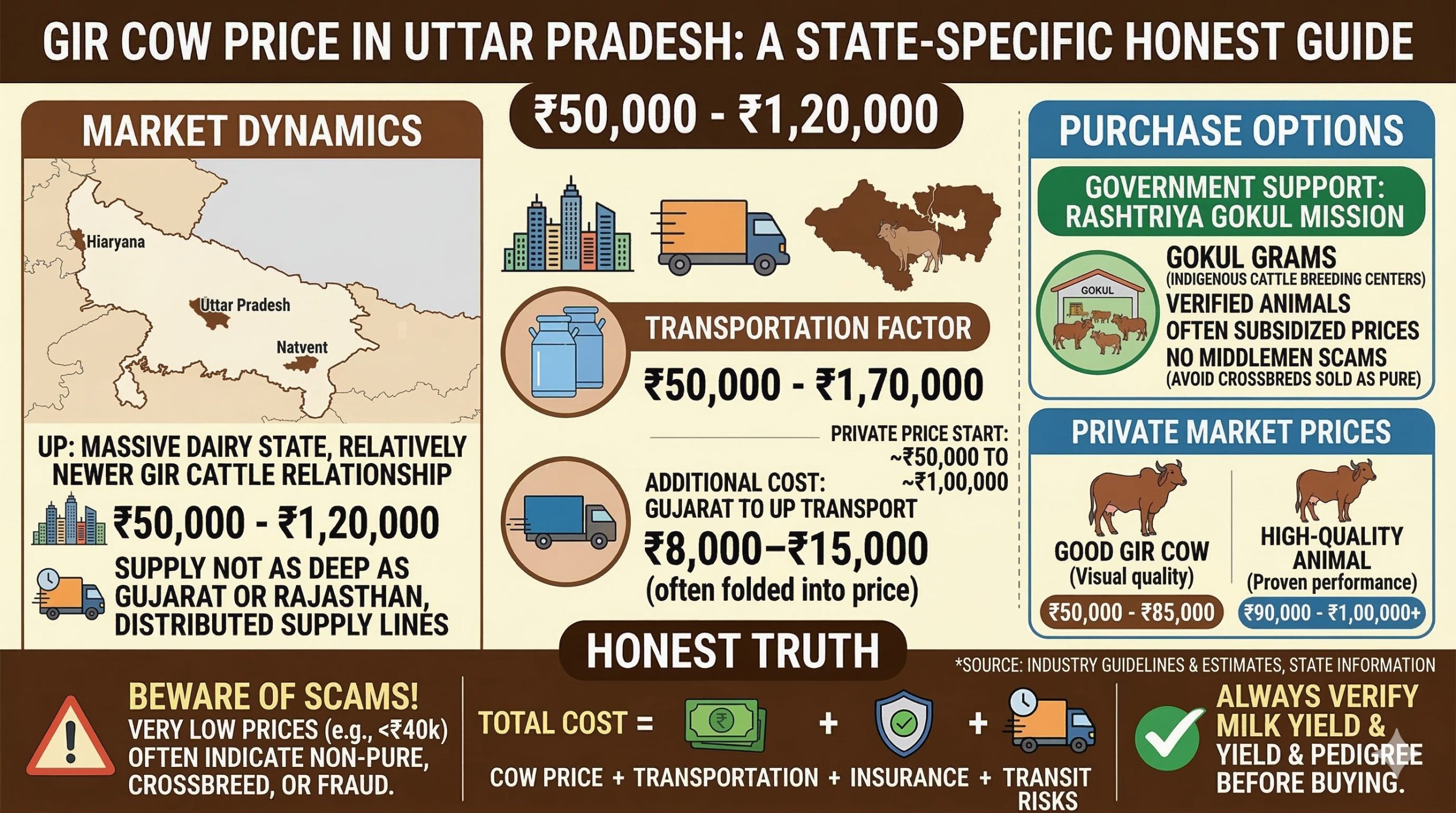
Price Range: ₹50,000 – ₹1,20,000
UP is a massive dairy state, but its relationship with Gir cattle is relatively newer compared to western India. Lucknow, Varanasi, Agra, Meerut — you’ll find Gir cattle in all these areas now, though supply isn’t as deep as in Gujarat or Rajasthan.
The Rashtriya Gokul Mission has had a real impact in UP, with Gokul Grams (indigenous cattle breeding centers) set up in several districts. If you’re in UP, checking these government centers is worth your time — the animals are verified, often subsidized, and you’re not dealing with a middleman trying to flip a crossbred as purebred.
Private market prices in UP for a good Gir cow start around ₹50,000 and go to ₹1,00,000 for high-quality animals. Transportation costs from Gujarat add ₹8,000–₹15,000 on top, which sellers naturally fold into their asking price.
Gir Cow Price in Haryana and Punjab
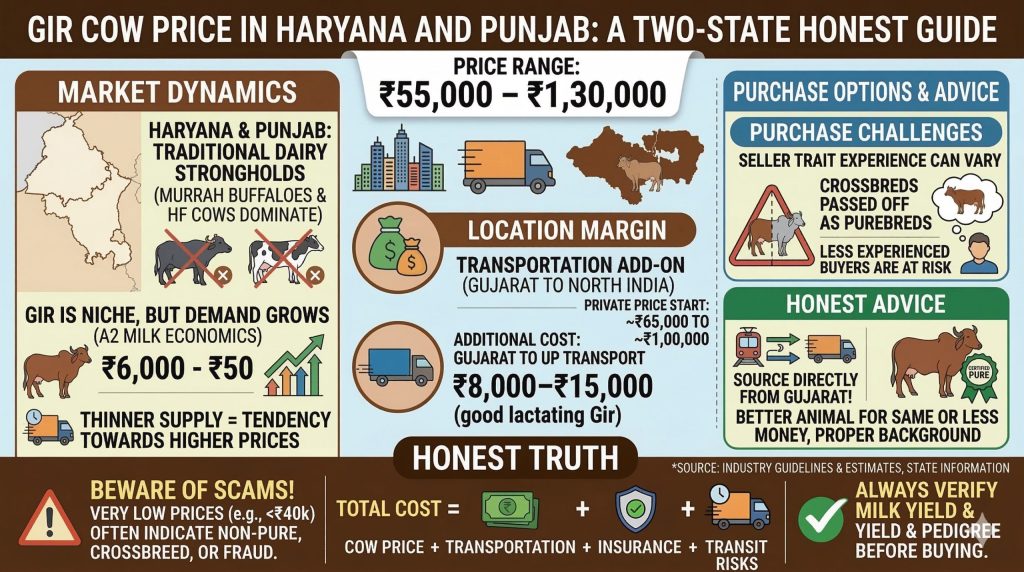
Price Range: ₹55,000 – ₹1,30,000
These two states are interesting cases. Haryana and Punjab are traditional dairy strongholds — Murrah buffaloes and HF cows dominate here. Gir is still relatively niche, but demand is growing steadily, especially among farmers who’ve seen the A2 milk economics work in other states.
Because supply is thinner here, prices tend to be on the higher side. A good lactating Gir in Haryana might cost ₹65,000 to ₹1,00,000. You’ll also find that sellers in these markets sometimes have less experience with Gir-specific traits, so crossbreds occasionally get passed off as purebreds to less experienced buyers.
Honest advice for buyers in Haryana and Punjab: If possible, source directly from Gujarat. Yes, it’s a bit of an effort. But you’ll get a better animal for the same or less money, with proper background.
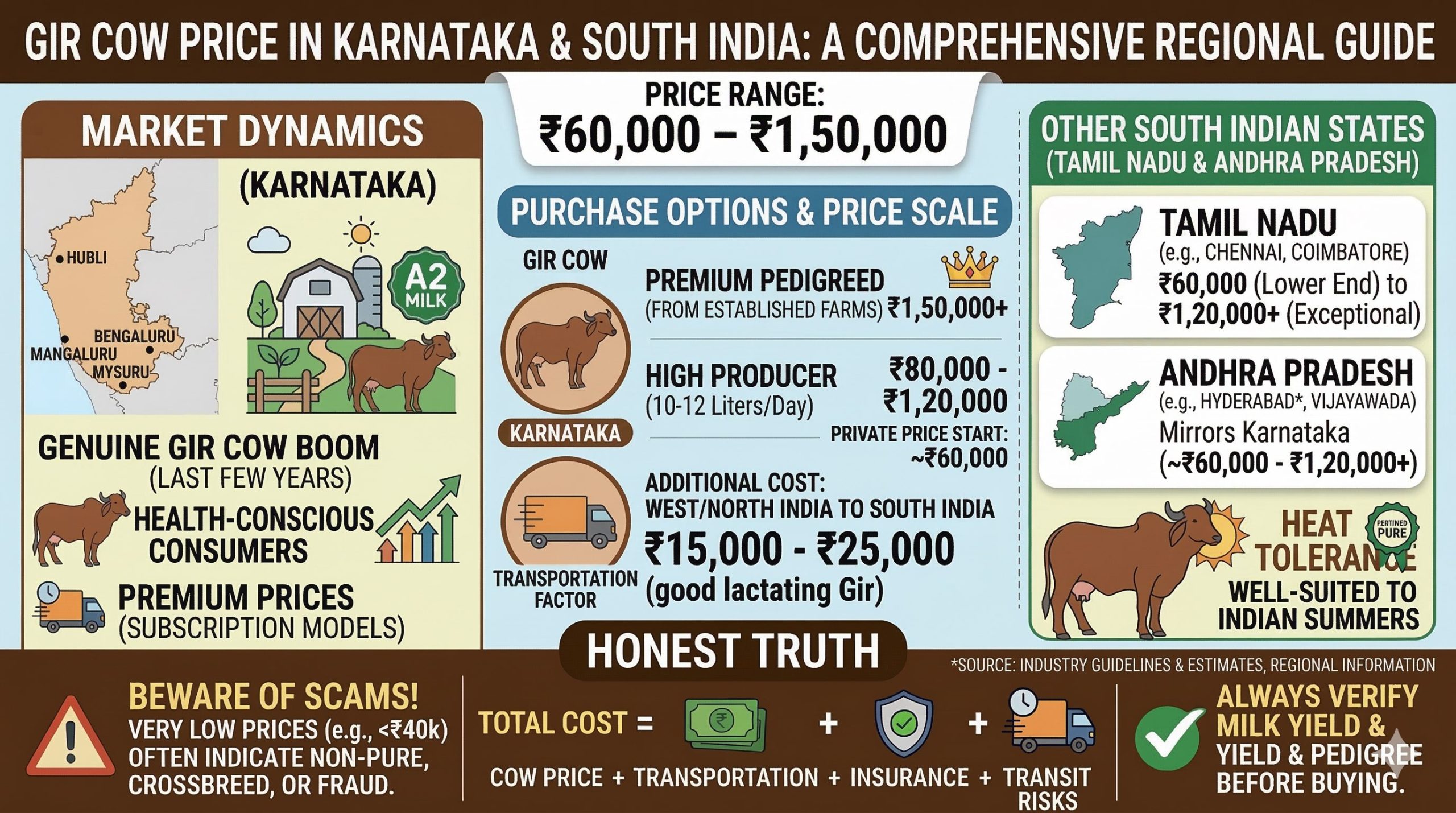
Gir Cow Price in Karnataka and South India
Price Range: ₹60,000 – ₹1,50,000
Bengaluru, Mysuru, Hubli, and Mangaluru have seen a genuine Gir cow boom in the last few years. South Indian urban consumers are among the most enthusiastic buyers of A2 milk — health-conscious, willing to pay premium prices, and often buying through subscription models directly from farms.
That strong consumer demand has translated into strong cattle prices. A Gir cow giving 10–12 liters per day in Karnataka can command ₹80,000 to ₹1,20,000 easily. Premium pedigreed animals from established farms have sold for ₹1,50,000 and beyond in this market.
Tamil Nadu and Andhra Pradesh are similar. The heat tolerance of Gir cattle makes them well-suited to South Indian summers, and farmers there are increasingly recognizing this. Prices in Chennai, Coimbatore, Hyderabad, and Vijayawada mirror Karnataka roughly — ₹60,000 on the lower end, ₹1,20,000+ for exceptional animals.
Gir Cow Price in Bihar and Jharkhand
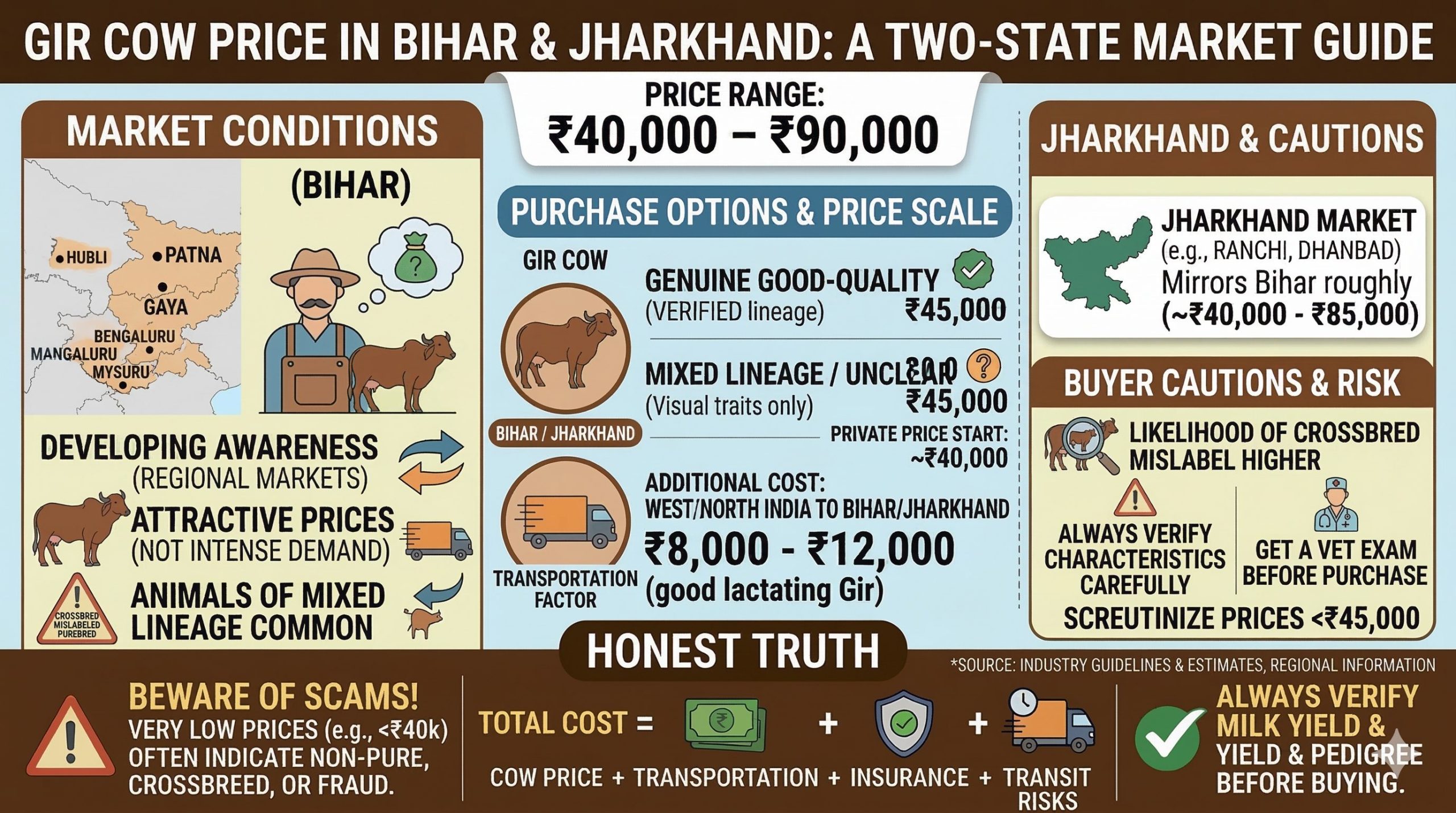
Price Range: ₹40,000 – ₹90,000
These markets are still developing in terms of Gir cattle awareness. You’ll find prices that can look attractive compared to western and southern India — partly because demand isn’t as intense, and partly because some of the animals available here are of mixed or unclear lineage.
That last point is the caution. Lower prices in Bihar and Jharkhand don’t always mean bad animals, but the likelihood of getting a crossbred mislabeled as purebred is higher in markets where buyers are less experienced with the breed. Always verify physical characteristics carefully and, if possible, get a vet to examine the animal before purchase.
A genuine good-quality Gir cow in these states typically ranges from ₹45,000 to ₹75,000. Anything much below that deserves extra scrutiny.
Gir Cow Price by Category (Across India)
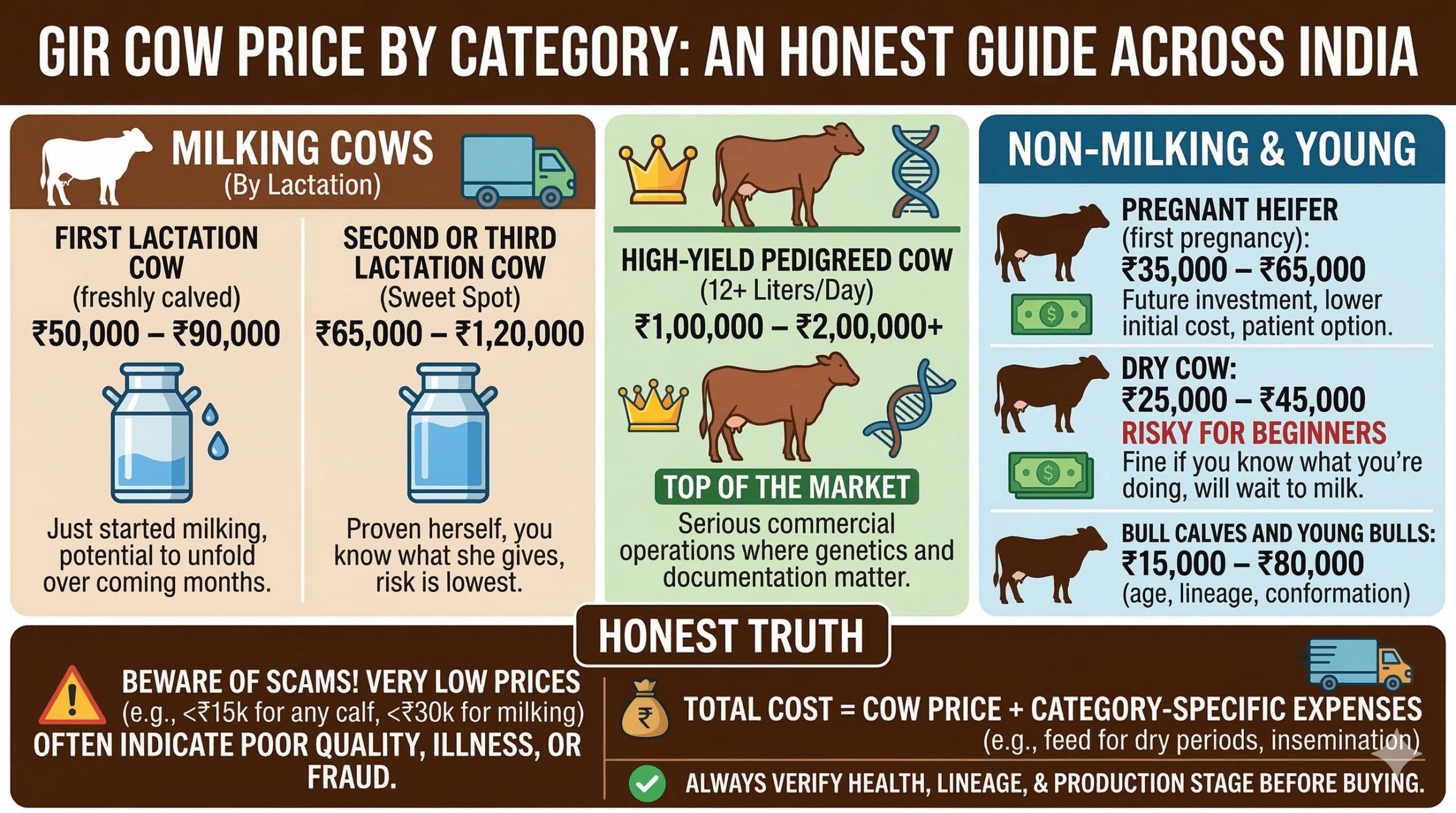
Since location isn’t the only variable, here’s a rough guide by animal type — because the same cow means very different things depending on where she is in her production cycle.
Pregnant Heifer (first pregnancy): ₹35,000 – ₹65,000. She’s not milking yet, but she’s your future investment. Good option if you’re patient and want to build a herd at lower initial cost.
First Lactation Cow (freshly calved): ₹50,000 – ₹90,000. She’s just started milking. You’ll see her potential unfold over the coming months.
Second or Third Lactation Cow: ₹65,000 – ₹1,20,000. This is often the sweet spot. She’s proven herself. You know what she gives. The risk of disappointment is lowest here.
High-Yield Pedigreed Cow (12+ liters/day): ₹1,00,000 – ₹2,00,000+. Top of the market. Makes sense for serious commercial operations where genetics and documentation matter.
Dry Cow: ₹25,000 – ₹45,000. She’s between lactations. Lower price but you’ll wait before she milks again. Fine if you know what you’re doing, risky for beginners.
Bull Calves and Young Bulls: ₹15,000 – ₹80,000 depending on age, lineage, and conformation.
Since location isn’t the only variable, here’s a rough guide by animal type — because the same cow means very different things depending on where she is in her production cycle.
Pregnant Heifer (first pregnancy): ₹35,000 – ₹65,000. She’s not milking yet, but she’s your future investment. Good option if you’re patient and want to build a herd at lower initial cost.
First Lactation Cow (freshly calved): ₹50,000 – ₹90,000. She’s just started milking. You’ll see her potential unfold over the coming months.
Second or Third Lactation Cow: ₹65,000 – ₹1,20,000. This is often the sweet spot. She’s proven herself. You know what she gives. The risk of disappointment is lowest here.
High-Yield Pedigreed Cow (12+ liters/day): ₹1,00,000 – ₹2,00,000+. Top of the market. Makes sense for serious commercial operations where genetics and documentation matter.
Dry Cow: ₹25,000 – ₹45,000. She’s between lactations. Lower price but you’ll wait before she milks again. Fine if you know what you’re doing, risky for beginners.
Bull Calves and Young Bulls: ₹15,000 – ₹80,000 depending on age, lineage, and conformation.
Red Flags When Buying a Gir Cow (Things Sellers Won’t Tell You)
This section might save you more money than everything else combined.
Flat forehead on a “purebred.” The domed forehead is non-negotiable in a true Gir. If it’s flat, she’s a crossbred. Period.
Seller refuses to show milking records. A serious dairy cow should have some record, even just a handwritten notebook. Refusal to show it usually means the numbers are embarrassing.
Price that’s too low. A genuinely lactating purebred Gir giving 8+ liters a day for ₹25,000 doesn’t exist. If it sounds too good, it’s a crossbred or a sick animal.
No information about the sire. Good breeders know who the father is. They’re proud of their bull lineage. Vague answers about parentage are a warning sign.
Swollen or uneven udder. Could indicate mastitis. Always check before buying. Press each quarter gently — if she reacts with pain or if the milk looks stringy or off-color, walk away.
Sudden urgency to sell. “I’m leaving town tomorrow, take her now.” That pressure is a sales tactic. Real sellers with quality animals don’t need to rush you.
Is the Price Worth It? Let’s Do Quick Math
Say you buy a solid Gir cow in Maharashtra for ₹80,000. She gives 10 liters a day. You sell A2 milk at ₹70 per liter directly to customers.
Daily income: ₹700 Monthly income: ₹21,000 Monthly feed and care cost: roughly ₹7,000–₹9,000 Net monthly: ₹12,000–₹14,000
Your cow pays for herself in 6 to 7 months. After that, she’s profit. For 8 to 10 years.
That’s the math that’s pulling farmers back to Gir. Not sentiment. Not tradition. Pure economics.
Final Word
Gir cow prices across India range from ₹35,000 to well over ₹1,50,000 depending on state, quality, age, and production history. Gujarat gives you the best access to quality at competitive prices. Southern and western metros command a premium. Developing markets in Bihar, UP, and the Northeast offer lower prices but require more buyer diligence.
Whatever state you’re in — don’t rush the purchase. Visit the farm. Watch a milking. Talk to the animal. Yes, really. The way a cow responds to a stranger tells you a lot about how she’s been handled.
Buy well once, and she’ll take care of you for a decade.
That’s the Gir cow promise — if you hold up your end of the deal.
Frequently Asked Questions: Gir Cow Price in India
Q1. What is the average Gir cow price in India in 2025?
Honestly, there’s no single answer — but if you pushed me for a ballpark, a decent lactating Gir cow in most Indian states will cost you somewhere between ₹50,000 and ₹1,00,000. Below ₹45,000 and you’re either getting a crossbred, a dry cow, or an animal with some problem the seller isn’t mentioning. Above ₹1,20,000 and you’re in premium pedigreed territory — which is absolutely worth it if you’re running a serious commercial dairy. The sweet spot for most small and mid-size farmers is ₹60,000 to ₹90,000 for a proven second or third lactation cow.
Q2. Which state has the cheapest Gir cow price in India?
Gujarat, hands down. It’s the origin state, supply is highest, and the market is mature enough that sellers can’t get away with wildly inflated prices. Specifically, the Saurashtra belt — Junagadh, Amreli, Bhavnagar — is where you’ll find the most competitive pricing on quality animals. That said, “cheapest” doesn’t always mean best value. A ₹55,000 cow in Gujarat that gives 12 liters a day is far better value than a ₹40,000 cow in Bihar that gives 5 liters and has unclear parentage. Always calculate price per liter potential, not just the sticker price.
Q3. Why is Gir cow so expensive compared to other breeds?
A few reasons stacked on top of each other. First, the A2 milk premium — Gir cow milk sells for ₹60 to ₹120 per liter in many markets, which drives up the value of the animal producing it. Second, longevity — a Gir cow stays productive for 10+ years, so buyers are essentially paying for a decade of returns upfront. Third, the slow breeding cycle — Gir cows calve roughly every 15 months, so you can’t mass-produce them the way you can with fast-cycling commercial breeds. Supply grows slowly. Demand is growing fast. Basic economics does the rest.
Q4. Can I get a Gir cow for under ₹30,000?
Technically yes — a dry cow, a very old cow, or a young heifer not yet in milk might fall in that range in some markets. But a healthy, lactating, reasonably productive Gir cow under ₹30,000? That’s not realistic in today’s market. If someone is offering you that, ask a lot of questions. Check the animal thoroughly. Get a vet involved before handing over any money. There are genuine distress sales occasionally — a farmer migrating, a family dealing with an emergency — but those are rare. Most sub-₹30,000 “Gir” offers are either crossbreds or animals with health or production problems.
Q5. Does the Gir cow price change seasonally?
Yes, it does. Prices tend to be slightly higher right after the monsoon when pasture is good and cows are in better condition. They can dip a little in peak summer when fodder is expensive and some farmers decide to offload animals they can’t afford to maintain through the hot months. Cattle fairs — which happen more frequently in winter across Gujarat and Rajasthan — also create more competition among sellers, which can work in a buyer’s favor. If you’re not in a hurry, late winter to early spring is often a good time to shop around.
Q6. Is it better to buy a pregnant Gir cow or a lactating one?
Depends entirely on your situation. A pregnant heifer costs less — usually ₹35,000 to ₹60,000 — and you’ll bond with her before she starts milking, which some farmers swear helps with temperament. But you’re waiting. Could be 2–4 months before she calves and starts producing. A lactating cow costs more upfront but starts generating income from day one. For someone who needs cash flow quickly, the lactating cow makes more sense. For someone building a long-term herd on a tighter budget, starting with pregnant heifers is a legitimate strategy. Just don’t expect milk before calving — obvious, but worth saying.
Q7. How do I verify a Gir cow’s milk yield before buying?
The most reliable method is simple — visit the farm at milking time. Morning milking session, unannounced if possible. Watch her being milked from start to finish and note the quantity yourself. Don’t rely on the seller’s verbal claims or even written records alone. A good seller won’t mind you doing this. In fact, honest breeders often invite this kind of scrutiny because it builds trust. If the seller says “come back tomorrow for milking” or finds excuses to delay — that’s your answer right there. Also check the milk visually: it should be creamy white, slightly thick, with a natural smell. Watery or discolored milk is a red flag.
Q8. Are Gir cows available online? Is it safe to buy them that way?
There are platforms like PashudhanPraharee, Animall app, and various Facebook groups and OLX listings where Gir cattle are sold. It’s become more common, especially post-COVID when people started managing more transactions digitally. But — and this is a big but — buying a cow online without physically visiting and inspecting the animal is genuinely risky. Photos can be flattering. Videos can be edited. Sellers can misrepresent yield, age, and pedigree. Use online platforms to find sellers and compare prices, then go visit in person before committing. Never pay full amount in advance to someone you haven’t met and whose farm you haven’t visited.
Q9. What additional costs should I budget for beyond the purchase price?
This catches a lot of first-time buyers off guard. Beyond the cow’s price, factor in transportation — hiring a vehicle or cattle carrier from Gujarat to another state can cost ₹8,000 to ₹20,000 depending on distance. Then there’s the adjustment period: a cow moved to a new environment often shows reduced milk yield for 2–4 weeks while she settles in. Budget for that income gap. Add initial veterinary checkup (₹500–₹1,500), any vaccinations she might need, shed preparation, and at least 2–3 months of fodder in advance. Realistically, add 20–25% on top of the purchase price as your true cost of bringing the animal home and getting her productive.
Q10. Can I get a government subsidy on Gir cow purchase?
Yes, and more people should take advantage of this. Under the Rashtriya Gokul Mission, there are provisions for financial support to farmers adopting indigenous breeds including Gir. NABARD’s dairy development schemes offer loans at subsidized interest rates for cattle purchase. Several state governments — Gujarat, Rajasthan, Uttar Pradesh, Maharashtra among them — have their own additional schemes. The process involves visiting your district’s Animal Husbandry Department or nearest Krishi Vigyan Kendra, submitting basic documentation, and applying through the relevant scheme. It takes some patience with paperwork, but subsidies of ₹10,000 to ₹25,000 per animal are available in certain schemes. Worth every hour you spend on the application.
Q11. Is the Gir cow price likely to increase in coming years?
Most experienced farmers and dairy economists think yes. Here’s why: the A2 milk market in India is growing at a strong pace, urban health consciousness is rising, and indigenous breed awareness is at an all-time high. Meanwhile, the breeding cycle for Gir cattle is slow — you can’t just flood the market overnight. Demand is outpacing supply in most non-Gujarat states. If you’re planning to buy, sooner is probably smarter than later. The farmers who bought quality Gir cattle five years ago at ₹40,000–₹50,000 are sitting very comfortably today — both on the milk income and the appreciated value of their animals.
Q12. What documents should I ask for when buying a Gir cow?
At minimum, ask for a health certificate from a registered veterinarian confirming the animal is disease-free. If the seller claims a pedigree, ask for the breed registration certificate — registered breeders will have this from INAPH (Information Network for Animal Productivity and Health) or similar bodies. A milk production record, even a simple handwritten one, is helpful. Some sellers also provide vaccination history. You won’t always get all of these, especially from small farmers selling one or two animals — but asking for them tells you a lot about how seriously the seller takes their operation. The more documentation they have, the more confidence you can have in the purchase.


