
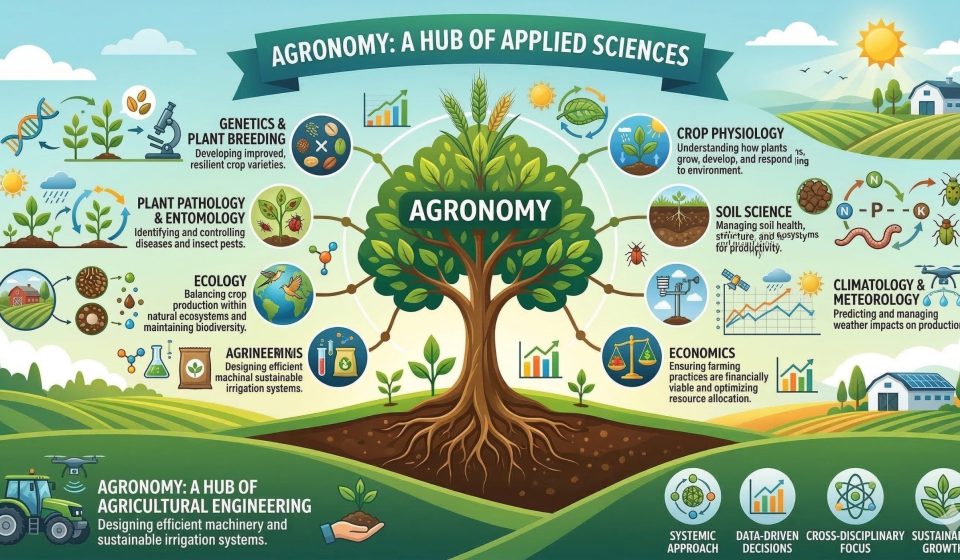
10000 Agronomy MCQ questions with answers
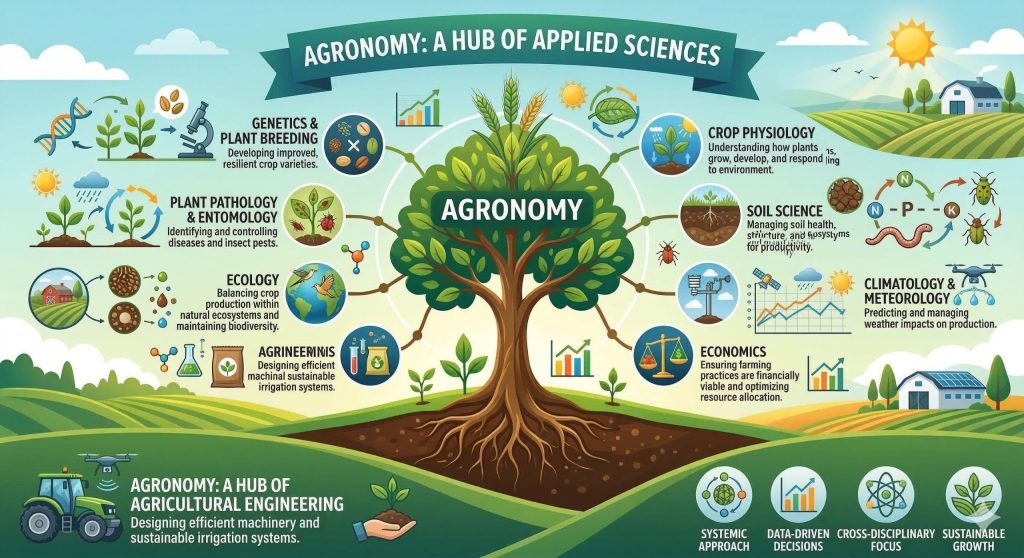
These Agronomy MCQ questions with answers, Multiple Choice Questions (MCQs) are a cornerstone of modern competitive exams, especially in specialized fields like Agriculture (ICAR, JRF, SRF, and State Exams). Their importance stems from how they test a candidate’s depth and breadth of knowledge.agronomy mcq for competitive exams
Q1. The term “Agriculture” is derived from which two Latin words?
- A. Agros and Nomos
- B. Ager and Cultura
- C. Agri and Culture
- D. Geo and Ponic
✅ Correct Answer: B. Ager and Cultura
Explanation:
Agriculture comes from the Latin words Ager (land or field) and Cultura (cultivation), meaning the cultivation of land.
Q2. Which branch of agriculture deals specifically with the cultivation of field crops and soil management?
A. Horticulture
B. Arviculture
C. Olericulture
D. Floriculture
✅ Correct Answer: B. Arviculture
Explanation:
Arviculture deals with field crops and soil management practices.
Q3. Agriculture is categorized as a “Mental Skill” when a farmer:
A. Handles farm implements efficiently
B. Applies fertilizers in the field
C. Decides on the selection of a crop to suit the climate
D. Operates a tractor for ploughing
✅ Correct Answer: C. Decides on the selection of a crop to suit the climate
Explanation:
Mental skill involves decision-making ability, such as selecting crops based on soil and climate.
Q4. Which of the following is considered the “Mother Branch” of agriculture?
A. Soil Science
B. Plant Breeding
C. Agronomy
D. Agricultural Extension
✅ Correct Answer: C. Agronomy
Explanation:
Agronomy integrates many agricultural disciplines like soil science, crop science, and environmental science, making it the mother branch of agriculture.
Q5. Cultivation of plants in a water medium without soil is known as:
A. Geoponic
B. Aeroponic
C. Hydroponic
D. Aquaponic
✅ Correct Answer: C. Hydroponic
Explanation:
Hydroponics is the cultivation of plants in water without soil using nutrient solutions.
Q6. The “Law of Minimum” was developed by:
A. Jethrotull
B. Justus van Liebig
C. F.T. Blackman
D. E.A. Mitscherlich
✅ Correct Answer: B. Justus van Liebig
Explanation:
Liebig’s Law of Minimum states that crop yield is limited by the nutrient in shortest supply.
Q7. “Jhum” cultivation is a term used for shifting cultivation in which Indian state?
A. Rajasthan
B. Andhra Pradesh
C. Assam
D. Madhya Pradesh
✅ Correct Answer: C. Assam
Explanation:
In Assam and North-East India, shifting cultivation is called Jhum cultivation.
Q8. The “Yellow Revolution” in India is associated with:
A. Milk
B. Fish
C. Oilseeds
D. Eggs
✅ Correct Answer: C. Oilseeds
Explanation:
The Yellow Revolution increased oilseed production in India.
Q9. Which scientist discovered the laws of heredity in 1866?
A. Charles Darwin
B. Gregor Johann Mendel
C. Francis Bacon
D. Thomas Malthus
✅ Correct Answer: B. Gregor Johann Mendel
Explanation:
Gregor Mendel discovered the laws of inheritance, which are the foundation of genetics.
Q10. The word “Agronomy” is derived from the Greek words:
A. Field and to Manage
B. Soil and to Grow
C. Land and to Cultivate
D. Earth and Science
✅ Correct Answer: A. Field and to Manage
Explanation:
Agronomy comes from Agros (field) and Nomos (management).
Q11. According to the Inverse Yield-Nitrogen Law proposed by Wilcox:
A. Yield increases with nitrogen content
B. Yield is inversely proportional to nitrogen content in dry matter
C. Nitrogen does not affect yield
D. Yield depends only on soil moisture
✅ Correct Answer: B
Explanation:
Wilcox stated that yielding ability is inversely proportional to nitrogen concentration in plant dry matter.
Q12. The “Theory of Limiting Factors” was proposed by:
A. Macy
B. Mitscherlich
C. F.T. Blackman
D. Zimmerman
✅ Correct Answer: C. F.T. Blackman
Explanation:
Blackman proposed that the slowest factor limits the rate of a process.
Q13. In Gap Analysis of crop production, Gap I refers to:
A. Potential yield – Research yield
B. Research yield – Potential farmer yield
C. Potential farmer yield – Average farmer yield
D. Laboratory yield – Field yield
✅ Correct Answer: A
Explanation:
Gap I represents the Research Gap.
Q14. Which is a non-monetary input in agronomy?
A. Fertilizers
B. HYV Seeds
C. Timely sowing
D. Irrigation water
✅ Correct Answer: C. Timely sowing
Explanation:
Timely sowing improves crop yield without major financial cost.
Q15. The Assartage System refers to:
A. Fallow system
B. Shifting cultivation
C. Mixed farming
D. Intensive cropping
✅ Correct Answer: B. Shifting cultivation
Q16. India is the largest producer of:
A. Wheat
B. Rice
C. Fruits
D. Vegetables
✅ Correct Answer: C. Fruits
Q17. The Critical Percentage concept was suggested by:
A. Macy
B. Liebig
C. Wilcox
D. Blackman
✅ Correct Answer: A. Macy
Q18. Which branch deals with the utilization of agricultural produce for nutrition?
A. Agricultural Economics
B. Home Science
C. Agricultural Extension
D. Crop Physiology
✅ Correct Answer: B. Home Science
Q19. The Blue Revolution is related to:
A. Fertilizers
B. Petroleum
C. Fish production
D. Water conservation
✅ Correct Answer: C. Fish production
Q20. When nutrient concentration increases but yield does not increase, it is called:
A. Luxury consumption
B. Poverty adjustment
C. Tissue minimum
D. Deficiency range
✅ Correct Answer: B. Poverty adjustment
Q21. G.B. Pant University (first agricultural university of India) was established in:
A. 1950
B. 1960
C. 1962
D. 1971
✅ Correct Answer: C. 1962
Q22. “Single grain” and “Massive” are soil structures of:
A. Weak
B. Moderate
C. Strong
D. Structureless
✅ Correct Answer: D. Structureless
Q23. The main objective of an agronomist is:
A. Increase soil erosion
B. Maximum production at minimum cost
C. Reduce seed quality
D. Avoid machinery
✅ Correct Answer: B
Q24. The Malthusian Theory states:
A. Food supply is unlimited
B. Population growth will exceed food production
C. The population grows more slowly than food
D. Birth control unnecessary
✅ Correct Answer: B
Q25. NRCB (National Research Centre for Banana) was established in:
A. 1985
B. 1990
C. 1995
D. 2000
✅ Correct Answer: C. 1995
Q26. Agriculture as a business aims at:
A. Family consumption only
B. Maximum net return
C. Hunting practices
D. Spiritual activities
✅ Correct Answer: B
Q27. Ratio of pesticide to fertilizer use in India:
A. 1:10
B. 1:100
C. 10:1
D. 1:50
✅ Correct Answer: B
Q28. Akiochi disease in rice occurs in:
A. Saline soil
B. Alkali soil
C. Acid sulphate soil
D. Alluvial soil
✅ Correct Answer: C
Q29. Percentage of population supported by agriculture in India:
A. 30%
B. 50%
C. 70%
D. 90%
✅ Correct Answer: C
Q30. Which revolution increased milk production in India?
A. Silver Revolution
B. White Revolution
C. Round Revolution
D. Grey Revolution
✅ Correct Answer: B. White Revolution
Agricultural Heritage of India MCQ (Chapter 2)
Agricultural Heritage of India explains the history of agriculture, ancient civilizations, geological timeline, and traditional farming practices in India.
These 30 MCQs with answers and explanations are useful for:
-
BSc Agriculture
-
ICAR JRF / SRF
-
Agriculture competitive exams
-
Agronomy & Agricultural History exams
Q1. The “Pangea” super-continent was surrounded by which gigantic ocean?
A. Tethys
B. Panthalassa
C. Gondwana
D. Laurasia
✅ Correct Answer: B. Panthalassa
Explanation:
Around 250 million years ago, all continents were united into a single landmass called Pangea, surrounded by the vast ocean Panthalassa.
Q2. In which geological period did dinosaurs first appear?
A. Jurassic
B. Cretaceous
C. Triassic
D. Eocene
✅ Correct Answer: C. Triassic
Explanation:
The Triassic period (~251–204 million years ago) marked the first appearance of dinosaurs.
Q3. The Himalayas were formed due to the collision of the Indian plate with which plate?
A. African plate
B. Eurasian plate
C. Australian plate
D. Antarctic plate
✅ Correct Answer: B. Eurasian plate
Explanation:
The Indian tectonic plate collided with the Eurasian plate, resulting in the formation of the Himalayan mountain range.
Q4. Which is the most ancient literary work of India mentioning biodiversity?
A. Rig-Veda
B. Arthasastra
C. Ramayana
D. Krishi-Parashara
✅ Correct Answer: A. Rig-Veda
Explanation:
The Rig-Veda contains early references to plants, animals, and natural resources.
Q5. The “Age of Food Producers” refers to:
A. Paleolithic Age
B. Mesolithic Age
C. Neolithic Age
D. Iron Age
✅ Correct Answer: C. Neolithic Age
Explanation:
The Neolithic Age marked the beginning of agriculture and the domestication of animals.
Q6. Which ancient texts stated that a king must learn agriculture and cattle rearing?
A. Charaka Samhita
B. Manusmriti and Arthasastra
C. Rig-Veda
D. Sangam Literature
✅ Correct Answer: B. Manusmriti and Arthasastra
Explanation:
Both Manu and Kautilya emphasized agriculture and cattle rearing as essential subjects for rulers.
Q7. The Indus Valley Civilization is also known as:
A. Vedic Civilization
B. Harappan Civilization
C. Aryan Civilization
D. Mesopotamian Civilization
✅ Correct Answer: B. Harappan Civilization
Explanation:
The civilization is called Harappan Civilization because the first site discovered was Harappa.
Q8. Which crop originated in the Indus Valley and was cultivated by Harappans?
A. Wheat
B. Barley
C. Cotton
D. Maize
✅ Correct Answer: C. Cotton
Explanation:
Gossypium arboreum (cotton) originated in the Indus Valley and was widely cultivated.
Q9. Evidence of a ploughed field was discovered at:
A. Mohenjo-daro
B. Lothal
C. Kalibangan
D. Ropar
✅ Correct Answer: C. Kalibangan
Explanation:
Excavations at Kalibangan revealed a grid-pattern ploughed field, indicating early mixed cropping.
Q10. The term “Mesolithic” means:
A. Old Stone Age
B. Middle Stone Age
C. New Stone Age
D. Bronze Age
✅ Correct Answer: B. Middle Stone Age
Explanation:
The Mesolithic period is known as the Middle Stone Age, characterized by microlith tools.
Q11. Who is known as the Father of Veterinary Science in India?
A. Sushruta
B. Shalihotra
C. Kautilya
D. Parashara
✅ Correct Answer: B. Shalihotra
Explanation:
Shalihotra wrote ancient texts on horse medicine and veterinary science.
Q12. According to Arthasastra, the Superintendent of Agriculture was called:
A. Gopa
B. Sitadhyaksha
C. Artha-pala
D. Vaisyas
✅ Correct Answer: B. Sitadhyaksha
Explanation:
The Sitadhyaksha managed state farms and agricultural operations.
Q13. Which crop was introduced in India by the Portuguese?
A. Rice
B. Wheat
C. Groundnut
D. Sugarcane
✅ Correct Answer: C. Groundnut
Explanation:
Portuguese traders introduced crops like groundnut, tobacco, potato, and chilli.
Q14. “Jhum” cultivation refers to shifting cultivation in:
A. Western Ghats
B. Rajasthan
C. Assam
D. Madhya Pradesh
✅ Correct Answer: C. Assam
Q15. Who wrote the agricultural treatise “Krishi-Parashara”?
A. Kashyapa
B. Parashara
C. Varahamihira
D. Kautilya
✅ Correct Answer: B. Parashara
Q16. The Sanskrit word “Vrihi” means:
A. Wheat
B. Rice
C. Barley
D. Cotton
✅ Correct Answer: B. Rice
Q17. Who brought the river Ganga to the plains according to legends?
A. Chandragupta
B. Ashoka
C. Bhagirath
D. Vikramaditya
✅ Correct Answer: C. Bhagirath
Q18. The Assartage system refers to:
A. Fallow system
B. Shifting cultivation
C. Mixed farming
D. Intensive cropping
✅ Correct Answer: B. Shifting cultivation
Q19. Fire altars and Sarasvati river settlements belong to which civilization?
A. Vedic / Harappan
B. Mughal
C. British
D. Sangam
✅ Correct Answer: A. Vedic / Harappan
Q20. The Law of Diminishing Returns was proposed by:
A. Jethro Tull
B. E.A. Mitscherlich
C. Justus von Liebig
D. Wilcox
✅ Correct Answer: B. E.A. Mitscherlich
Q21. Kunja, Prastha and Drona were ancient units for:
A. Soil classification
B. Irrigation methods
C. Measurement of grains
D. Types of ploughs
✅ Correct Answer: C. Measurement of grains
Q22. The “choicest fruit of Hindustan” was:
A. Banana
B. Guava
C. Mango
D. sapota
✅ Correct Answer: C. Mango
Q23. The Siddha system of medicine is most common in:
A. North India
B. Tamil Nadu
C. Western India
D. North-East India
✅ Correct Answer: B. Tamil Nadu
Q24. In the Rig-Veda, “Yava” refers to:
A. Wheat
B. Rice
C. Barley
D. Millets
✅ Correct Answer: C. Barley
Q25. Who wrote the horticulture text “Vrikshayurveda”?
A. Surapala
B. Kautilya
C. Panini
D. Amarsimha
✅ Correct Answer: A. Surapala
Q26. Which metal was NOT known to the Indus Valley people?
A. Copper
B. Bronze
C. Iron
D. Gold
✅ Correct Answer: C. Iron
Q27. “Marutam” in Sangam literature refers to:
A. Hills
B. Coastal land
C. Agricultural land
D. Desert
✅ Correct Answer: C. Agricultural land
Q28. “Pusa” in IARI history refers to:
A. Punjab USA
B. Phipps of USA
C. Public Sector Agency
D. Private Union
✅ Correct Answer: B. Phipps of USA
Q29. The Golden Age of Indian History refers to:
A. Harappan Period
B. Mughal Period
C. Gupta Period
D. British Period
✅ Correct Answer: C. Gupta Period
Q30. The Royal Commission on Agriculture was appointed in:
A. 1905
B. 1926
C. 1947
D. 1950
✅ Correct Answer: B. 1926
Agricultural Resources in India and the World MCQ (Chapter 3)
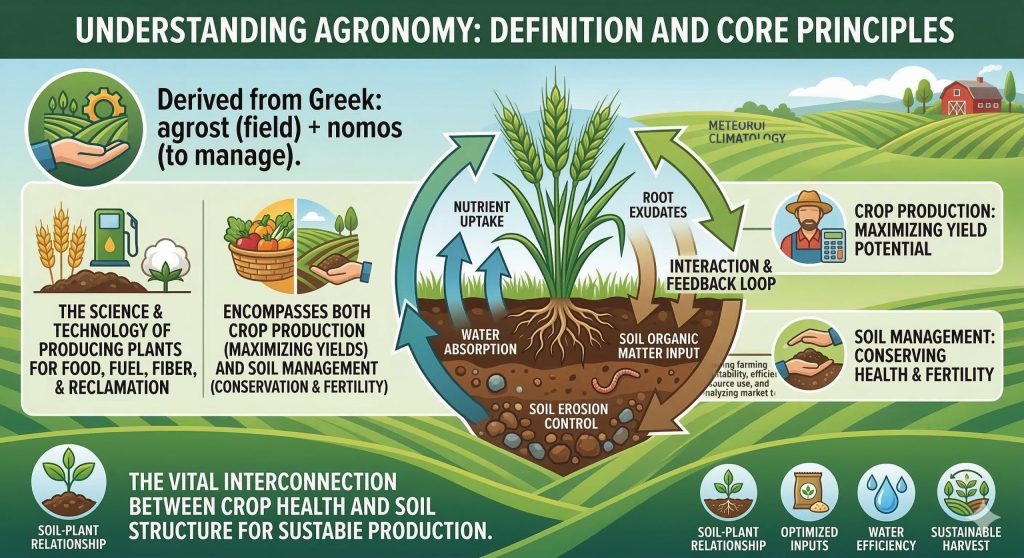
Agricultural resources include land, water, livestock, and human resources that support agricultural production.
These 30 MCQs with answers and explanations are important for:
-
BSc Agriculture
-
ICAR JRF / SRF
-
Agriculture competitive exams
-
Agronomy and agricultural economics
Q1. What is the total geographical area of India?
A. 328.7 million hectares
B. 142.0 million hectares
C. 190.5 million hectares
D. 420.2 million hectares
✅ Correct Answer: A. 328.7 million hectares
Explanation:
India covers 328.7 million hectares, which is about 2.4% of the world’s total land area.
Q2. The Net Sown Area in India is approximately:
A. 100 million hectares
B. 141 million hectares
C. 190 million hectares
D. 328 million hectares
✅ Correct Answer: B. 141 million hectares
Explanation:
The Net Sown Area (NSA) represents the actual cultivated land, around 141.2 million hectares.
Q3. Which country has the highest percentage of land under cultivation?
A. USA
B. China
C. India
D. Russia
✅ Correct Answer: C. India
Explanation:
India has about 43% of its land under cultivation, which is one of the highest globally.
Q4. India ranks first in the world in the population of:
A. Sheep
B. Goats
C. Cattle
D. Buffalo
✅ Correct Answer: D. Buffalo
Explanation:
India has the largest buffalo population, playing a major role in milk production.
Q5. The Gross Cropped Area of India is approximately:
A. 141 million hectares
B. 190 million hectares
C. 210 million hectares
D. 328 million hectares
✅ Correct Answer: B. 190 million hectares
Explanation:
The Gross Cropped Area (GCA) is around 190.8 million hectares, indicating cropping intensity of about 135%.
Q6. The largest source of irrigation in India is:
A. Canals
B. Tanks
C. Wells and Tube-wells
D. Rivers
✅ Correct Answer: C. Wells and Tube-wells
Explanation:
Groundwater irrigation through tube wells and wells contributes more than 50% of irrigation.
Q7. The average size of operational land holdings in India is:
A. 4.0 hectares
B. 2.5 hectares
C. 1.41 hectares
D. 0.5 hectares
✅ Correct Answer: C. 1.41 hectares
Explanation:
Due to population pressure and land fragmentation, the average farm size has decreased.
Q8. Culturable Waste Land refers to land that:
A. Cannot be cultivated
B. Not cultivated for more than 5 years, but suitable for farming
C. Forest land
D. Urban land
✅ Correct Answer: B
Explanation:
This land can be cultivated but remains unused for more than five years.
Q9. Freshwater available on Earth is approximately:
A. 97%
B. 10%
C. 2.7%
D. 0.5%
✅ Correct Answer: C. 2.7%
Explanation:
About 97.3% of water is saline, leaving 2.7% freshwater.
Q10. Percentage of India’s population dependent on agriculture:
A. 25%
B. 45%
C. 58%
D. 85%
✅ Correct Answer: C. 58%
Q11. Which state has the largest forest area in India?
A. Punjab
B. Haryana
C. Madhya Pradesh
D. Arunachal Pradesh
✅ Correct Answer: C. Madhya Pradesh
Q12. Cropping Intensity formula is:
A. NSA / GCA ×100
B. GCA / NSA ×100
C. Forest / Total area ×100
D. Irrigated / Total area ×100
✅ Correct Answer: B
Explanation:
Cropping Intensity = Gross Cropped Area ÷ Net Sown Area × 100
Q13. India is the second largest producer of:
A. Maize and Bajra
B. Rice and Wheat
C. Sorghum and Pulses
D. Barley and Oats
✅ Correct Answer: B. Rice and Wheat
Q14. Current fallows are lands left uncultivated for:
A. More than 5 years
B. 1–5 years
C. Less than 1 year
D. Permanent
✅ Correct Answer: C. Less than 1 year
Q15. Ultimate irrigation potential of India:
A. 50 million hectares
B. 113.5 million hectares
C. 200 million hectares
D. 328 million hectares
✅ Correct Answer: B. 113.5 million hectares
Q16. Largest continent by land area:
A. Africa
B. North America
C. Asia
D. Antarctica
✅ Correct Answer: C. Asia
Q17. India’s Exclusive Economic Zone extends up to:
A. 12 nautical miles
B. 100 nautical miles
C. 200 nautical miles
D. 500 nautical miles
✅ Correct Answer: C. 200 nautical miles
Q18. The sector consuming the highest water in India:
A. Industry
B. Domestic
C. Agriculture
D. Power
✅ Correct Answer: C. Agriculture
Q19. India’s share of the world population:
A. 2.4%
B. 10%
C. 17%
D. 25%
✅ Correct Answer: C. 17%
Q20. Land not available for cultivation includes:
A. Fallow land
B. Net sown area
C. Land for buildings and roads
D. Grazing land
✅ Correct Answer: C
Q21. Silver Fiber Revolution is related to:
A. Milk
B. Fish
C. Cotton
D. Silk
✅ Correct Answer: C. Cotton
Q22. Country with the largest permanent pasture area:
A. India
B. Australia
C. Japan
D. UK
✅ Correct Answer: B. Australia
Q23. India depends heavily on imports for which fertilizer nutrient?
A. Nitrogen
B. Phosphorus
C. Potassium
D. Zinc
✅ Correct Answer: C. Potassium
Q24. Virtual Water refers to:
A. Hydroponic water
B. Water used to produce crops
C. Rainwater
D. Digital water model
✅ Correct Answer: B
Q25. Major irrigation projects cover:
A. < 2000 hectares
B. 2000–10000 hectares
C. > 10000 hectares
D. Drip irrigation areas
✅ Correct Answer: C
Q26. Total livestock population of India:
A. 100 million
B. 250 million
C. 485 million
D. 900 million
✅ Correct Answer: C. 485 million
Q27. Net irrigated area to net sown area ratio:
A. 10%
B. 40%
C. 75%
D. 95%
✅ Correct Answer: B. 40%
Q28. Granary of India refers to:
A. Deccan Plateau
B. Punjab and Haryana
C. Odisha Coast
D. Thar Desert
✅ Correct Answer: B. Punjab and Haryana
Q29. Agroforestry combines:
A. Crops and fish
B. Trees with crops or livestock
C. Only trees
D. Crops and industries
✅ Correct Answer: B
Q30. Pink Revolution is related to:
A. Tomatoes
B. Onions / Prawns / Pharmaceuticals
C. Meat production
D. Flowers
✅ Correct Answer: B
Chapter 4: Agricultural Meteorology MCQ questions with answers
Agricultural Meteorology studies the interaction between weather, climate, and agricultural production.
It helps farmers optimize crop management, irrigation scheduling, fertilizer application, and pest control based on weather conditions.
Q1. The term “Meteorology” is derived from the Greek word ‘Meteoro’, which means:
- A. Earth’s surface
- B. Above the earth’s surface
- C. Soil science
- D. Water cycle
Correct Answer: B
Explanation: Meteorology literally means “the science” of things “above the earth’s surface” (atmosphere).
Q2. Agricultural meteorology is often defined as the:
- A. Study of deep space
- B. Physics of the lower atmosphere
- C. Chemistry of the lithosphere
- D. Biology of marine life
Correct Answer: B
Explanation: It is frequently quoted as the “physics of the lower atmosphere” because it studies atmospheric characteristics and behavior.
Q3. Which layer of the atmosphere is closest to the Earth’s surface where most weather occurs?
- A. Stratosphere
- B. Mesosphere
- C. Troposphere
- D. Thermosphere
Correct Answer: C
Explanation: The troposphere is the lower layer of the atmosphere where weather elements like pressure, temperature, and humidity are analyzed.
Q4. What is the estimated percentage of pre-harvest losses for various crops in India due to weather?
- A. 2% to 5%
- B. 10% to 100%
- C. 50% to 60%
- D. 5% to 15%
Correct Answer: B
Explanation: Total annual pre-harvest losses in India are estimated to range from 10% to 100% depending on weather extremes.
Q5. Post-harvest losses in India are estimated to be between:
- A. 1% and 5%
- B. 5% and 15%
- C. 20% and 30%
- D. 40% and 50%
Correct Answer: B
Explanation: Post-harvest losses due to weather and storage factors are estimated between 5 and 15%.
Q6. Agrometeorology helps farmers by suggesting they avoid fertilizer sprays when:
- A. The sun is shining
- B. Rain is forecast
- C. It is a new moon
- D. The wind is still
Correct Answer: B
Explanation: To reduce losses of chemicals, spraying should be avoided if rain is forecast.
Q7. The change of state of water from liquid to vapor and its diffusion into the atmosphere is:
- A. Transpiration
- B. Condensation
- C. Evaporation
- D. Sublimation
Correct Answer: C
Explanation: Evaporation is the change of water from solid/liquid to vapor and its diffusion into the air.
Q8. How much latent heat is required for the process of evaporation of 1 gram of water?
- A. 100 calories
- B. 540 calories
- C. 720 calories
- D. 80 calories
Correct Answer: B
Explanation: A supply of energy providing 540 calories per gram of water is needed for evaporation.
Q9. Evaporation is inversely proportional to which water factor?
- A. Temperature
- B. Surface area
- C. Salinity
- D. Wind speed
Correct Answer: C
Explanation: Dissolved salts and impurities decrease the rate of evaporation; thus, it is inversely proportional to salinity.
Q10. The loss of water from living plants is specifically called:
- A. Evaporation
- B. Guttation
- C. Transpiration
- D. Percolation
Correct Answer: C
Explanation: Transpiration is the loss of water from living plants, occurring through stomata, cuticles, or lenticels.
Q11. The rate of transpiration is almost inversely proportional to:
- A. Air temperature
- B. Wind velocity
- C. Atmospheric humidity
- D. Light intensity
Correct Answer: C
Explanation: High atmospheric humidity reduces the gradient, thereby slowing the rate of transpiration.
Q12. Summer rainfall in India is mostly received in which regions?
- A. Western India
- B. North-west plains
- C. South-east Peninsular and Bengal
- D. Himalayan tract
Correct Answer: C
Explanation: Summer rainfall (March to May) occurs mainly as local storms in South-east Peninsular India and Bengal.
Q13. Which nutrient is often deficient in wet/flooded soils due to poor nitrification?
- A. Phosphorus
- B. Nitrogen
- C. Potassium
- D. Calcium
Correct Answer: B
Explanation: In wet soils, nitrification suffers, leading to Nitrogen deficiency characterized by yellowing of plants.
Q14. A “Dry Spell” in a 7-day period is defined if the total rain is less than:
- A. 10 mm
- B. 5e mm (where ‘e’ is avg daily evaporation)
- C. 100 mm
- D. 25 mm
Correct Answer: B
Explanation: A dry spell is identified when total rain in a 7-day period is less than 5 times the average daily evaporation.
Q15. Critical Dry Spell (CDS) is the duration when how much available moisture is depleted?
- A. 10%
- B. 25%
- C. 50%
- D. 100%
Correct Answer: C
Explanation: CDS is the time between wet spells during which 50% of available moisture is depleted in the top 50 cm soil layer.
Q16. Drought is generally defined as the prolonged absence of:
- A. Wind
- B. Sunshine
- C. Precipitation
- D. Humidity
Correct Answer: C
Explanation: Drought results from a prolonged absence of precipitation combined with high evaporation.
Q17. “Aberration” in rainfall refers to:
- A. Normal monsoon behavior
- B. Deviation from normal behavior
- C. Higher than average rainfall
- D. Predictable rain patterns
Correct Answer: B
Explanation: Aberration means the deviation of rainfall from its expected normal behavior.
Q18. Intermittent drought is most pronounced in soils with:
- A. High water holding capacity
- B. Low water holding capacity
- C. Deep black color
- D. Clay texture
Correct Answer: B
Explanation: Light soils with less storage capacity (e.g., 100 mm) show drought symptoms much earlier than deep black soils.
Q19. Which practice is a cultural measure to mitigate moisture stress during a dry spell?
- A. Increasing irrigation
- B. Thinning of crops
- C. Heavy fertilizer application
- D. Deep ploughing during the crop
Correct Answer: B
Explanation: Thinning of crops (e.g., removing alternate rows) reduces the plant population and transpiration demand.
Q20. An “Agroclimate” can be defined as the effect of weather parameters on:
- A. Soil formation only
- B. Urban planning
- C. Crop growth and production
- D. Marine life
Correct Answer: C
Explanation: Agroclimate focuses on the conditions and effects of weather parameters specifically on crop systems.
Q21. The moisture index (MI) used for agroclimatic classification is based on:
- A. P (Precipitation) and PE (Potential Evapotranspiration)
- B. T (Temperature) and RH (Relative Humidity)
- C. Wind speed and Day length
- D. Soil type and pH
Correct Answer: A
Explanation: The formula for MI is $100 times (P – PE) / PE$.
Q22. Remote Sensing (RS) techniques in India are significantly used by which organization for resource inventory?
- A. ICAR
- B. ISRO
- C. RBI
- D. UPSC
Correct Answer: B
Explanation: ISRO launched Rohini satellites in the 1980s specifically for resource inventory using RS.
Q23. A mathematical representation of a system is called a:
- A. Formula
- B. Theorem
- C. Model
- D. Hypothesis
Correct Answer: C
Explanation: A model is a mathematical representation of a system used for simulation or prediction.
Q24. In crop weather modeling, DTT stands for:
- A. Daily Total Temperature
- B. Daily Thermal Time
- C. District Traffic Timer
- D. Daily Transpiration Total
Correct Answer: B
Explanation: DTT is the daily thermal time accumulation used to measure progress toward development stages.
Q25. Which type of model includes “Time” as a variable?
- A. Static model
- B. Dynamic model
- C. Linear model
- D. Constant model
Correct Answer: B
Explanation: Dynamic models include time as a variable, predicting changes in status over the season.
Q26. Deterministic models differ from Stochastic models because they:
- A. Use probabilities
- B. Estimate an exact value
- C. Are only used for weather
- D. Do not use math
Correct Answer: B
Explanation: Deterministic models estimate exact values with defined coefficients, unlike stochastic models which use probability.
Q27. The primary goal of crop simulation models is to estimate production as a function of:
- A. Market prices
- B. Weather, soil, and management
- C. Political stability
- D. Only rainfall
Correct Answer: B
Explanation: Simulation models estimate agricultural production based on weather, soil conditions, and management.
Q28. Which model defines mechanism and processes that cause the behavior of a system?
- A. Descriptive model
- B. Explanatory model
- C. Simple model
- D. Static model
Correct Answer: B
Explanation: Explanatory models contain quantitative descriptions of the mechanisms and processes of a system.
Q29. Cloudy nights are generally warmer than clear nights because:
- A. Clouds reflect the sun
- B. Clouds absorb and re-emit the earth’s long-wave radiation
- C. Clouds generate their own heat
- D. Wind stops during cloudy nights
Correct Answer: B
Explanation: Lower layers of the atmosphere absorb the earth’s radiation when clouds are present, increasing night temperatures.
Q30. High temperature and low relative humidity (RH) at the flowering stage of maize can lead to:
- A. Better pollination
- B. Desiccated pollen and poor grain formation
- C. Early maturity
- D. Increased grain weight
Correct Answer: B
Explanation: Extreme heat and low RH desiccate pollen, leading to poor fertilization and grain set.
Q31. Which of the following is a “Non-monetary” input that can be optimized using agrometeorology?
- A. Seed purchase
- B. Fertilizer choice
- C. Selecting sowing dates
- D. Pesticide spray
Correct Answer: C
Explanation: Selecting sowing dates is a management decision that doesn’t cost money but significantly impacts yield.
Q32. Meteorological studies are often called “physics of the lower atmosphere” because they focus on:
- A. Solar flares
- B. Gravity in space
- C. Individual atmospheric phenomena
- D. Ocean floor currents
Correct Answer: C
Explanation: It studies characteristics like air pressure, temperature, and humidity.
Q33. Which organization is the main body for remote sensing in Hyderabad, India?
- A. SAC
- B. NRSA
- C. NIO
- D. NBSSLUP
Correct Answer: B
Explanation: The National Remote Sensing Agency (NRSA) is located in Hyderabad.
Q34. The “Barrle Concept” (Law of Minimum) was adapted to agrometeorology to show that:
- A. All factors are equal
- B. The lowest growth factor sets the capacity for yield
- C. Water is the only important factor
- D. Nitrogen is never limiting
Correct Answer: B
Explanation: Justus van Liebig’s law states that the growth factor in the lowest supply limits the yield.
Q35. “Pai Nursery” is a technique mentioned for which crop to handle problem soils?
- A. Rice
- B. Maize
- C. Wheat
- D. Cotton
Correct Answer: B
Explanation: A specific nursery technique for maize is mentioned for problem areas like Dharmapuri.
Q36. In agrometeorology, “Insolation” refers to:
A. Protection from heat
B. Radiation from the sun received by the earth
C. Soil moisture loss
D. Atmospheric pressure
Correct Answer: B
Explanation: Insolation is the incoming solar radiation received by the earth’s surface.
Q37. Weather influences agricultural operations from:
- A. Only during harvest
- B. Only during sowing
- C. Sowing to harvest
- D. Only during storage
Correct Answer: C
Explanation: Weather affects every stage of the agricultural cycle.
Q38. “Shelterbelts” are used in agrometeorology to mitigate:
- A. Soil acidity
- B. Cold and heat waves
- C. Pest attacks
- D. Fertilizer runoff
Correct Answer: B
Explanation: They act as physical barriers against temperature extremes and strong winds.
Q39. Which of these is a biotic factor modified by weather?
- A. Soil pH
- B. Pollination by bees
- C. Topography
- D. Solar radiation
Correct Answer: B
Explanation: Weather affects the activity of pollinators like bees and wasps.
Q40. “Meteoro” in Greek specifically refers to:
- A. Stars
- B. Above the earth
- C. Ground
- D. Deep water
Correct Answer: B
Explanation: It refers to things in the atmosphere.
Q41. A model that describes the behavior of a system in a simple manner without the underlying mechanism is:
- A. Mechanistic
- B. Descriptive
- C. Explanatory
- D. Dynamic
Correct Answer: B
Explanation: Descriptive models reflect little of the mechanisms and use simple mathematical equations.
Q42. Evaporation from the soil helps in deciding which agricultural requirement?
- A. Fertilizer dose
- B. Seed rate
- C. Irrigation water requirement
- D. Planting depth
Correct Answer: C
Explanation: Soil evaporation is a key factor in the water budget for irrigation planning.
Q43. Which of the following increases the rate of transpiration?
- A. High RH
- B. Low air temperature
- C. Increase in wind velocity
- D. Reduction in leaf area
Correct Answer: C
Explanation: Higher wind speeds replace moist air near the leaf with dry air, speeding up transpiration.
Q44. “Flood” management includes growing vegetation to:
- A. Increase runoff
- B. Reduce runoff and increase soil porosity
- C. Increase evaporation
- D. Stop rainfall
Correct Answer: B
Explanation: Vegetation helps conserve water in the soil and reduces surface flow.
Q45. For a crop affected by flood, which immediate relief measure is suggested?
- A. Apply heavy urea granules
- B. Foliar spray of nutrients (1% urea)
- C. Deep ploughing
- D. Harvest immediately
Correct Answer: B
Explanation: Foliar sprays are absorbed faster by plants whose roots are suffering from lack of aeration.
Q46. The moisture index of “Semi-arid” regions typically involves:
- A. Positive MI
- B. Negative MI
- C. Zero MI
- D. Only occurs in the poles
Correct Answer: B
Explanation: Semi-arid areas are defined by specific moisture and thermal indices in the Krishnan classification.
Q47. Remote sensing allows for the monitoring of:
- A. Only urban traffic
- B. Resource inventory and resource planning
- C. Only deep sea fish
- D. Individual leaf cells
Correct Answer: B
Explanation: It is used for ресурсе inventory, Resource Management, and crop weather modeling.
Q48. A “Static model” is one where:
- A. Time is a primary variable
- B. Values remain constant over a given period
- C. Output is always random
- D. Only used for animals
Correct Answer: B
Explanation: In static models, time is not included as a variable.
Q49. In crop models, the “Harvest Index” typically:
- A. Fluctuates wildly every day
- B. Does not vary much from year to year in absence of stress
- C. Is used to measure soil pH
- D. Is only for tree crops
Correct Answer: B
Explanation: For a specific variety, HI remains relatively stable unless stress occurs.
Q50. The study of agrometeorology makes farmers more:
- A. Indifferent to nature
- B. “Weather conscious” for planning
- C. Dependent on pesticides
- D. Focused on deep-sea mining
Correct Answer: B
Explanation: It allows them to use weather information to plan operations effectively.
Chapter 7: Tillage, agronomy mcq for competitive exams
Here is a comprehensive set of 50 high-quality MCQs covering definitions, physical properties, modern concepts, and practical applications.
Q1. Which branch of soil science focuses on the study of soils from the standpoint of higher plants and food production?
- A. Pedology
- B. Edaphology
- C. Geology
- D. Petrology
Correct Answer: B Explanation: While pedology studies soil origin and classification as a natural body, edaphology is practical and considers soil properties as they relate to plant production.
Q2. Soil is considered a “three-phase system.” What is the ideal volume proportion of Solid:Water:Air in a productive soil?
- A. 45:25:30
- B. 50:25:25
- C. 40:40:20
- D. 60:20:20
Correct Answer: B
Explanation: A normal soil ideally comprises 50% solid space (mineral and organic) and 50% pore space, with the pore space shared equally by air (25%) and water (25%) .
Q3. Which soil component is referred to as the “storehouse of nutrients” and responsible for desirable soil structure?
- A. Mineral matter
- B. Soil air
- C. Soil organic matter
- D. Soil water
Correct Answer: C
Explanation: Soil organic matter (SOM) promotes large pore sizes, improves aeration, and acts as the main source of Nitrogen (95%), Phosphorus (5-6%), and Sulfur (80%) .
Q4. According to the USDA textural classification, a soil particle with a diameter of < 0.002 mm is classified as:
- A. Silt
- B. Fine sand
- C. Clay
- D. Gravel
Correct Answer: C
Explanation: Clay is defined as mineral particles having a diameter smaller than 0.002 mm .
Q5. The “relative proportion of sand, silt, and clay” in a soil mass is known as:
- A. Soil structure
- B. Soil texture
- C. Soil tilth
- D. Soil porosity
Correct Answer: B
Explanation: Soil texture refers to the nature of distribution and the proportion of various-sized particles (sand, silt, clay) present in the soil.
Q6. Which physical property of soil can be changed or improved by agricultural operations like ploughing and puddling?
- A. Soil texture
- B. Soil structure
- C. Particle density
- D. Specific gravity
Correct Answer: B
Explanation: Soil structure (the arrangement of particles) can be modified by tillage and organic matter, whereas soil texture is a permanent characteristic.
Q7. “Single grain” and “Massive” are terms used to describe which grade of soil structure?
- A. Weak
- B. Moderate
- C. Strong
- D. Structureless
Correct Answer: D
Explanation: Structureless soils show no visible peds; they are called “massive” if coherent (like compact clay) or “single grain” if non-coherent (like loose sand).
Q8. The ratio of the weight of a unit volume of dry soil (including pore spaces) to the weight of an equal volume of water is called:
- A. Particle density
- B. Apparent Specific Gravity (Bulk Density)
- C. True specific gravity
- D. Real density
Correct Answer: B
Explanation: Apparent specific gravity (ASG) or dry bulk density considers the total volume including pores, which is vital for irrigation and water-holding studies.
Q9. Which type of soil pore space is primarily responsible for the ready movement of air and rapid infiltration of water?
- A. Micropores
- B. Capillary pores
- C. Macropores (Non-capillary pores)
- D. Hygroscopic pores
Correct Answer: C
Explanation: Macropores (non-capillary pores) allow free movement of air and water, while micropores restrict movement to slow capillary action .
Q10. In the “Irrigability Classification” of soils, Class A represents:
- A. Severe soil limitation
- B. Moderate soil limitation
- C. No soil limitation
- D. Not suitable for irrigation
Correct Answer: C
Explanation: Class A indicates no soil limitation for irrigation, whereas Class E indicates the soil is not suitable for irrigation.
Q11. The force of attraction between “molecules of different substances” (e.g., soil solid and water) is called:
- A. Cohesion
- B. Adhesion
- C. Surface tension
- D. Capillarity
Correct Answer: B
Explanation: Adhesion is the force attracting soil mass to liquid surface, creating a thin film of water around soil particles.
Q12. At “Field Capacity,” soil moisture is typically held at a tension of:
- A. 1/3 to 15 atmospheres
- B. 31 atmospheres
- C. 10,000 atmospheres
- D. 0 atmospheres
Correct Answer: A
Explanation: Field capacity is the level where water is held at approximately 1/3 to 15 atmospheres (depending on soil type), making it available for plants.
Q13. “Hygroscopic water” is considered unavailable to plants because it is held at a tension of:
- A. 0.1 to 0.3 atm
- B. 1/3 to 15 atm
- C. 31 to 10,000 atm
- D. Less than 1/10 atm
Correct Answer: C Explanation: Hygroscopic water is held so tightly by adhesive forces (up to 10,000 atm) that plants cannot exert enough energy to extract it.
Q14. The movement of water through water-filled pore spaces due to gravity is termed as:
- A. Unsaturated flow
- B. Capillary flow
- C. Saturated flow
- D. Vapor movement
Correct Answer: C
Explanation: Saturated flow occurs when pore spaces are filled with water, and water moves downward primarily due to gravitational force.
Q15. Darcy’s Law is used to compute the:
- A. Soil organic matter content
- B. Velocity of water flow through soil
- C. Rate of evaporation
- D. Nutrient uptake by roots
Correct Answer: B
Explanation: Darcy’s Law states that the quantity of water passing through a unit cross-section of soil is proportional to the hydraulic gradient.
Q16. “Moisture Equivalent” is defined as the moisture retained by a saturated soil after being centrifuged at:
- A. 10 times the force of gravity
- B. 100 times the force of gravity
- C. 1000 times the force of gravity
- D. 10,000 times the force of gravity
Correct Answer: C
Explanation: Moisture equivalent is the percentage of water held after centrifuging a saturated sample for 30 minutes at 1000 times gravity; it is approximately equal to field capacity.
Q17. Which mechanism of water absorption by plants involves “transpiration pull” and occurs when the root cells remain passive?
- A. Active absorption
- B. Osmotic absorption
- C. Passive absorption
- D. Imbibition
Correct Answer: C
Explanation: Passive absorption is driven by rapid transpiration in leaves, creating a tension that pulls water upward through the xylem.
Q18. Who is considered the “Father of Tillage”?
- A. Justus van Liebig
- B. Jethro Tull
- C. Arthur Young
- D. Gregor Mendel
Correct Answer: B
Explanation: Jethro Tull is regarded as the Father of Tillage; he suggested that thorough ploughing was necessary to break soil into fine particles.
Q19. “Tilth” is defined as:
- A. The depth of the plough layer
- B. A chemical property of soil
- C. The physical condition of soil resulting from tillage
- D. The percentage of sand in a field
Correct Answer: C
Explanation: Tilth refers to the loose, friable, airy, and crumbly condition of the soil that creates an ideal seedbed.
Q20. For “Rainfed Agriculture,” what size of soil aggregates is considered desirable for good tilth?
- A. Above 5 mm in diameter
- B. 1–2 mm in diameter
- C. 10–15 mm in diameter
- D. Powder-like dust
Correct Answer: B
Explanation: While larger aggregates (>5 mm) are needed for irrigated agriculture, smaller aggregates (1–2 mm) are preferred for rainfed conditions.
Q21. “Primary Tillage” is characterized by:
- A. Shallow stirring of the soil
- B. Formation of ridges and furrows
- C. The first cutting and inverting of the soil after harvest
- D. Application of fertilizers
Correct Answer: C
Explanation: Primary tillage is the deepest operation performed (10–30 cm) to cut and invert the soil to restore structure and control weeds.
Q22. “Blind Tillage” is a practice usually followed in:
- A. Rice pudding
- B. Tuber crops and cereals at the pre-emergence stage
- C. Deep-rooted orchards
- D. Desert sands
Correct Answer: B
Explanation: Blind tillage is done after planting but before or during early crop growth to uproot weeds without damaging the buried crop seeds or tubers .
Q23. Which factor primarily dictates the “Time of Ploughing”?
- A. Seed rate
- B. Type of fertilizer used
- C. Moisture status of the soil
- D. Number of labourers available
Correct Answer: C Explanation: The optimum moisture content for tillage is about 60% of field capacity; ploughing at the right moisture is critical for achieving good tilth .
Q24. “Zero Tillage” is also known as:
- A. Minimum tillage
- B. Chemical tillage
- C. Clean tillage
- D. Conservation tillage
Correct Answer: B Explanation: Because weeds are controlled using herbicides (like Paraquat or Glyphosate) instead of mechanical cultivation, it is often called chemical tillage.
Q25. Which implement is considered a “Primary Tillage” tool?
- A. Disc harrow
- B. Country (Desi) plough
- C. Cultivator
- D. Blade harrow
Correct Answer: B
Explanation: The indigenous/wooden plough is used for the initial opening and loosening of the soil, making it a primary tillage implement.
Q26. In “Stubble Mulch Farming,” the primary objective is to:
- A. Remove all crop residues from the field
- B. Burn the stubbles to release nutrients
- C. Protect the soil by leaving crop residues on the surface
- D. Use stubbles as animal feed only
Correct Answer: C
Explanation: Stubble mulch tillage keeps the soil protected at all times by leaving residues on the surface to prevent erosion and conserve moisture.
Q27. The first Agricultural University in India (G.B. Pant University) was established in which year?
- A. 1950
- B. 1960
- C. 1971
- D. 1985
Correct Answer: B Explanation: G.B. Pant Nagar Agricultural University was established in 1960.
Q28. “Puddling” is a form of:
- A. Dry tillage
- B. Off-season tillage
- C. Wet tillage
- D. Subsoil tillage
Correct Answer: C
Explanation: Puddling is done when the soil is in a saturated or anaerobic condition, specifically for rice cultivation.
Q29. Which soil structure is characterized by the “vertical axis being more developed than the horizontal,” giving a pillar-like shape?
- A. Platy
- B. Prismatic
- C. Blocky
- D. Granular
Correct Answer: B
Explanation: Prism-like structures have a dominant vertical axis and are commonly found in subsoil horizons of arid regions .
Q30. “Luxury Consumption” in nutrient management refers to a state where:
- A. Added nutrients increase yield significantly
- B. Added nutrients increase plant nutrient percentage but not yield
- C. Added nutrients cause plant toxicity
- D. Nutrients are absent from the soil
Correct Answer: B
Explanation: In the luxury consumption range, adding nutrients has little effect on yield but increases the nutrient composition percentage in plant tissues.
Q31. The term “Agrostology” refers to the study of:
- A. Weeds
- B. Grasses
- C. Soil pH
- D. Tillage tools
Correct Answer: B
Explanation: Agrostology is the science dealing with the study, classification, and management of grasses.
Q32. Which type of “Problem Soil” is characterized by a pH < 8.5, ESP < 15%, and EC > 4 m.mhos/cm?
- A. Sodic soil
- B. Saline-alkali soil
- C. Saline soil
- D. Acid soil
Correct Answer: C
Explanation: Saline soils have high electrical conductivity (EC) but low exchangeable sodium percentage (ESP) and relatively lower pH.
Q33. “Akiochi” disease in rice is caused by the toxicity of:
- A. Nitrogen
- B. Hydrogen Sulphide ($H_{2}S$)
- C. Zinc
- D. Phosphorus
Correct Answer: B
Explanation: Akiochi disease occurs due to $H_{2}S$ toxicity in the presence of high organic matter and Iron toxicity.
Q34. Which amendment is commonly used to reclaim “Alkali (Sodic) Soils”?
- A. Lime
- B. Gypsum ($CaSO_{4}$)
- C. Urea
- D. Rock Phosphate
Correct Answer: B
Explanation: Gypsum is used to convert exchangeable sodium into soluble sodium sulfate, which can then be leached out.
Q35. “Infiltration” is defined as:
- A. The horizontal movement of water in soil
- B. The upward movement of water due to heat
- C. The process of entry of water into the soil profile through the surface
- D. The loss of water from plant leaves
Correct Answer: C
Explanation: Infiltration is the downward entry of water into the soil through the surface.
Q36. For small-seeded crops like Tobacco or Ragi, what type of tilth is required?
- A. Coarse tilth
- B. Fine tilth
- C. No tilth
- D. Rough cloddy tilth
Correct Answer: B
Explanation: Small-seeded crops require a fine, powdery seedbed to ensure intimate contact between the soil and the seed.
Q37. The “Critical Percentage” concept for plant nutrients was proposed by:
- A. Liebig
- B. Blackman
- C. Macy
- D. Mitscherlich
Correct Answer: C
Explanation: Macy suggested the relationship between nutrient sufficiency and plant response in terms of yield and tissue concentration.
Q38. “Capillary water” is held in the soil against the force of gravity by:
- A. Adhesion only
- B. Cohesion and surface tension
- C. Magnetic force
- D. Sublimation
Correct Answer: B
Explanation: Capillary water is held by the combined forces of cohesion (between water molecules) and surface tension.
Q39. What is the standard depth for “Shallow-rooted crops” during ploughing?
- A. 5–10 cm
- B. 10–20 cm
- C. 25–30 cm
- D. 50 cm
Correct Answer: B
Explanation: Desirable ploughing depth is 10–20 cm for shallow-rooted crops and 15–30 cm for deep-rooted crops.
Q40. “Summer Tillage” in Tamil Nadu is locally known as:
- A. Jhum
- B. Kodai uzavu
- C. Podu
- D. Kumari
Correct Answer: B
Explanation: Summer tillage performed to destroy weeds and soil-borne pests using summer showers is called Kodai uzavu.
Q41. Which physical constraint in soil leads to “poor germination and restriction of shoot development” in red lateritic soils?
- A. High acidity
- B. Soil crusting (Encrustation)
- C. High sand content
- D. Excess Nitrogen
Correct Answer: B
Explanation: Hardening of the soil surface due to Fe and Al hydroxides results in crusting, which impedes seedling emergence.
Q42. In agrometeorology, “Isohyets” are lines connecting points with equal values of:
- A. Temperature
- B. Pressure
- C. Rainfall
- D. Wind speed
Correct Answer: C
Explanation: An isohyet connects points of equal precipitation/rainfall on a map.
Q43. Which type of “Land Classification” uses red color in soil mapping?
- A. Group I
- B. Group II
- C. Group III
- D. Group IV
Correct Answer: C
Explanation: Group III soils, which have medium water holding capacity and limited irrigation practice, are indicated in red.
Q44. The loss of water from “living plants” is specifically termed:
- A. Evaporation
- B. Transpiration
- C. Percolation
- D. Seepage
Correct Answer: B
Explanation: Transpiration is the water loss from living plant parts, primarily through stomata.
Q45. “Minimum Tillage” is most beneficial in which type of soil texture?
- A. Heavy clay
- B. Coarse and medium textured soils
- C. Saline soils
- D. Waterlogged soils
Correct Answer: B
Explanation: It improves soil conditions in coarse/medium soils due to in situ decomposition of residues and higher infiltration.
Q46. Which “Essential Element” is most limiting for Indian agriculture?
- A. Phosphorus
- B. Potassium
- C. Nitrogen
- D. Zinc
Correct Answer: C
Explanation: Nitrogen is the most limiting nutrient, though balanced use with P and K is essential for food security.
Q47. The “Pai Nursery” technique is used for which crop in problem soil areas?
- A. Rice
- B. Maize
- C. Wheat
- D. Cotton
Correct Answer: B
Explanation: This transplanted nursery technique for maize is used in areas like Dharmapuri with red ferruginous soils.
Q48. Which “Soil Moisture Constant” represents the lower limit of available water?
- A. Saturation point
- B. Field capacity
- C. Permanent Wilting Point (PWP)
- D. Hygroscopic coefficient
Correct Answer: C
Explanation: PWP is the point where plants can no longer extract water, representing the lower limit of the available water range .
Q49. “Strip Tillage” refers to:
- A. Tilling the entire field surface
- B. Ploughing only a narrow strip and leaving the rest undisturbed
- C. Tilling along contour lines
- D. Tilling only during the night
Correct Answer: B
Explanation: Strip tillage involves mixing and tilling soil in a narrow strip while leaving the intervening soil surface undisturbed.
Q50. The “Cropping Intensity” of India is approximately:
- A. 100%
- B. 135%
- C. 200%
- D. 50%
Correct Answer: B Explanation: Based on the ratio of Gross Cropped Area to Net Sown Area, India’s cropping intensity is roughly 135%.
Chapter 6: Seeds and Sowing MCQ questions with answers
here is an extensive set of 50 high-quality MCQs covering seed quality, classes of seeds, sowing methods, and planting geometry for competitive exams.
Chapter 6: Seeds and Sowing
Q1. What is the fundamental difference between a “Seed” and a “Grain”?
- A. Seed is for consumption; Grain is for sowing.
- B. Seed is a biological embryo with legal standards; Grain is a commercial commodity for consumption.
- C. Grains require higher purity than seeds.
- D. There is no difference; they are the same.
Correct Answer: B
Explanation: A seed is a living embryo meant for propagation and must meet genetic and physical purity standards, whereas grain is produced for food or industrial use.
Q2. The ability of a seed to germinate and produce a normal seedling under favorable conditions is known as:
- A. Seed Vigour
- B. Seed Purity
- C. Seed Viability
- D. Seed Longevity
Correct Answer: C
Explanation: Viability refers to the seed’s capacity to germinate and develop into a healthy plant.
Q3. Which class of seed is the progeny of Nucleus seed and is produced under the direct supervision of a plant breeder?
- A. Foundation Seed
- B. Certified Seed
- C. Breeder Seed
- D. Truthfully Labelled Seed
Correct Answer: C
Explanation: Breeder seed is produced by the originating plant breeder and carries a golden yellow tag.
Q4. The “Golden Yellow” tag is issued for which class of seed?
- A. Certified Seed
- B. Foundation Seed
- C. Breeder Seed
- D. Registered Seed
Correct Answer: C
Explanation: Breeder seeds are identified by a golden yellow tag, while Foundation seeds have a white tag and Certified seeds have an azure blue tag.
Q5. Which seed class is known as the “Mother Seed”?
- A. Breeder Seed
- B. Foundation Seed
- C. Certified Seed
- D. Nucleus Seed
Correct Answer: B
Explanation: Foundation seed is called the “Mother Seed” because it is the source for producing Registered and Certified seeds.
Q6. The “Genetic Purity” of Breeder seed should be:
- A. 90%
- B. 95%
- C. 98%
- D. 100%
Correct Answer: D
Explanation: Breeder seed must maintain 100% genetic purity as it is the base for all subsequent seed generations.
Q7. “Real Value” of a seed is calculated using which formula?
- A. (Purity % × Germination %) / 100
- B. (Purity % + Germination %) / 100
- C. (Seed Weight / Germination %) × 100
- D. (Germination % / Purity %) × 100
Correct Answer: A
Explanation: Real value (or Utility Percentage) determines the actual quality of the seed lot based on its cleanliness and ability to sprout.
Q8. The “Test Weight” of a seed refers to the weight of:
- A. 100 seeds
- B. 500 seeds
- C. 1000 seeds
- D. 10,000 seeds
Correct Answer: C
Explanation: Test weight is usually the weight of 1000 seeds (used for small seeds), while “Seed Index” is the weight of 100 seeds (used for bold seeds like Bold Maize or Bold Groundnut).
Q9. Which sowing method involves scattering seeds manually over the soil surface?
- A. Drilling
- B. Dibbling
- C. Broadcasting
- D. Transplanting
Correct Answer: C
Explanation: Broadcasting is the most primitive method where seeds are spread by hand, often resulting in uneven distribution and higher seed rates.
Q10. “Dibbling” is a method of sowing where:
- A. Seeds are dropped in a continuous stream.
- B. Seeds are placed in holes at regular intervals.
- C. Seeds are sown in a nursery first.
- D. Seeds are mixed with sand before scattering.
Correct Answer: B
Explanation: Dibbling ensures precise spacing and depth by placing seeds in specific holes made by a dibbler or hand.
Q11. The seed rate for “Broadcasting” is generally:
- A. Lower than drilling
- B. Equal to dibbling
- C. Higher than drilling
- D. Half of the transplanting rate
Correct Answer: C
Explanation: Because broadcasting is less efficient and seeds are often left at the surface or buried too deep, a higher seed rate is required to compensate for poor emergence.
Q12. In which sowing method are seeds placed in a furrow at a uniform depth and covered with soil?
- A. Dibbling
- B. Drilling
- C. Broadcasting
- D. Check row planting
Correct Answer: B
Explanation: Drilling uses seed drills to drop seeds in furrows at specific depths and rows.
Q13. For a “Square Planting” geometry, if the spacing is $30 text{ cm} times 30 text{ cm}$, what is the plant population per hectare?
- A. 1,11,111 plants
- B. 33,333 plants
- C. 66,666 plants
- D. 10,00,000 plants
Correct Answer: A
Explanation: Population = Area / Spacing. $10,000text{ m}^2 / (0.3text{ m} times 0.3text{ m}) = 1,11,111$.
Q14. “Hardening of seeds” is a pre-treatment done primarily to:
- A. Increase seed size
- B. Improve drought tolerance
- C. Kill soil-borne pathogens
- D. Change the seed color
Correct Answer: B
Explanation: Seed hardening (soaking in water/chemicals and drying) helps the seed withstand moisture stress by modifying the physiological state of the embryo.
Q15. Which chemical is commonly used for “Seed Pelleting” to provide nutrients to the emerging seedling?
- A. Urea
- B. DAP or Rock Phosphate
- C. Sodium Chloride
- D. Formalin
Correct Answer: B
Explanation: Pelleting involves coating small seeds with nutrients (like P) or protectants to improve handling and early growth.
Q16. The “Optimum depth of sowing” is generally related to:
- A. The height of the farmer
- B. The length of the day
- C. The size of the seed
- D. The price of the seed
Correct Answer: C
Explanation: Smaller seeds are sown shallow (2–3 cm) while larger seeds can be sown deeper (5–10 cm) as they have more food reserves to reach the surface.
Q17. Which of the following is a “Pre-emergence” tillage operation done to break the soil crust?
- A. Primary tillage
- B. Blind Tillage
- C. Deep ploughing
- D. Summer tillage
Correct Answer: B
Explanation: Blind tillage is done after sowing but before seedlings emerge to break the crust and uproot early weeds.
Q18. “Seed Dormancy” refers to:
- A. The death of the seed
- B. A state where viable seeds fail to germinate even under favorable conditions
- C. The period when seeds are being transported
- D. The stage of flowering
Correct Answer: B
Explanation: Dormancy is a protective mechanism that prevents immediate germination until certain conditions or internal changes occur.
Q19. The process of removing “off-type” plants from a seed production field is called:
- A. Weeding
- B. Thinning
- C. Roguing
- D. Topping
Correct Answer: C
Explanation: Roguing is essential to maintain genetic purity by removing plants that do not match the characteristics of the variety being grown.
Q20. “After-ripening” is a physiological process required by some seeds to:
- A. Increase water content
- B. Overcome primary dormancy
- C. Change seed coat color
- D. Become resistant to insects
Correct Answer: B
Explanation: Some seeds require a period of dry storage (after-ripening) to complete embryo development and break dormancy.
Q21. Which type of germination is characterized by the “cotyledons remaining below the soil surface”?
- A. Epigeal
- B. Hypogeal
- C. Viviparous
- D. Aerial
Correct Answer: B
Explanation: In hypogeal germination (e.g., Pea, Gram, Maize), the epicotyl elongates, and the cotyledons stay underground.
Q22. “Epigeal” germination is commonly seen in:
- A. Wheat
- B. Rice
- C. Castor and Bean
- D. Coconut
Correct Answer: C
Explanation: In epigeal germination, the hypocotyl elongates, pushing the cotyledons above the soil surface.
Q23. The “Azure Blue” tag is found on the bags of:
- A. Foundation Seed
- B. Registered Seed
- C. Certified Seed
- D. Breeder Seed
Correct Answer: C
Explanation: Certified seed, which is the class of seed sold to farmers for commercial cultivation, carries a blue tag.
Q24. Scarification of seeds is a process used to:
- A. Kill pests
- B. Soften or break a hard seed coat
- C. Increase seed weight
- D. Decrease moisture
Correct Answer: B
Explanation: Scarification (mechanical or chemical) is used to break physical dormancy caused by impermeable seed coats.
Q25. “Seed Vigour” represents:
- A. The number of seeds in a pack
- B. The sum total of properties that determine the level of activity and performance of the seed
- C. The price of the seed
- D. The color of the seed
Correct Answer: B
Explanation: High vigour seeds germinate rapidly and uniformly even under stressful environmental conditions.
Q26. Which of the following is an example of “Vegetative Propagation”?
- A. Sowing wheat seeds
- B. Planting sugarcane setts
- C. Broadcasting mustard
- D. Drilling bajra
Correct Answer: B
Explanation: Sugarcane is propagated using stem cuttings (setts), which is a form of asexual/vegetative reproduction.
Q27. The ratio between the “weight of seeds” and the “weight of the grain” in a crop is called:
- A. Harvest Index
- B. Seed-to-grain ratio
- C. Shelling percentage
- D. Test weight
Correct Answer: C
Explanation: Shelling percentage is commonly used for crops like groundnut to indicate the proportion of kernel to the whole pod.
Q28. “Priming” of seeds involves:
- A. Coating seeds with plastic
- B. Controlled hydration to trigger metabolic activity without actual radicle emergence
- C. Cooking the seeds
- D. Drying seeds to 0% moisture
Correct Answer: B
Explanation: Priming “short-cuts” the germination process, leading to faster and more synchronized seedling emergence in the field.
Q29. For “Transplanting” rice, the age of the seedlings (in days) should generally be:
- A. 5–10 days
- B. 21–25 days
- C. 50–60 days
- D. 90 days
Correct Answer: B
Explanation: For medium-duration rice varieties, 3-week-old (21-25 days) seedlings are ideal for transplanting.
Q30. “Gap filling” is an operation performed to:
- A. Apply more fertilizer
- B. Maintain optimum plant population by replacing dead seedlings
- C. Increase the depth of the soil
- D. Remove weeds
Correct Answer: B
Explanation: Gap filling is done about 7–10 days after sowing/transplanting to ensure there are no empty spaces in the field.
Q31. Which planting geometry is most suitable for “Intercropping”?
- A. Solid Row Planting
- B. Paired Row Planting
- C. Random Broadcasting
- D. Triangular Planting
Correct Answer: B
Explanation: Paired row planting (reducing space between two rows and increasing space after the pair) allows room for an intercrop without reducing the main crop population.
Q32. “Thinning” should ideally be performed:
- A. Before sowing
- B. During flowering
- C. 10–15 days after emergence
- D. Just before harvest
Correct Answer: C
Explanation: Thinning involves removing excess plants to maintain the desired spacing and reduce competition for resources.
Q33. Which class of seed is NOT part of the regular seed multiplication chain in India?
- A. Breeder Seed
- B. Foundation Seed
- C. Registered Seed
- D. Certified Seed
Correct Answer: C
Explanation: In India, the Registered seed stage is often skipped, moving directly from Foundation to Certified seed.
Q34. “Isolation distance” is maintained in seed production to prevent:
- A. Insect attacks
- B. Soil erosion
- C. Cross-pollination and physical admixture
- D. Over-watering
Correct Answer: C
Explanation: Keeping a specific distance between two different varieties of the same crop ensures genetic purity is not compromised by stray pollen.
Q35. For which crop is the “STP” (Space Transpanting Technique) used?
- A. Wheat
- B. Sugarcane
- C. Potato
- D. Cotton
Correct Answer: B
Explanation: STP is a method in sugarcane where single-bud setts are raised in a nursery and then transplanted to the field to save on seed material.
Q36. The term “Inert Matter” in a seed lot includes:
- A. Only seeds of other varieties
- B. Weed seeds
- C. Sand, stones, and broken seed pieces without embryos
- D. Live insects
Correct Answer: C
Explanation: Inert matter comprises non-living components found within the seed sample.
Q37. A “Seed Drill” performs which of the following functions?
- A. Only makes a furrow
- B. Makes furrow, drops seed, and covers it
- C. Only harvests the crop
- D. Only applies fertilizer
Correct Answer: B
Explanation: A modern seed drill automates the entire process of row-sowing at a consistent depth.
Q38. “Pre-sowing” irrigation is also known as:
- A. Life irrigation
- B. Palewa (or Paleo)
- C. After-irrigation
- D. Flooding
Correct Answer: B
Explanation: Palewa is an irrigation given to the field before final tillage and sowing to ensure sufficient moisture for germination.
Q39. What is the standard “Germination percentage” required for Certified Wheat seeds?
- A. 60%
- B. 75%
- C. 85%
- D. 95%
Correct Answer: C
Explanation: Most cereal seeds, including wheat, must have a minimum germination percentage of 85% to be certified.
Q40. The “White” tag is characteristic of:
- A. Nucleus Seed
- B. Foundation Seed
- C. Breeder Seed
- D. Certified Seed
Correct Answer: B
Explanation: Foundation seed bags are identified by a white-colored tag.
Q41. “Vivipary” is a condition where:
- A. Seeds germinate while still attached to the parent plant
- B. Seeds never germinate
- C. Seeds germinate only in the dark
- D. Seeds germinate in the freezer
Correct Answer: A
Explanation: Vivipary is common in mangroves and sometimes seen in crops like Tomato or Maize under very humid conditions.
Q42. The “Optimum Plant Population” for a crop depends on:
- A. Soil fertility
- B. Growth habit of the variety
- C. Availability of moisture
- D. All of the above
Correct Answer: D
Explanation: All these factors influence how many plants a unit of land can support without excessive competition.
Q43. “Seed treatment with Rhizobium” is specific to which group of crops?
- A. Cereals
- B. Millets
- C. Legumes (Pulses)
- D. Oilseeds
Correct Answer: C
Explanation: Legumes form a symbiotic relationship with Rhizobium bacteria for atmospheric nitrogen fixation.
Q44. Which factor is MOST critical for the germination of all seeds?
- A. Light
- B. Fertilizer
- C. Moisture (Water)
- D. Soil pH
Correct Answer: C
Explanation: Water is the primary requirement to trigger the metabolic processes that lead to embryo growth.
Q45. “Heliotropism” in plants refers to:
- A. Movement towards water
- B. Movement towards the sun
- C. Movement towards the earth
- D. Resistance to heat
Correct Answer: B
Explanation: Certain plants, like Sunflower, show movement in response to the direction of the sun.
Q46. The scientific name for “True Potato Seed” (TPS) technology developer is:
- A. Dr. M.S. Swaminathan
- B. Dr. S. Ramanujam
- C. Dr. Pushkarnath
- D. Dr. R. Ramanujan
Correct Answer: B
Explanation: Dr. S. Ramanujam developed the TPS technique to reduce the cost of potato cultivation by using botanical seeds instead of tubers.
Q47. In “Wet Nursery” of rice, the seeds are:
- A. Sown dry in dry soil
- B. Pre-germinated and sown on puddled soil
- C. Sown at a depth of 10 cm
- D. Mixed with herbicides and sown
Correct Answer: B
Explanation: In a wet nursery, seeds are sprouted first and then broadcast onto a saturated, puddled mud bed.
Q48. “Seed rate” is defined as:
- A. The cost of seeds per kg
- B. The amount of seed required to sow one unit area (e.g., kg/ha)
- C. The speed at which seeds are sown
- D. The number of seeds produced per plant
Correct Answer: B
Explanation: It is the quantity of seed needed to achieve the desired plant population for a specific area.
Q49. “Dapog” method of nursery raising was introduced in India from:
- A. USA
- B. Philippines
- C. Japan
- D. China
Correct Answer: B
Explanation: The Dapog method (raising seedlings on a non-soil surface like plastic or banana leaves) originated at IRRI, Philippines.
Q50. For a “Rectangular Planting” geometry of $60 text{ cm} times 20 text{ cm}$ for Maize, the number of plants per hectare is:
- A. 50,000
- B. 83,333
- C. 1,00,000
- D. 33,333
Correct Answer: B
Explanation: $10,000 / (0.6 times 0.2) = 10,000 / 0.12 = 83,333$ plants/ha.
Chapter 8: Nutrient Management
Chapter 8: Nutrient Management, here are 50 high-quality MCQs covering essential elements, fertilizers, manures, and integrated nutrient management.
Q1. Who proposed the “Criteria of Essentiality” for plant nutrients?
- A. Liebig and Wilcox
- B. Arnon and Stout
- C. Blackman and Mitscherlich
- D. Nicholas and Watson
Correct Answer: B
Explanation: Arnon and Stout (1939) established the three criteria: a plant cannot complete its life cycle without the element, the deficiency is specific, and the element is directly involved in metabolism.
Q2. Which of the following is classified as a “Framework Element” in plants?
- A. Nitrogen
- B. Phosphorus
- C. Carbon
- D. Potassium
Correct Answer: C
Explanation: Carbon, Hydrogen, and Oxygen are called framework elements as they constitute the bulk of the plant body (cellulose, starch, etc.).
Q3. Essential elements required by plants in concentrations less than 100 ppm are called:
- A. Macro-nutrients
- B. Micro-nutrients
- C. Trace elements
- D. Both B and C
Correct Answer: D
Explanation: Micro-nutrients or trace elements (Fe, Zn, Mn, Cu, B, Mo, Cl, Ni) are required in very small quantities.
Q4. Nitrogen is primarily absorbed by plants in the form of:
- A. $N_{2}$ gas
- B. Nitrate ($NO_{3}^{-}$)
- C. Nitrite ($NO_{2}^{-}$)
- D. Amide
Correct Answer: B
Explanation: Although some crops like rice can take up Ammonium ($NH_{4}^{+}$), most plants prefer the Nitrate form.
Q5. The “Purplish coloration” of older leaves in crops like Maize is a characteristic deficiency symptom of:
- A. Nitrogen
- B. Potassium
- C. Phosphorus
- D. Magnesium
Correct Answer: C
Explanation: Phosphorus deficiency leads to the accumulation of anthocyanin pigments, causing a purple or reddish tint on older leaves.
Q6. Which nutrient is known as the “Traffic Policeman” of the plant?
- A. Calcium
- B. Potassium
- C. Iron
- D. Boron
Correct Answer: B
Explanation: Potassium (K) regulates stomatal opening/closing and the translocation of sugars, maintaining the plant’s water balance.
Q7. “White bud” in Maize is caused by the deficiency of:
- A. Copper
- B. Zinc
- C. Manganese
- D. Boron
Correct Answer: B
Explanation: Zinc deficiency causes chlorosis in the mid-veins of young leaves, appearing as a white or bleached area.
Q8. Which element is a constituent of Chlorophyll but is categorized as a secondary nutrient?
- A. Iron
- B. Magnesium
- C. Sulfur
- D. Manganese
Correct Answer: B
Explanation: Magnesium (Mg) is the central atom of the chlorophyll molecule and is essential for photosynthesis.
Q9. “Hidden Hunger” refers to a condition where:
- A. The plant is dying due to lack of water
- B. The plant shows severe deficiency symptoms
- C. The plant has a nutrient deficiency but shows no visible symptoms
- D. The soil has no nutrients at all
Correct Answer: C
Explanation: In this state, the plant’s yield is reduced even though it appears healthy to the naked eye.
Q10. Which fertilizer is known as “Kisan Khad”?
- A. Urea
- B. Ammonium Sulphate
- C. Calcium Ammonium Nitrate (CAN)
- D. Single Super Phosphate (SSP)
Correct Answer: C
Explanation: CAN is neutral in nature and safe for the soil, earning it the name “Kisan Khad” (Farmer’s Fertilizer).
Q11. The nitrogen content in Urea is:
- A. 21%
- B. 33%
- C. 46%
- D. 60%
Correct Answer: C
Explanation: Urea is the most concentrated solid nitrogenous fertilizer used in India.
Q12. “Single Super Phosphate” (SSP) contains what percentage of $P_{2}O_{5}$?
- A. 16%
- B. 32%
- C. 46%
- D. 18%
Correct Answer: A
Explanation: SSP contains 16% water-soluble $P_{2}O_{5}$ and is also a good source of Sulfur (12%).
Q13. Muriate of Potash (KCl) is NOT recommended for which crop?
- A. Wheat
- B. Rice
- C. Tobacco
- D. Cotton
Correct Answer: C
Explanation: The chloride ion in KCl adversely affects the “burnability” and quality of tobacco leaves.
Q14. What is the N:P:K ratio typically recommended for Cereal crops?
- A. 1:2:1
- B. 4:2:1
- C. 2:1:1
- D. 1:1:1
Correct Answer: B
Explanation: Cereals generally require more Nitrogen, followed by Phosphorus and Potassium.
Q15. “Bio-fertilizers” are:
- A. Crushed animal bones
- B. Liquid chemical sprays
- C. Preparations containing living microorganisms
- D. Organic compost
Correct Answer: C
Explanation: They contain microbes like Rhizobium or Azotobacter that fix nitrogen or solubilize nutrients.
Q16. Which organism is used as a bio-fertilizer specifically for Lowland Rice?
- A. Rhizobium
- B. Azolla
- C. VAM
- D. Azotobacter
Correct Answer: B
Explanation: Azolla is a floating water fern that hosts the N-fixing cyanobacteria Anabaena azollae.
Q17. “Farm Yard Manure” (FYM) usually contains approximately how much Nitrogen?
- A. 0.5%
- B. 2.0%
- C. 5.0%
- D. 10.0%
Correct Answer: A
Explanation: Average FYM contains 0.5% N, 0.2% $P_{2}O_{5}$, and 0.5% $K_{2}O$.
Q18. The process of “Green Manuring” involves:
- A. Painting the plants green
- B. Turning undecomposed green plant tissue into the soil
- C. Applying high doses of Nitrogen
- D. Using green-colored fertilizer granules
Correct Answer: B
Explanation: Leguminous crops are grown and ploughed into the same field to improve soil fertility and organic matter.
Q19. Which of the following is an example of an “In-situ” green manure crop?
- A. Glyricidia
- B. Dhaincha (Sesbania)
- C. Pongamia
- D. Neem
Correct Answer: B
Explanation: Dhaincha and Sunnhemp are grown in the field and ploughed in, whereas Glyricidia is often used for green leaf manuring (brought from outside).
Q20. “VAM” (Vesicular Arbuscular Mycorrhiza) helps mainly in the uptake of:
- A. Nitrogen
- B. Phosphorus
- C. Potassium
- D. Zinc
Correct Answer: B
Explanation: VAM is a fungus that forms a symbiotic association with roots, extending the reach of the root system to absorb immobile Phosphorus.
Q21. Biuret content in Urea used for foliar spray should not exceed:
- A. 0.5%
- B. 1.5%
- C. 5.0%
- D. 10.0%
Correct Answer: A
Explanation: High biuret is toxic to plants; for foliar application, it must be very low (ideally < 0.5%).
Q22. “Fertigation” is the process of:
- A. Applying fertilizer by hand
- B. Applying fertilizer through irrigation water
- C. Deep placement of fertilizer
- D. Mixing fertilizer with seeds
Correct Answer: B
Explanation: Fertigation allows for precise and efficient nutrient delivery directly to the root zone, usually via drip systems.
Q23. Which nutrient deficiency causes “Dieback” and “Exanthema” in Citrus?
- A. Iron
- B. Manganese
- C. Copper
- D. Molybdenum
Correct Answer: C
Explanation: Copper is vital for enzyme systems; its deficiency causes death of terminal shoots.
Q24. “Whiptail” of cauliflower is caused by the deficiency of:
- A. Boron
- B. Molybdenum
- C. Magnesium
- D. Calcium
Correct Answer: B
Explanation: This is a classic symptom where the leaf blade fails to develop, leaving only the midrib.
Q25. Which element is essential for the “Nitrogenase” enzyme involved in N-fixation?
- A. Boron
- B. Cobalt
- C. Molybdenum
- D. Chlorine
Correct Answer: C
Explanation: Molybdenum is a structural component of nitrogenase, making it essential for legumes.
Q26. Vermicompost is produced with the help of:
- A. Bacteria
- B. Earthworms
- C. Fungi
- D. Termites
Correct Answer: B
Explanation: Earthworms consume organic waste and excrete “castings” which are rich in nutrients and growth hormones.
Q27. “Eutrophication” in water bodies is primarily caused by the runoff of:
- A. Potassium
- B. Nitrogen and Phosphorus
- C. Calcium
- D. Iron
Correct Answer: B
Explanation: Excess N and P lead to algal blooms, which deplete oxygen in the water and kill aquatic life.
Q28. The “Pink” color of healthy root nodules in legumes is due to:
- A. Nitrogen gas
- B. Leghaemoglobin
- C. Anthocyanin
- D. Iron oxide
Correct Answer: B
Explanation: Leghaemoglobin regulates oxygen supply to the nitrogen-fixing bacteria.
Q29. “Night Soil” refers to:
- A. Soil collected at night
- B. Human excreta
- C. Cattle shed washings
- D. Forest leaf litter
Correct Answer: B
Explanation: It is a rich source of nutrients but requires proper composting to remove pathogens.
Q30. Which nutrient is highly immobile in the soil but very mobile within the plant?
- A. Calcium
- B. Boron
- C. Phosphorus
- D. Nitrogen
Correct Answer: C
Explanation: Phosphorus moves very slowly in soil (mostly by diffusion) but can be easily translocated from old leaves to new growth within the plant.
Q31. “Nitification” is the process of converting:
- A. Nitrate to Nitrogen gas
- B. Ammonium to Nitrate
- C. Organic N to Ammonia
- D. Nitrogen gas to Ammonia
Correct Answer: B
Explanation: This is a two-step biological process involving Nitrosomonas and Nitrobacter.
Q32. Which fertilizer has the highest “Acid-forming” capacity?
- A. Urea
- B. Ammonium Sulphate
- C. Anhydrous Ammonia
- D. Sodium Nitrate
Correct Answer: C
Explanation: Anhydrous ammonia and ammonium sulfate have high physiological acidity compared to other N-sources.
Q33. The element responsible for the “Internal Necrosis” of Amla and “Hen and Chicken” disorder in Grapes is:
- A. Boron
- B. Zinc
- C. Copper
- D. Iron
Correct Answer: A
Explanation: Boron is critical for cell wall formation and reproductive growth.
Q34. “Chelates” are used to provide which type of nutrients?
- A. Macro-nutrients
- B. Micro-nutrients (like Fe, Zn)
- C. Only Nitrogen
- D. Only Phosphorus
Correct Answer: B
Explanation: Chelation keeps metal ions in a soluble form that the plant can absorb, preventing them from being “fixed” in the soil.
Q35. “Integrated Nutrient Management” (INM) aims at:
- A. Using only chemical fertilizers
- B. Using only organic manures
- C. Balanced use of chemical, organic, and biological sources
- D. Increasing the price of fertilizers
Correct Answer: C
Explanation: INM maintains soil health and productivity by combining all available nutrient sources.
Q36. Which nutrient’s availability increases as the soil pH decreases (becomes more acidic)?
- A. Phosphorus
- B. Calcium
- C. Iron
- D. Molybdenum
Correct Answer: C
Explanation: Most micronutrients (except Molybdenum) become more soluble and available in acidic soils.
Q37. “Luxury consumption” is most commonly associated with which nutrient?
- A. Nitrogen
- B. Phosphorus
- C. Potassium
- D. Sulfur
Correct Answer: C
Explanation: Plants often absorb K in quantities far exceeding their actual requirement for growth.
Q38. Which of the following is a “Non-edible” oil cake?
- A. Groundnut cake
- B. Mustard cake
- C. Castor cake
- D. Sesame cake
- Correct Answer: C
Explanation: Castor, Neem, and Mahua cakes are non-edible and are used directly as organic manures.
Q39. “Denitrification” occurs mostly in:
- A. Well-aerated soils
- B. Waterlogged/Anaerobic soils
- C. Desert sands
- D. Forest soils
Correct Answer: B
Explanation: In the absence of oxygen, bacteria convert Nitrate into $N_{2}$ or $N_{2}O$ gas, which escapes into the atmosphere.
Q40. The Nitrogen-fixing bacteria found in the root nodules of Soybean is:
- A. Rhizobium leguminosarum
- B. Bradyrhizobium japonicum
- C. Rhizobium meliloti
- D. Azotobacter
Correct Answer: B
Explanation: Bradyrhizobium is a slow-growing genus specific to crops like soybean and cowpea.
Q41. Which nutrient is a part of the “Energy Currency” of the cell (ATP)?
- A. Nitrogen
- B. Potassium
- C. Phosphorus
- D. Magnesium
Correct Answer: C
Explanation: Phosphorus is essential for energy storage and transfer in the form of Adenosine Triphosphate (ATP).
Q42. “Oilseeds” require a higher amount of which secondary nutrient for oil synthesis?
- A. Calcium
- B. Magnesium
- C. Sulfur
- D. Iron
Correct Answer: C
Explanation: Sulfur is a constituent of amino acids (Cysteine, Methionine) and is vital for oil content.
Q43. “Ammophos” is a type of:
- A. Nitrogenous fertilizer
- B. Complex fertilizer
- C. Potassic fertilizer
- D. Organic manure
Correct Answer: B
Explanation: Complex fertilizers like Ammonium Phosphate contain two or more primary nutrients.
Q44. The deficiency of which element causes “Interveinal Chlorosis” in younger leaves first?
- A. Magnesium
- B. Nitrogen
- C. Iron
- D. Potassium
Correct Answer: C
Explanation: Iron is immobile; therefore, symptoms appear on the top/younger leaves, unlike Magnesium (mobile) where symptoms appear on older leaves.
Q45. “Rock Phosphate” is best used as a fertilizer in which type of soil?
- A. Alkali soils
- B. Saline soils
- C. Acidic soils
- D. Neutral soils
Correct Answer: C
Explanation: The acidity in the soil helps solubilize the phosphorus in the rock phosphate, making it available to plants.
Q46. Which of the following is a “Micro-primary” nutrient (often called a bridge)?
- A. Boron
- B. Sulfur
- C. Zinc
- D. Copper
Correct Answer: B
Explanation: Sulfur is now often considered the “fourth major nutrient” due to its widespread deficiency and importance.
Q47. “Humus” is the:
- A. Freshly fallen leaves
- B. Fully decomposed, dark-colored organic matter
- C. Living earthworms in soil
- D. Mineral part of the soil
Correct Answer: B
Explanation: Humus is stable and improves soil structure, water-holding capacity, and CEC.
Q48. The C:N ratio of “Humus” is approximately:
- A. 10:1
- B. 100:1
- C. 40:1
- D. 5:1
Correct Answer: A
Explanation: Decomposed organic matter stabilizes at a Carbon to Nitrogen ratio of about 10:1 to 12:1.
Q49. Which of the following is a “Free-living” Nitrogen-fixing bacteria?
- A. Rhizobium
- B. Azotobacter
- C. Anabaena
- D. Frankia
Correct Answer: B
Explanation: Azotobacter fixes nitrogen independently in the soil without forming nodules on plant roots.
Q50. “Basal dressing” refers to the application of fertilizer:
- A. Standing crop
- B. Through leaves
- C. At the time of sowing or planting
- D. After harvesting
Correct Answer: C
Explanation: Basal application ensures nutrients are available to the seedling from the very beginning of its growth.
Chapter 9: Water Management, here are 50 high-quality MCQs covering irrigation principles, methods, water use efficiency, and scheduling.
Chapter 9: Water Management
Q1. The total amount of water used by a crop in a given period for transpiration and building of plant tissues plus evaporation from the soil is called:
- A. Evaporation
- B. Transpiration
- C. Consumptive Use (CU)
- D. Percolation
Correct Answer: C
Explanation: Consumptive use includes the total water lost through Evapotranspiration (ET) plus the small amount (less than 1%) used for metabolic processes within the plant.
Q2. “Water Use Efficiency” (WUE) is mathematically expressed as:
- A. $Y / WR$ (Yield / Water Requirement)
- B. $WR / Y$ (Water Requirement / Yield)
- C. $ET / Y$
- D. $Y + WR$
Correct Answer: A
Explanation: WUE is the ratio of crop yield (Y) to the amount of water used (WR) to produce that yield. It is expressed in kg/ha-mm.
Q3. Which irrigation method is most suitable for closely sown crops like Wheat or Ragi on leveled lands?
- A. Basin irrigation
- B. Border strip irrigation
- C. Check basin irrigation
- D. Furrow irrigation
Correct Answer: C
Explanation: In check basin irrigation, the field is divided into small plots surrounded by levees, which is ideal for uniform water distribution in cereals.
Q4. “Drip Irrigation” is also known as:
- A. Overhead irrigation
- B. Trickle irrigation
- C. Surge irrigation
- D. Sub-surface irrigation
Correct Answer: B
Explanation: Drip or trickle irrigation involves the slow application of water (drop by drop) directly to the root zone through emitters.
Q5. The “Critical Stage” for irrigation in Wheat is:
- A. Tillering
- B. Flowering
- C. CRI (Crown Root Initiation)
- D. Dough stage
Correct Answer: C
Explanation: CRI stage (around 21 days after sowing) is the most sensitive stage in wheat; moisture stress here leads to drastic yield reduction.
Q6. Which instrument is used to measure “Soil Moisture Tension” directly in the field?
- A. Piezometer
- B. Lysimeter
- C. Tensiometer
- D. Hygrometer
Correct Answer: C
Explanation: Tensiometers measure the force with which water is held by the soil, usually effective between 0 and 0.85 bars of tension.
Q7. “Lysimeters” are primarily used to measure:
- A. Soil pH
- B. Evapotranspiration (ET)
- C. Ground water table depth
- D. Rain intensity
Correct Answer: B
Explanation: A lysimeter is a container filled with soil and a crop used to determine the water balance, specifically the ET.
Q8. The movement of water from the “Soil Surface into the Soil” is called:
- A. Percolation
- B. Seepage
- C. Infiltration
- D. Leaching
Correct Answer: C
Explanation: Infiltration is the downward entry of water into the soil through the soil-atmosphere interface.
Q9. Which irrigation method has the “Highest Water Application Efficiency”?
- A. Flood irrigation
- B. Furrow irrigation
- C. Sprinkler irrigation
- D. Drip irrigation
Correct Answer: D
Explanation: Drip irrigation can reach efficiencies of over 90-95% as it minimizes evaporation and deep percolation losses.
Q10. “Effective Rainfall” is defined as:
- A. Total rainfall recorded by rain gauge
- B. Rainfall that is stored in the root zone and available for crop use
- C. Rainfall that causes floods
- D. Rainfall that occurs during the night
Correct Answer: B
Explanation: Not all rain is useful; effective rainfall excludes runoff and deep percolation that moves beyond the reach of plant roots.
Q11. The “IW/CPE Ratio” approach for irrigation scheduling was developed by:
- A. Parihar et al.
- B. Michael
- C. Richards
- D. Dastane
Correct Answer: A
Explanation: This approach uses the ratio between Irrigation Water (IW) and Cumulative Pan Evaporation (CPE) to determine when to irrigate.
Q12. “Duty of Water” is defined as:
- A. The amount of water required by one plant
- B. The area irrigated by a unit discharge of water flowing continuously
- C. The weight of water in the soil
- D. The tax paid on water use
Correct Answer: B
Explanation: Duty represents the relationship between the volume of water and the area of crop it matures (expressed in hectares/cumec).
Q13. For “Saline Soils,” which irrigation method is preferred to leach down salts?
- A. Drip
- B. Sprinkler
- C. Flood irrigation
- D. Furrow
Correct Answer: C
Explanation: Continuous flooding helps in dissolving and leaching the salts down below the root zone.
Q14. “Available Water” for plants is the moisture held between:
- A. Saturation and Field Capacity
- B. Field Capacity and Permanent Wilting Point
- C. Field Capacity and Hygroscopic Coefficient
- D. PWP and Air-dry state
Correct Answer: B
Explanation: This is the range of soil moisture that plant roots can actually extract for growth.
Q15. Which of the following is a “Drainage” related problem?
- A. Soil erosion
- B. Waterlogging
- C. Drought
- D. High wind speed
Correct Answer: B
Explanation: Poor drainage leads to waterlogging, where soil pores are filled with water, depriving roots of oxygen.
Q16. The “Critical stage” for irrigation in Rice is:
- A. Seedling stage
- B. Panicle Initiation to Flowering
- C. Harvesting stage
- D. Nursery stage
Correct Answer: B
Explanation: Rice is most sensitive to moisture stress during the reproductive phase, particularly from panicle initiation to flowering.
Q17. “Conjunctive Use” of water refers to:
- A. Using water for two crops at once
- B. Combined use of surface water (canals) and ground water (wells)
- C. Using water only for drinking
- D. Using seawater for irrigation
Correct Answer: B
Explanation: Conjunctive use helps in managing water scarcity and preventing the rise of the water table.
Q18. “Micro-irrigation” includes which of the following?
- A. Canal irrigation
- B. Drip and Sprinkler irrigation
- C. Tank irrigation
- D. River lift irrigation
Correct Answer: B
Explanation: These methods apply water at low rates and high frequency, improving efficiency.
Q19. The “Base Period” in irrigation refers to:
- A. The height of the plant
- B. The time between first watering and last watering of a crop
- C. The time the sun is in the sky
- D. The fallow period
Correct Answer: B
Explanation: It is the period (in days) from the first irrigation at the time of sowing to the last irrigation before harvest.
Q20. “Specific Heat” of water is high, which helps in:
- A. Making water salty
- B. Regulating plant and soil temperature
- C. Increasing soil erosion
- D. Fast evaporation
Correct Answer: B
Explanation: High specific heat means water absorbs/loses heat slowly, buffering the plant against sudden temperature changes.
Q21. Which method is most suitable for “Undulating Topography” where leveling is too costly?
- A. Basin irrigation
- B. Furrow irrigation
- C. Sprinkler irrigation
- D. Flood irrigation
Correct Answer: C
Explanation: Sprinklers can apply water uniformly over hilly or uneven land without requiring extensive land leveling.
Q22. “Water Logging” affects plants primarily by:
- A. Increasing temperature
- B. Causing oxygen deficiency (Hypoxia) in the root zone
- C. Increasing photosynthesis
- D. Reducing salt concentration
Correct Answer: B
Explanation: Excess water displaces air in the soil pores, stopping root respiration and nutrient uptake.
Q23. Which crop has the “Highest Total Water Requirement”?
- A. Wheat
- B. Rice
- C. Sugarcane
- D. Maize
Correct Answer: C
Explanation: While Rice uses more water per day, Sugarcane stays in the field for 10-12 months, resulting in a higher total seasonal water requirement (1500–2500 mm).
Q24. “Delta” of a crop refers to:
- A. The triangular area at the mouth of a river
- B. The total depth of water required by a crop during its base period
- C. The rate of flow in a canal
- D. The width of a furrow
Correct Answer: B
Explanation: Delta is the total depth of water (in cm or mm) applied to the crop over the entire growing season.
Q25. “Surge Irrigation” is a modification of:
- A. Drip irrigation
- B. Furrow/Border irrigation
- C. Sprinkler irrigation
- D. Manual watering
Correct Answer: B
Explanation: It involves the “on-off” intermittent supply of water to furrows, which improves distribution uniformity.
Q26. The “Point” at which a plant cannot recover even if water is added to the soil is:
- A. Temporary Wilting Point
- B. Permanent Wilting Point (PWP)
- C. Ultimate Wilting Point
- D. Saturation point
Correct Answer: B
Explanation: At PWP, the soil moisture tension is so high (~15 bars) that the plant can no longer extract water.
Q27. “Capillary Rise” is more prominent in:
- A. Sandy soils
- B. Clayey soils
- C. Gravelly soils
- D. Peat soils
Correct Answer: B
Explanation: Small pore spaces in clay soils allow water to rise higher from the water table compared to large pores in sandy soils.
Q28. “Gated Pipes” are used in which irrigation system?
- A. Drip
- B. Sprinkler
- C. Improved Surface Irrigation
- D. Hydroponics
Correct Answer: C
Explanation: Gated pipes replace head ditches and allow better control of water flow into individual furrows or borders.
Q29. “Anti-transpirants” like Atrazine (in low doses) act by:
- A. Reflecting light
- B. Forming a film over the leaf
- C. Inducing stomatal closure
- D. Increasing leaf area
Correct Answer: C
Explanation: Stomatal closing type anti-transpirants reduce water loss by increasing the resistance to vapor diffusion.
Q30. Which of the following is a “Physical” method of soil moisture measurement?
- A. Feel and appearance method
- B. Tensiometer method
- C. Gravimetric (Oven dry) method
- D. All of the above
Correct Answer: D
Explanation: All these methods are used to assess the status of moisture in the soil.
Q31. “Vertical Drainage” refers to:
- A. Digging deep trenches
- B. Pumping out ground water through tubewells
- C. Using open ditches
- D. Water flowing over the surface
Correct Answer: B
Explanation: By lowering the water table through pumping, the vertical space is drained of excess water.
Q32. “Quality of Irrigation Water” is judged by:
- A. Total Soluble Salts (EC)
- B. Sodium Adsorption Ratio (SAR)
- C. Boron content
- D. All of the above
Correct Answer: D
Explanation: These parameters determine if the water will cause salinity or sodicity in the soil.
Q33. “Pre-monsoon” irrigation given to help in land preparation is called:
- A. Life irrigation
- B. Palewa
- C. After-irrigation
- D. Flooding
Correct Answer: B
Explanation: Palewa provides the necessary moisture for final tillage and ensuring uniform germination.
Q34. In “Sprinkler Irrigation,” the water pressure is usually maintained at:
- A. 0.1 to 0.5 kg/cm²
- B. 1.0 to 4.0 kg/cm²
- C. 10 to 20 kg/cm²
- D. 100 kg/cm²
Correct Answer: B
Explanation: Moderate pressure is required to break the water into fine droplets resembling rain.
Q35. “Mulching” helps in water conservation by:
- A. Increasing transpiration
- B. Reducing evaporation from the soil surface
- C. Increasing runoff
- D. Killing the crop
Correct Answer: B
Explanation: Mulch acts as a physical barrier between the soil and the atmosphere, preventing moisture loss.
Q36. “Water Requirement” (WR) = ?
- A. $ET + text{Metabolic needs}$
- B. $ET + text{Seepage losses} + text{Percolation}$
- C. $ET + text{Application losses} + text{Special needs (e.g., Leaching)}$
- D. Only rainfall
Correct Answer: C
Explanation: WR is the total quantity of water regardless of its source (rain or irrigation) needed for crop maturity.
Q37. Which state in India has the “Highest percentage of area under Micro-irrigation”?
- A. Uttar Pradesh
- B. Bihar
- C. Rajasthan / Maharashtra / Andhra Pradesh
- D. Kerala
Correct Answer: C
Explanation: Due to water scarcity, these states have led the adoption of drip and sprinkler technologies.
Q38. “Perched Water Table” occurs when:
- A. There is no water in the soil
- B. An impervious layer exists above the main water table
- C. The ocean level rises
- D. Plants stop drinking water
Correct Answer: B
Explanation: An impermeable layer (like clay pan) traps water above it, creating a localized zone of saturation.
Q39. The “Coefficient of Variation” in sprinkler irrigation measures:
- A. The cost of the pipes
- B. The uniformity of water distribution
- C. The height of the sprinklers
- D. The speed of the pump
Correct Answer: B
Explanation: It indicates how evenly water is spread across the field.
Q40. “Leaching Requirement” (LR) is the fraction of water that must be:
- A. Evaporated
- B. Passed through the root zone to control salinity
- C. Stored in the stem
- D. Removed by plants
Correct Answer: B
Explanation: LR ensures that salts do not accumulate in the root zone to toxic levels.
Q41. “Kaolin” spray is an example of which type of anti-transpirant?
- A. Stomatal closing type
- B. Film forming type
- C. Reflecting type
- D. Growth retardant
Correct Answer: C
Explanation: Kaolin is a white clay that reflects solar radiation, reducing the leaf temperature and transpiration rate.
Q42. Which stage of “Maize” is most sensitive to water stress?
- A. Seedling
- B. Silking and Tasseling
- C. Early vegetative
- D. Physiological maturity
Correct Answer: B
Explanation: Moisture stress during the flowering (silking/tasseling) stage causes poor pollination and “shriveled” grains.
Q43. “Advection” refers to the transfer of heat through:
- A. Vertical air movement
- B. Horizontal air movement
- C. Direct contact
- D. Vacuum
Correct Answer: B
Explanation: Horizontal movement of warm, dry air (like Loo) increases the ET rate of crops.
Q44. The “Unit” of Water Use Efficiency is:
- A. kg/ha
- B. kg/ha-mm
- C. mm/day
- D. cumec
Correct Answer: B
Explanation: It shows how many kilograms of yield are produced for every millimeter of water used.
Q45. “Sub-irrigation” is common in which type of condition?
- A. High desert sands
- B. Places with a naturally high water table (e.g., parts of Kerala/Kashmir)
- C. Deep black soils of Maharashtra
- D. Rocky mountains
Correct Answer: B
Explanation: Water is applied below the surface or the water table is manipulated to allow upward capillary movement to roots.
Q46. “Fertigation” offers the advantage of:
- A. Higher fertilizer use efficiency
- B. Reduced labor cost
- C. Uniform distribution of nutrients
- D. All of the above
Correct Answer: D
Explanation: Fertigation combines irrigation and fertilization for optimal resource use.
Q47. The “Neutron Moisture Meter” is used to measure soil moisture based on:
- A. Electrical conductivity
- B. Scattering of neutrons by hydrogen atoms (water)
- C. The weight of the soil
- D. The color of the soil
Correct Answer: B
Explanation: It is a non-destructive, highly accurate method for measuring moisture in the field.
Q48. “Tensiometers” work best in which type of soil?
- A. Heavy clay
- B. Sandy soils
- C. Sodic soils
- D. Peat
Correct Answer: B
Explanation: They are most effective in coarse-textured soils where moisture tension changes rapidly.
Q49. “Hydraulic Conductivity” is a measure of:
- A. How much salt is in water
- B. The ability of soil to transmit water
- C. The pressure in a pipe
- D. The depth of a well
Correct Answer: B
Explanation: It depends on soil porosity and pore-size distribution.
Q50. “Drainage Coefficient” is defined as:
- A. The amount of fertilizer lost in water
- B. The depth of water to be removed from an area in 24 hours
- C. The number of pipes in a field
- D. The percentage of sand in a drain
Correct Answer: B
Explanation: It is used to design the capacity of drainage systems to prevent waterlogging.
Chapter 10: Weed Management MCQ questions with answers
Here are 50 high-quality MCQs covering weed biology, classification, competition, and various control methods (physical, chemical, and biological).
Q1. Which of the following is the most accurate definition of a “Weed”?
- A. Any plant that grows in the forest
- B. A plant growing where it is not desired
- C. A plant that has no medicinal value
- D. A plant that grows only in water
Correct Answer: B
Explanation: A weed is defined as a plant out of place, or a plant growing where it is not wanted, particularly in cultivated fields.
Q2. Who is known as the “Father of Weed Science,” having first used the term “Weed”?
- A. Justus van Liebig
- B. Jethro Tull
- C. M.S. Swaminathan
- D. B.P. Pal
Correct Answer: B
Explanation: Jethro Tull (1731) was the first to use the word “weed” and defined it as a plant growing where it is not desired.
Q3. Weeds that are always found in association with human-disturbed habitats and never in a wild state are called:
- A. Facultative weeds
- B. Obligate weeds
- C. Noxious weeds
- D. Satellite weeds
Correct Answer: B
Explanation: Obligate weeds occur only in cultivated or otherwise disturbed lands (e.g., Chenopodium album).
Q4. “Noxious weeds” are those that are:
- A. Edible for cattle
- B. Easy to control
- C. Difficult to control, troublesome, and often unwanted by law
- D. Used as green manure
Correct Answer: C
Explanation: Noxious weeds are particularly undesirable because of their persistence and the difficulty involved in their eradication (e.g., Cyperus rotundus).
Q5. A weed that completes its life cycle in only one year is classified as:
- A. Biennial
- B. Perennial
- C. Annual
- D. Ephemeral
Correct Answer: C
Explanation: Annual weeds produce seeds and die within one season or year.
Q6. “Mimicry weeds” are those that:
- A. Change color according to the soil
- B. Look very similar to the crop plant morphologically
- C. Produce a pleasant smell
- D. Grow only at night
Correct Answer: B
Explanation: Mimicry weeds like Phalaris minor (in wheat) or Echinochloa crus-galli (in rice) are difficult to distinguish from the crop during early growth stages.
Q7. Which weed is known as “King of Weeds” or “Nut grass”?
- A. Cynodon dactylon
- B. Cyperus rotundus
- C. Parthenium hysterophorus
- D. Eichhornia crassipes
Correct Answer: B
Explanation: Cyperus rotundus is considered one of the world’s worst weeds due to its extensive underground tuber system.
Q8. “Allelopathy” refers to:
- A. The physical competition for light
- B. The chemical inhibition of one plant by another through the release of toxins
- C. The process of cross-pollination
- D. The uptake of water by weeds
Correct Answer: B
Explanation: Many weeds release allelochemicals from their roots or decomposing residues that inhibit the germination or growth of crop plants.
Q9. The “Critical Period of Weed Competition” for most upland crops is generally:
- A. The first 1/3rd of the crop duration
- B. Just before harvest
- C. During the ripening stage
- D. Throughout the year
Correct Answer: A
Explanation: The first 3 to 6 weeks (or the first 15–45 days) are crucial; if weeds are controlled during this period, yield loss is minimized.
Q10. Which of the following is a “Parasitic Weed” that attaches to the roots of Sorghum and Pearl Millet?
- A. Cuscuta
- B. Striga
- C. Orobanche
- D. Loranthus
Correct Answer: B
Explanation: Striga (Witchweed) is a partial root parasite that derives nutrients and water from the host cereal crops.
Q11. Orobanche (Broomrape) is a total root parasite commonly found in:
- A. Rice
- B. Wheat
- C. Tobacco and Mustard
- D. Sugarcane
Correct Answer: C
Explanation: Orobanche lacks chlorophyll and depends entirely on the roots of solanaceous or cruciferous hosts.
Q12. “Stale Seedbed” technique involves:
- A. Sowing seeds in dry soil
- B. Pre-irrigation to encourage weed germination followed by their destruction before crop sowing
- C. Mixing weed seeds with crop seeds
- D. Deep ploughing during harvest
Correct Answer: B
Explanation: This cultural method reduces the weed seed bank in the topsoil before the actual crop is planted.
Q13. “Herbicides” are chemicals used to:
- A. Kill insects
- B. Kill weeds
- C. Increase soil pH
- D. Speed up ripening
Correct Answer: B
Explanation: Herbicides (or weedicides) are phytotoxic chemicals used to suppress or kill unwanted vegetation.
Q14. A “Selective Herbicide” is one that:
- A. Kills all vegetation it touches
- B. Kills only specific weeds without harming the crop
- C. Only works in the winter
- D. Is applied only to the soil
Correct Answer: B
Explanation: Selectivity allows a herbicide like 2,4-D to kill broad-leaved weeds while leaving cereal crops unharmed.
Q15. “Pre-emergence” application of herbicide means applying it:
- A. Before the crop is sown
- B. After sowing but before the crop/weeds emerge
- C. After the crop has grown 2 feet tall
- D. Only during rain
Correct Answer: B
Explanation: Pre-emergence herbicides (e.g., Pendimethalin) form a chemical barrier on the soil surface to kill germinating weed seeds.
Q16. Which herbicide is most commonly used to control broad-leaved weeds in Cereal crops?
- A. Butachlor
- B. 2,4-D
- C. Paraquat
- D. Glyphosate
Correct Answer: B
Explanation: 2,4-D is a systemic, selective herbicide highly effective against dicot weeds in monocot crops.
Q17. “Glyphosate” is classified as a:
- A. Selective herbicide
- B. Non-selective, systemic herbicide
- C. Contact herbicide
- D. Pre-emergent herbicide
Correct Answer: B
Explanation: Glyphosate (Roundup) kills almost all green plant tissue and moves throughout the plant system (translocated).
Q18. “Paraquat” is a:
- A. Systemic herbicide
- B. Non-selective, contact herbicide
- C. Soil sterilant
- D. Hormone
Correct Answer: B
Explanation: Paraquat kills only the plant parts it directly contacts and has no residual activity in the soil.
Q19. The biological control of Lantana camara was successfully achieved using:
- A. Cactoblastis cactorum
- B. Teleonemia scrupulosa
- C. Zygogramma bicolorata
- D. Neochetina bruchi.
Correct Answer: B Explanation: Teleonemia scrupulosa (Lantana bug) was introduced to control the spread of this invasive shrub.
Q20. “Parthenium” (Gajar Ghas) can be biologically controlled by the beetle:
- A. Cyrtobagous salviniae
- B. Zygogramma bicolorata
- C. Dactylopius tomentosus
- D. Ladybird beetle
Correct Answer: B
Explanation: The Mexican beetle Zygogramma bicolorata feeds specifically on Parthenium leaves.
Q21. “Bio-herbicides” are:
- A. Chemicals derived from petroleum
- B. Pathogenic organisms (fungi, bacteria) used to control weeds
- C. Organic manures
- D. Hand-pulling tools
Correct Answer: B
Explanation: Examples include “Devine” and “Collego,” which use fungal spores (Mycoherbicides) to target specific weeds.
Q22. “Herbicide Resistance” in weeds is most likely to develop due to:
- A. Using different herbicides every year
- B. Repeated use of the same herbicide with the same mode of action
- C. Hand weeding
- D. Crop rotation
Correct Answer: B
Explanation: Constant selection pressure allows resistant biotypes (like Phalaris minor resistant to Isoproturon) to dominate.
Q23. Which weed is known as “Terror of Bengal” or “Water Hyacinth”?
- A. Typha
- B. Eichhornia crassipes
- C. Pistia
- D. Salvinia
Correct Answer: B
Explanation: Water Hyacinth is an invasive aquatic weed that clogs water bodies, depletes oxygen, and interferes with navigation.
Q24. “Integrated Weed Management” (IWM) involves:
- A. Using only high doses of chemicals
- B. A combination of cultural, physical, biological, and chemical methods
- C. Letting weeds grow to improve soil organic matter
- D. Using only manual labor
Correct Answer: B
Explanation: IWM aims to keep weed populations below the economic threshold level using a variety of compatible tools.
Q25. “Active Ingredient” (a.i.) in a herbicide formulation refers to:
- A. The total weight of the bottle
- B. The part of the formulation that actually kills the weeds
- C. The water added to the spray
- D. The smell of the chemical
Correct Answer: B
Explanation: Herbicide doses are always calculated based on the active ingredient per hectare.
Q26. “Wetting Agents” or “Surfactants” are added to herbicide sprays to:
- A. Increase the price
- B. Change the color
- C. Improve leaf coverage and penetration
- D. Prevent evaporation
Correct Answer: C
Explanation: They reduce surface tension, allowing the herbicide droplet to spread out on waxy leaf surfaces.
Q27. Cuscuta (Dodder) is a total stem parasite commonly seen on:
- A. Rice
- B. Wheat
- C. Lucerne (Alfalfa) and Onion
- D. Mango
Correct Answer: C
Explanation: Cuscuta appears as yellow, leafless twining threads that suck nutrients from the host stem.
Q28. “Chemical Fallow” refers to:
- A. Leaving land empty and using herbicides to keep it weed-free
- B. Using chemicals to grow crops faster
- C. Applying fertilizer to fallow land
- D. Spraying water on sand
Correct Answer: A
Explanation: It is a moisture conservation practice in dryland areas where weeds are killed chemically instead of by tillage.
Q29. Which herbicide is commonly used in “Puddled Rice” to control grasses?
- A. Butachlor
- B. Atrazine
- C. Simazine
- D. 2,4-DB
Correct Answer: A
Explanation: Butachlor (Machete) is a standard pre-emergence herbicide for transplanted rice.
Q30. “Atrazine” is a widely used herbicide for weed control in:
- A. Cotton
- B. Maize and Sugarcane
- C. Pulses
- D. Tobacco
Correct Answer: B
Explanation: Atrazine is highly effective and selective for maize and sorghum.
Q31. “Scoping” or “Roguing” in weed management refers to:
- A. Spraying the whole field
- B. Removing specific weeds or off-types by hand
- C. Deep ploughing
- D. Burning the stubble
Correct Answer: B Explanation: It is often done in seed production plots to ensure purity.
Q32. “Basal Application” of herbicide refers to:
- A. Spraying the leaves
- B. Applying the chemical to the lower part of the stem or bark of woody weeds
- C. Mixing with irrigation water
- D. Applying to the seed before sowing
Correct Answer: B
Explanation: This is used for brush or tree control.
Q33. Which of the following is a “Summer Annual” weed?
- A. Chenopodium album
- B. Trianthema portulacastrum
- C. Avena fatua
- D. Phalaris minor
Correct Answer: B
Explanation: Trianthema (Itchwy) thrives during the hot summer/kharif months.
Q34. “Soil Solarization” is a method of weed control that uses:
- A. Heavy machinery
- B. Transparent polyethylene sheets to trap solar heat in moist soil
- C. Chemical gases
- D. Darkness
Correct Answer: B
Explanation: The high temperatures generated (up to 50–60°C) kill weed seeds, soil pathogens, and nematodes.
Q35. A “Herbicide Mixture” is used to:
- A. Increase the toxicity to humans
- B. Broaden the spectrum of weed control (control both grasses and broad-leaves)
- C. Make the spray smell better
- D. Reduce the water requirement
Correct Answer: B
Explanation: Mixing two herbicides can control a wider variety of weed species in one application.
Q36. “Persistence” of a herbicide refers to:
- A. How fast it kills a weed
- B. The length of time it remains active in the soil
- C. The color of the chemical
- D. Its price in the market
Correct Answer: B
Explanation: High persistence can lead to “carry-over” injury to the next sensitive crop in the rotation.
Q37. “Multi-storied Weeding” or “Layering” competition happens when:
- A. Weeds and crops are of the same height
- B. Weeds occupy different vertical spaces (canopy levels) than the crop
- C. Only one weed is present
- D. Weeds grow underground only
Correct Answer: B
Explanation: Weeds of different heights compete for light at various levels of the canopy.
Q38. “Aerosol” formulation of herbicide is mostly used in:
- A. Large fields
- B. Greenhouse or indoor weed control
- C. Rice paddies
- D. Oceans
Correct Answer: B
Explanation: Aerosols are fine mists packaged under pressure.
Q39. “Volatility” of a herbicide is a concern because:
- A. It might catch fire
- B. The vapors can drift and damage nearby sensitive crops
- C. It smells bad
- D. It becomes too heavy
Correct Answer: B
Explanation: Esters of 2,4-D are highly volatile and can damage neighboring broad-leaved crops like cotton or grapes.
Q40. “Band Application” involves:
- A. Spraying the entire field
- B. Spraying only a narrow strip over or along the crop row
- C. Spraying only the fence
- D. Spraying the water tank
Correct Answer: B
Explanation: It saves chemical costs by treating only the area near the crop, leaving the inter-row space for mechanical cultivation.
Q41. Which of the following weeds has a “Nut-like” underground tuber?
- A. Cynodon dactylon
- B. Cyperus rotundus
- C. Echinochloa
- D. Amaranthus
Correct Answer: B Explanation: The tubers of Cyperus (Nut-sedge) store food and allow the weed to survive harsh conditions and tillage.
Q42. “Kharif” weeds are those that emerge during:
- A. Winter (Nov–Feb)
- B. Rainy season (June–Oct)
- C. Summer (Mar–May)
- D. All year round
Correct Answer: B
Explanation: They coincide with the monsoon season and crops like Rice, Maize, and Groundnut.
Q43. “Biological control” is most successful against:
- A. Native weeds in small gardens
- B. Large-scale infestations of introduced (alien) weeds in rangelands or water bodies
- C. Weeds in high-value vegetable plots
- D. Weeds in the Arctic
Correct Answer: B
Explanation: It is a self-sustaining and cost-effective method for widespread invasive species.
Q44. “Systemic Herbicides” are also called:
- A. Contact herbicides
- B. Translocated herbicides
- C. Temporary herbicides
- D. Soil inhibitors
Correct Answer: B
Explanation: They move through the xylem or phloem to reach the roots or growing points.
Q45. “Post-emergence” herbicides are applied:
- A. To the soil before planting
- B. Directly to the foliage of standing weeds and crops
- C. To the seeds
- D. During the fallow period only
Correct Answer: B
Explanation: Examples include 2,4-D and Propanil.
Q46. The scientific name of “Bermuda grass” or “Arugampul” is:
- A. Cyperus rotundus
- B. Cynodon dactylon
- C. Argemone mexicana
- D. Solanum nigrum
Correct Answer: B
Explanation: Cynodon dactylon is a perennial grass that spreads via rhizomes and stolons.
Q47. “Mowing” is a physical method of weed control used primarily in:
- A. Rice fields
- B. Lawns, pastures, and roadsides
- C. Wheat fields
- D. Vegetable nurseries
Correct Answer: B
Explanation: Mowing prevents seed production and exhausts the food reserves of tall-growing weeds.
Q48. “Cropping Intensity” can help in weed management by:
- A. Leaving the soil bare
- B. Smothering weeds through dense crop cover
- C. Using more water
- D. Increasing weed seed production
Correct Answer: B
Q49. Which herbicide is used as a “Post-emergence” spray in Rice to control Echinochloa?
- A. Propanil (Stam F-34)
- B. Atrazine
- C. Simazine
- D. Fluchloralin
Correct Answer: A
Q50. “Satellite Weeds” are those that:
- A. Come from space
- B. Are always found with a particular crop due to similar requirements and life cycles
- C. Only grows on hills
- D. Die when the sun sets
Correct Answer: B
Explanation: They are specialized weeds that have evolved to thrive alongside specific crops (e.g., Phalaris minor in Wheat).
Part 2: Cropping and Farming Systems MCQ questions with answers
Q1. The “yearly sequence and spatial arrangement of crops” and fallow on a given area is called:
- A. Farming System
- B. Cropping Pattern
- C. Cropping System
- D. Mixed Farming
Correct Answer: B
Q2. When the “Cropping Pattern” is integrated with the management of resources to satisfy farm goals, it is known as:
- A. Cropping System
- B. Monoculture
- C. Relay Cropping
- D. Multi-storied cropping
Correct Answer: A
Q14. “Farming System” is a broader term than cropping system because it includes:
- A. Only the soil
- B. Interaction of crops, livestock, poultry, fisheries, and other enterprises
- C. Only the marketing of grains
- D. The weather only
Correct Answer: B
Q30. “Harvest Index” (HI) is the ratio of:
- A. Economic yield to Biological yield
- B. Grain yield to Straw yield
- C. Seed weight to Root weight
- D. Height of plant to Width of plant
Correct Answer: A
Explanation: $HI = left( frac{text{Economic Yield}}{text{Biological Yield}} right) times 100$
II. Specialized Cropping Systems
| System | Key Feature |
| Monoculture | Growing only one crop year after year on the same land. |
| Relay Cropping | Sowing the next crop before harvesting the current one (like a relay race). |
| Alley Cropping | Growing food crops between hedgerows of trees/shrubs. |
| Multi-storied | Plants of different heights grown together (e.g., Coconut + Pepper). |
| Ratoon Cropping | Growth from the stubbles of the previous harvest (e.g., Sugarcane). |
Q10. The Land Equivalent Ratio (LER) is used to evaluate the efficiency of:
- A. Monoculture
- B. Intercropping
- C. Irrigation
- D. Tillage
Correct Answer: B
Explanation: If LER is 1.25, the intercrop gives a 25% yield advantage over sole crops.
Q26. “Trap Crops” are grown to:
- A. Trap rainwater
- B. Attract and trap pests away from the main crop
- C. Trap the sun’s energy
- D. Catch the seeds of weeds
Correct Answer: B
Example: Planting Marigolds around a tomato to attract fruit borers.
III. Sustainable and Integrated Farming
Q15. The main objective of “Integrated Farming System” (IFS) is:
- A. To use as many chemicals as possible
- B. To recycle waste from one enterprise as an input for another
- C. To grow only cash crops
- D. To replace all manual labor with robots
Correct Answer: B
Q40. “Organic Farming” strictly prohibits the use of:
- A. Cow dung
- B. Synthetic chemical fertilizers and pesticides
- C. Green manure
- D. Bio-fertilizers
Correct Answer: B
Q44. “Precision Farming” uses which technology to manage field variability?
- A. Bullock carts
- B. GPS, GIS, and Remote Sensing
- C. Hand-pulling of weeds
- D. Traditional calendars
Correct Answer: B
Chapter 12: Dryland Agriculture MCQ questions with answers
Part 1: Definitions and Classifications
Q1. “Dryland Agriculture” in India is generally classified into how many categories based on rainfall?
- A. Two
- B. Three
- C. Four
- D. Five
Correct Answer: B
Explanation: It is categorized into Dry farming ($<750$ mm), Dryland farming ($750–1150$ mm), and Rainfed farming ($>1150$ mm).
Q2. “Dry Farming” is practiced in areas where the annual rainfall is:
- A. Less than 750 mm
- B. 750–1150 mm
- C. More than 1150 mm
- D. Exactly 1000 mm
Correct Answer: A
Explanation: Dry farming occurs in arid regions where the rainfall is highly deficient and the growing season is very short (less than 75 days).
Q3. The “Index of Aridity” (IA) is used to classify climatic zones. A “Semi-arid” zone has an IA of:
- A. 0 to 20
- B. 20 to 50
- C. 50 to 100
- D. Above 100
Correct Answer: B
Explanation: The aridity index helps in understanding the severity of water deficiency in a particular region.
Q4. What percentage of India’s total cultivated area is under “Dryland/Rainfed” conditions?
- A. 20%
- B. 40%
- C. 60%
- D. 85%
Correct Answer: C
Explanation: Approximately 60% of India’s net sown area is rainfed, contributing significantly to pulses and oilseed production.
Part 2: Understanding Drought MCQ questions with answers
Q5. “Drought” is a situation where the “moisture available” from precipitation is:
- A. More than the transpiration rate
- B. Equal to the evaporation rate
- C. Less than the potential evapotranspiration (PET)
- D. Only occurring in the winter
Correct Answer: C
Explanation: Drought is a condition of moisture deficiency where the water supply is insufficient to meet the demand of plants and atmosphere.
Q6. “Meteorological Drought” is defined as a situation where the actual rainfall is:
- A. 10% less than the normal
- B. 25% or more or less than the normal rainfall
- C. Always zero
- D. Occurring only in the mountains
Correct Answer: B
Explanation: The IMD defines meteorological drought when the seasonal rainfall is less than 75% of the long-term average.
Q7. “Agricultural Drought” occurs when:
- A. It doesn’t rain for one day
- B. Soil moisture and rainfall are inadequate during the growing season to support healthy crop growth
- C. The farmer runs out of seeds
- D. The price of crops falls
Correct Answer: B
Explanation: It refers specifically to the impact of water deficiency on crop yields and plant physiological processes.
Q8. “Hydrological Drought” is associated with:
- A. Death of insects
- B. Depletion of surface and sub-surface water resources (tanks, reservoirs, ground water)
- C. High humidity
- D. High wind speed
Correct Answer: B
Explanation: This usually occurs after prolonged meteorological drought, leading to the drying up of water bodies.
Part 3: Plant Adaptations and Strategies MCQ questions with answers
Q9. Plants that can “endure” or survive long periods of drought without injury are called:
- A. Ephemerals
- B. Drought resistant
- C. Hydrophytes
- D. Parasites
Correct Answer: B
Q10. “Drought Escapers” are plants that:
- A. Have very long roots
- B. Store water in their stems
- C. Complete their life cycle very quickly before the moisture is exhausted
- D. Change their leaf color
Correct Answer: C
Explanation: These are mostly short-lived (ephemeral) plants that mature within the brief window of moisture availability.
Q11. Which of the following is an “Anatomical Adaptation” to drought?
- A. Increasing leaf area
- B. Sinking of stomata or thick cuticles on leaves
- C. Producing fewer seeds
- D. Growing taller
Correct Answer: B
Q23. Which crop is considered a “highly drought-tolerant” millet?
- A. Rice
- B. Wheat
- C. Pearl Millet (Bajra)
- D. Maize
Correct Answer: C
Explanation: Bajra has a deep root system and short duration, making it ideal for extremely dry areas like Rajasthan.
Part 4: Conservation and Management Techniques MCQ questions with answers
Q12. “In-situ” moisture conservation refers to:
- A. Storing water in plastic tanks
- B. Conserving rainfall within the field where it falls
- C. Bringing water from other states
- D. Using ice for irrigation
Correct Answer: B
Q13. “Contour Bunding” is recommended for lands with a slope of:
- A. Less than 1%
- B. 2 to 6%
- C. More than 20%
- D. Exactly 10%
Correct Answer: B
Q14. “Broad Bed and Furrows” (BBF) system was developed by:
- A. ICAR
- B. ICRISAT
- C. IARI
- D. TNAU
Correct Answer: B
Explanation: ICRISAT (Hyderabad) developed BBF specifically for managing heavy black soils (Vertisols) in rainfed areas.
Q15. The “BBF” system is particularly useful for:
- A. Only drought management
- B. Managing both moisture stress and excess water (drainage) in heavy soils
- C. Only for rice
- D. Only for trees
Correct Answer: B
Q16. “Vertical Mulching” is a practice used specifically in:
- A. Sandy soils
- B. Coffee plantations
- C. Heavy clay soils (Black soils) to improve infiltration
- D. Deserts
Correct Answer: C
Q25. “Mulching” in drylands helps primarily in:
- A. Increasing weed growth
- B. Reducing soil evaporation and regulating soil temperature
- C. Increasing the speed of wind
- D. Killing the seeds
Correct Answer: B
Q26. “Inter-plot Water Harvesting” involves:
- A. Taking water from a neighbor’s plot
- B. Using a portion of the field as a “catchment” to provide runoff to the cropped portion
- C. Using only sprinklers
- D. Growing crops in pots
Correct Answer: B
Explanation: The field is divided into a ratio (e.g., 2:1), where one part acts as a mini-watershed for the other.
Part 5: Inputs and Water Harvesting
Q17. Which “Antitranspirant” acts by forming a thin physical barrier on the leaf surface?
- A. PMA (Phenyl Mercuric Acetate)
- B. Atrazine
- C. Waxol / Mobileaf / Hexadecanol
- D. Kaolin
Correct Answer: C
Q18. “Kaolin” is an example of which type of antitranspirant?
- A. Stomatal closing type
- B. Film forming type
- C. Reflecting type
- D. Growth retardant
Correct Answer: C
Q19. “Cyocel” (CCC) is used in dryland agriculture as a:
- A. Fertilizer
- B. Growth retardant to reduce shoot growth and improve root-shoot ratio
- C. Herbicide
- D. Seed coating
Correct Answer: B
Q20. “Water Harvesting” means:
- A. Harvesting the crop using water
- B. Collection and storage of excess runoff for productive use
- C. Digging a well
- D. Drinking rainwater
Correct Answer: B
Q21. A “Farm Pond” is an example of:
- A. Large dam
- B. Small-scale water harvesting structure at the farm level
- C. Natural lake
- D. Underground river
Correct Answer: B
Q22. “Life Saving Irrigation” is provided:
- A. Every day
- B. During the critical stage of the crop when it is about to wilt
- C. Only at harvest
- D. Only to the farmer’s garden
Correct Answer: B
Q24. “Contingency Crop Planning” is:
- A. Planning for a normal year
- B. Alternative crop strategies to be adopted during aberrant weather (late monsoon/dry spells)
- C. Buying insurance for crops
- D. Selling crops in advance
Correct Answer: B
Q26. “Inter-plot Water Harvesting” involves:
- A. Taking water from a neighbor’s plot
- B. Using a portion of the field as a “catchment” to provide runoff to the cropped portion
- C. Using only sprinklers
- D. Growing crops in pots
Correct Answer: B
Explanation: The field is divided into a ratio (e.g., 2:1), where one part acts as a mini-watershed for the other.
Q27. “Crust breaking” is a vital operation in drylands after a light rain because:
- A. It makes the soil look better
- B. It improves aeration and helps seedlings emerge through the hard surface
- C. It stops the rain
- D. It kills insects
Correct Answer: B
Explanation: Red soils often form a hard crust after rain, which prevents seedling emergence and reduces infiltration.
Q28. “Mid-season corrections” in dryland agriculture include:
- A. Re-sowing the whole field
- B. Thinning, weeding, and foliar spray of urea to mitigate stress effects
- C. Changing the soil
- D. Applying heavy doses of DAP
Correct Answer: B Explanation: These are management adjustments made during the standing crop to help it survive a dry spell.
Q29. The “Root:Shoot ratio” in drought-tolerant plants is usually:
- A. Very low
- B. High (Deep roots, smaller canopy)
- C. Zero
- D. Constant
Correct Answer: B
Explanation: A higher ratio ensures the plant can explore more soil volume for water while losing less through transpiration.
Q30. “Watershed Management” is the:
- A. Management of a water tank
- B. Rational utilization of all natural resources (land, water, vegetation) in a geographical unit drained by a common point
- C. Building of a wall around a field
- D. Study of fish
Correct Answer: B
Explanation: It is the basic unit for planning sustainable development in rainfed areas.
Q31. “Dead Furrows” are made at intervals in the field to:
- A. Bury dead animals
- B. Act as small drainage and moisture conservation channels
- C. Plant trees
- D. Store fertilizer
Correct Answer: B
Explanation: They are created at 3–5 meter intervals during the last tillage to trap and store moisture.
Q32. “Red soils” are more prone to drought than “Black soils” because:
- A. They have more nitrogen
- B. They have lower water-holding capacity
- C. They are always found on mountains
- D. They are very cold
Correct Answer: B
Explanation: Sandy/red soils hold less water and dry out faster compared to clayey black soils.
Q33. “Pre-monsoon sowing” is practiced in drylands to:
- A. Save time
- B. Take advantage of the very first rains for germination
- C. Use old seeds
- D. Avoid paying laborers
Correct Answer: B
Explanation: In some areas, seeds are sown in dry soil just before the expected onset of monsoon.
Q34. Which of the following is a “C4” crop commonly grown in drylands?
- A. Rice
- B. Sorghum (Jowar)
- C. Wheat
- D. Soybean
Correct Answer: B
Explanation: C4 plants like Sorghum and Maize are more efficient in using water and can thrive under high temperatures.
Q35. “Albedo” refers to:
- A. The depth of a well
- B. The fraction of solar radiation reflected by a surface
- C. The smell of the soil
- D. The age of a tree
Correct Answer: B
Explanation: Increasing the albedo of a crop canopy (e.g., using Kaolin) reduces the heat load and water loss.
Q36. “Dust Mulch” is created by:
- A. Bringing dust from outside
- B. Shallow tillage of the topsoil to break capillary pores
- C. Using a vacuum cleaner
- D. Burning the soil
Correct Answer: B
Explanation: Frequent shallow cultivation creates a loose soil layer that prevents moisture from traveling to the surface and evaporating.
Q37. “Seed Hardening” involves:
- A. Keeping seeds in a freezer
- B. Repeatedly soaking seeds in water/chemicals and drying them before sowing
- C. Coating seeds with cement
- D. Boiling the seeds
Correct Answer: B
Explanation: This “trains” the embryo to withstand moisture stress later in the field.
Q38. “Avenue Cropping” is another name for:
- A. Mixed cropping
- B. Alley cropping
- C. Relay cropping
- D. Mono-cropping
Correct Answer: B
Explanation: It refers to growing crops in the avenues/alleys formed by rows of trees.
Q39. In drylands, the “Fertilizer dose” is generally:
- A. Double the irrigated dose
- B. Lower than the irrigated dose and preferably applied based on moisture availability
- C. Never used
- D. Applied through airplanes only
Correct Answer: B
Explanation: Excessive nitrogen can cause “luxuriant growth” which depletes soil moisture too quickly (luxury consumption).
Q40. “Shelterbelts” help in drylands by:
- A. Providing homes for birds
- B. Reducing wind velocity and reducing ET losses
- C. Stopping the rain
- D. Increasing soil temperature
Correct Answer: B
Explanation: Rows of trees act as windbreaks, creating a micro-climate that reduces water loss from crops.
Q41. “Dryland horticulture” focuses on crops like:
- A. Banana and Grapes
- B. Ber, Amla, and Pomegranate
- C. Strawberry and Apple
- D. Cabbage and Cauliflower
Correct Answer: B
Explanation: These fruit crops are hardy and can produce yields even under limited water availability.
Q42. “CAM” plants (like Pineapple or Cacti) save water by:
- A. Having no leaves
- B. Opening their stomata at night and keeping them closed during the day
- C. Growing in the shade
- D. Using no carbon dioxide
Correct Answer: B
Explanation: Crassulacean Acid Metabolism (CAM) is an extreme adaptation for water conservation.
Q43. “PMA” (Phenyl Mercuric Acetate) is a:
- A. Film-forming antitranspirant
- B. Stomatal closing type antitranspirant
- C. Reflecting type antitranspirant
- D. Fertilizer
Correct Answer: B
Explanation: It is a chemical that induces the partial closure of stomata.
Q44. “Land Capability Classification” (LCC) for drylands helps in:
- A. Deciding the price of land
- B. Determining the best use of land (Cropping vs. Pasture vs. Forestry)
- C. Digging wells
- D. Building roads
Correct Answer: B
Explanation: LCC ensures that land is not “over-used” (e.g., not using marginal lands for intensive cropping).
Q45. “Check Dams” are constructed in:
- A. The middle of the field
- B. Gullies and small streams to harvest water and check erosion
- C. On the roof
- D. In the desert only
Correct Answer: B
Explanation: They reduce the flow velocity of water and allow for ground water recharge.
Q46. “Sowing across the slope” is a:
- A. Waste of time
- B. Simple and effective moisture conservation practice
- C. Method to increase erosion
- D. Religious practice
Correct Answer: B
Explanation: Each row and furrow acts as a mini-bund to trap rainwater.
Q47. “Evaporation” in drylands accounts for what percentage of total water loss?
- A. 1%
- B. 10%
- C. 25–50% or more
- D. 0%
Correct Answer: C
Explanation: A huge portion of limited rainfall is lost directly from the soil surface before the crop can use it.
Q48. “Hydrophilic polymers” are used as soil additives to:
- A. Kill weeds
- B. Increase the water-holding capacity of the soil
- C. Change the soil color
- D. Make the soil harder
Correct Answer: B
Explanation: These substances can absorb and hold many times their weight in water.
Q49. “Transpiration Ratio” is the:
- A. Amount of water transpired per unit of dry matter produced
- B. Number of leaves on a plant
- C. Speed of the wind
- D. Amount of rain per year
Correct Answer: A
Explanation: Drought-resistant crops usually have a lower transpiration ratio (they are more efficient).
Q50. “Sustainable development” in drylands is best achieved through:
- A. Continuous chemical use
- B. Integrated Watershed Management
- C. Growing only rice
- D. Moving all farmers to cities
Correct Answer: B
Explanation: Watershed management balances production with resource conservation.
Chapter 13: Harvest and Post-Harvest Technology MCQ questions with answers
Here are 50+ high-quality MCQs covering maturity indices, harvesting methods, threshing, drying, and storage of various crops.
Q1. “Harvesting” is defined as:
- A. The process of sowing seeds
- B. The removal of the entire plant or economic parts after reaching maturity
- C. The application of water before maturity
- D. The storage of grains in a godown
Correct Answer: B
Explanation: Harvesting is the operation of cutting, picking, or pulling the important part of the plant from the field at the end of its life cycle.
Q2. “Physiological Maturity” refers to the stage when:
- A. The plant is completely dry and brown
- B. The translocation of photosynthates to the economic part is stopped
- C. The grains are ready to be eaten fresh
- D. The first leaf appears
Correct Answer: B
Explanation: At this stage, the “black layer” forms in cereals like Maize or Sorghum, indicating that no more food is moving into the grain.
Q3. “Harvest Maturity” usually occurs:
- A. Before physiological maturity
- B. 7–10 days after physiological maturity
- C. Exactly at the same time as flowering
- D. Only during the night
Correct Answer: B
Explanation: Harvest maturity is reached after the moisture content drops to a safe level for mechanical handling, usually a few days after physiological maturity.
Q4. The moisture content of Rice at the time of “Harvesting” should ideally be:
- A. 10–12%
- B. 20–25%
- C. 40–50%
- D. 5%
Correct Answer: B
Explanation: Harvesting at 20–25% moisture prevents grain shattering and ensures better milling quality.
Q5. Which crop shows the maturity symptom of “leaves turning yellow and drooping” while the pods turn brown?
- A. Rice
- B. Wheat
- C. Groundnut / Pulses
- D. Sugarcane
Correct Answer: C
Explanation: For most legumes and oilseeds, the change in color of leaves and pods from green to brown/yellow is a key index.
Q6. “Black Layer” formation in the hilum region is a maturity index for:
- A. Cotton
- B. Maize and Sorghum
- C. Tobacco
- D. Potato
Correct Answer: B
Explanation: The appearance of a dark layer at the base of the grain indicates the completion of the grain-filling process.
Q7. The “Brix value” (measured by a refractometer) used to check the maturity of Sugarcane should be:
- A. 5–10%
- B. 18–20%
- C. 50%
- D. 100%
Correct Answer: B
Explanation: A Brix reading of 18–20% indicates that the cane has reached peak sucrose content and is ready for crushing.
Q8. “Threshing” is the process of:
- A. Cutting the crop
- B. Separating the grains from the earheads or pods
- C. Removing weeds
- D. Putting seeds in the ground
Correct Answer: B
Explanation: Threshing can be done manually (beating), by animal treading, or using mechanical threshers.
Q9. “Winnowing” is done to:
- A. Break the grains
- B. Separate the grains from the chaff (husk) using wind
- C. Cook the grains
- D. Wash the grains
Correct Answer: B
Explanation: It uses the difference in weight between the grain and the lighter chaff/straw; the wind blows the chaff away.
Q10. The “Safe Storage Moisture” for most Cereal grains is:
- A. 18–20%
- B. 10–12%
- C. 5%
- D. 25%
Correct Answer: B
Explanation: Moisture levels above 14% promote the growth of fungi (molds) and increase insect activity, leading to spoilage.
Q11. For “Oilseeds,” the safe storage moisture content is lower than cereals, usually around:
- A. 12%
- B. 7–9%
- C. 15%
- D. 20%
Correct Answer: B
Explanation: Due to high oil content, these seeds are more prone to rancidity and heating if stored at higher moisture levels.
Q12. “Sun drying” of grains is the most common method because:
- A. It is very expensive
- B. It uses free solar energy and reduces moisture effectively
- C. It only works in the winter
- D. It adds vitamins to the grain
Correct Answer: B
Explanation: Grains are spread in thin layers on a drying floor (threshing floor) and stirred frequently.
Q13. “Mechanical Drying” (using hot air) is preferred when:
- A. The weather is very sunny
- B. Harvesting is done during the rainy season or for large-scale operations
- C. There is no electricity
- D. The farmer wants to play with machines
Correct Answer: B
Explanation: It allows for faster drying and better control over the final moisture content regardless of weather.
Q14. “Respiration” of stored grains leads to:
- A. Production of heat, moisture, and $CO_{2}$
- B. Production of oxygen
- C. The grains becoming heavier
- D. Grains turning blue
Correct Answer: A
Explanation: High moisture increases the respiration rate, which can cause “self-heating” and damage the grains.
Q15. “Aflatoxin” contamination, common in Groundnut and Maize, is caused by:
- A. Insects
- B. The fungus Aspergillus flavus
- C. High soil pH
- D. Rats
Correct Answer: B
Explanation: This fungus thrives in moist conditions (above 9% for groundnut) and produces toxins that are harmful to humans and livestock.
Q16. “Milling” of Rice involves the removal of:
- A. Only the roots
- B. The husk and bran layers
- C. The starch
- D. The internal embryo
Correct Answer: B
Explanation: Milling produces polished white rice by removing the protective outer layers.
Q17. “Parboiling” of Rice is a process of:
- A. Boiling the rice until it is fully cooked
- B. Hydrothermal treatment (soaking and steaming) of paddy before milling
- C. Frying the rice
- D. Coloring the rice yellow
Correct Answer: B
Explanation: Parboiling hardens the grain, reduces breakage during milling, and preserves B-vitamins in the endosperm.
Q18. “Ginning” is a term associated with the processing of:
- A. Jute
- B. Cotton
- C. Tobacco
- D. Sugarcane
Correct Answer: B
Explanation: Ginning is the process of separating the cotton fibers (lint) from the seeds.
Q19. “Curing” is an essential post-harvest process in:
- A. Rice
- B. Tobacco and Onion
- C. Wheat
- D. Cotton
Correct Answer: B
Explanation: Curing involves controlled drying to achieve the desired color, aroma, and texture (essential for tobacco leaves).
Q20. “Retting” is a biological process used to extract fibers from:
- A. Cotton
- B. Jute and Sunnhemp
- C. Silk
- D. Wool
Correct Answer: B
Explanation: Bundles of stalks are submerged in water to allow microbes to dissolve the “glue” (pectin) that holds the fibers to the stem.
Q21. “Harvest Index” (HI) of a crop is calculated as:
- A. $text{Biological Yield} / text{Economic Yield}$
- B. $(text{Economic Yield} / text{Biological Yield}) times 100$
- C. $text{Grain weight} times text{Straw weight}$
- D. $text{Plant height} / text{Number of leaves}$
Correct Answer: B
Explanation: HI represents the fraction of total dry matter that is of economic value (e.g., grain).
Q22. “Shattering” refers to:
- A. The grain breaking during milling
- B. The shedding of seeds from the earhead before or during harvest
- C. The plant falling over due to the wind
- D. The seeds not germinating
Correct Answer: B
Explanation: Delaying the harvest beyond maturity often leads to heavy losses due to shattering, especially in crops like Greengram or Mustard.
Q23. Which instrument is used to measure the moisture content of grains quickly?
- A. Anemometer
- B. Grain Moisture Meter
- C. Tensiometer
- D. Barometer
Correct Answer: B
Explanation: These meters usually work on the principle of electrical conductivity or capacitance of the grain.
Q24. “Combined Harvester” (Combine) performs which three operations?
- A. Sowing, Weeding, Harvesting
- B. Harvesting, Threshing, and Winnowing
- C. Ploughing, Levelling, Sowing
- D. Spraying, Irrigation, Harvest
Correct Answer: B
Explanation: It is a versatile machine that completes the entire harvesting process in a single pass.
Q25. “Fumigation” of storehouses is done to:
- A. Paint the walls
- B. Kill storage pests and insects using poisonous gases
- C. Increase the humidity
- D. Clean the floor with water
Correct Answer: B
Explanation: Chemicals like Aluminium Phosphide (Celphos) are used to generate phosphine gas to kill insects in bulk storage.
Q26. “CAP Storage” (Cover and Plinth) is a method used for:
- A. Storing grains inside a cold storage
- B. Outdoor bulk storage of food grains under polythene covers
- C. Storing seeds in a refrigerator
- D. Underground storage
Correct Answer: B
Explanation: It is a temporary storage method used by organizations like FCI when godown space is insufficient.
Q27. “Lid-opening” of the boll is a maturity symptom of:
- A. Sunflower
- B. Cotton
- C. Groundnut
- D. Castor
Correct Answer: B
Explanation: When the cotton bolls burst open, and the white lint is visible, the crop is ready for picking.
Q28. “Back-turning” of the head (capitulum) and yellowing of bracts indicate maturity in:
- A. Maize
- B. Sunflower
- C. Safflower
- D. Niger
Correct Answer: B
Explanation: The back of the sunflower head turns lemon yellow when it is mature.
Q29. “Nipper” or “Sickle” are tools used for:
- A. Manual harvesting
- B. Sowing
- C. Weeding
- D. Threshing
Correct Answer: A
Explanation: The sickle is the most common hand tool used for cutting cereal stalks in India.
Q30. “Dockage” refers to:
- A. The weight of the ship
- B. Foreign matter (dust, stones, weed seeds) present in a grain lot
- C. The price of the grain
- D. The size of the grain
Correct Answer: B
Explanation: High dockage reduces the market value and storability of the produce.
Q31. “Shelling” is the term used for removing seeds from:
- A. Rice
- B. Maize (from the cob) or Groundnut (from the pod)
- C. Wheat
- D. Cotton
Correct Answer: B
Explanation: It involves separating the kernel from the protective shell or cob.
Q32. “Case hardening” during artificial drying occurs when:
- A. The grain becomes a stone
- B. The outside of the grain dries too fast, trapping moisture inside
- C. The grain is painted
- D. The grain is frozen
Correct Answer: B
Explanation: Using excessively high temperatures at the start of drying can cause the outer layer to become impermeable.
Q33. “Storage life” of a grain is doubled for every:
- A. 1% decrease in moisture or 5°C decrease in temperature
- B. 10% increase in water
- C. 2 days of sun
- D. 1 kg of fertilizer
Correct Answer: A
Explanation: This rule of thumb highlights the importance of cool and dry storage conditions.
Q34. “Rat-proofing” of a godown involves:
- A. Keeping cats in the godown
- B. Constructing the plinth at least 1 meter high with overhanging ledges
- C. Using plastic bags only
- D. Closing all doors forever
Correct Answer: B
Explanation: Proper engineering prevents rodents from entering and damaging the stored produce.
Q35. “Jute bags” (Gunnies) are popular for storage because:
- A. They are waterproof
- B. They are breathable and allow for some aeration
- C. They are very heavy
- D. They are edible
Correct Answer: B
Explanation: However, for long-term storage, moisture-proof plastic liners or metal bins are better.
Q36. “Pusa Bin” is an improved storage structure developed by:
- A. ICAR
- B. IARI
- C. TNAU
- D. PAU
Correct Answer: B
Explanation: It is an earthen bin with a plastic film embedded in the walls to make it moisture-proof and airtight.
Q37. “Hulling” percentage in Rice is usually around:
- A. 10%
- B. 65–70%
- C. 95%
- D. 40%
Correct Answer: B
Explanation: It indicates the amount of brown rice obtained from a given weight of paddy.
Q38. “Stripping” is a method of harvesting:
- A. Rice
- B. Fiber from the retted stalks of Jute
- C. Wheat
- D. Potatoes
Correct Answer: B
Explanation: After retting, the fibers are manually “stripped” from the woody core of the plant.
Q39. “Top-firing” or “Bottom-firing” are methods of:
- A. Cooking rice
- B. Curing Tobacco in a barn
- C. Burning weeds
- D. Scaring birds
Correct Answer: B
Explanation: This refers to the placement of heat sources in a flue-curing barn.
Q40. “Maturity Index” for Potato is:
- A. Change in leaf color
- B. When the skin of the tuber becomes firm and doesn’t rub off easily
- C. When the plant produces flowers
- D. When the soil turns red
Correct Answer: B
Explanation: Firm skin indicates that the tubers are physiologically mature and will store better.
Q41. “De-haulming” in Potato refers to:
- A. Removing the roots
- B. Cutting off the above-ground vegetative parts before harvest to harden the tuber skin
- C. Washing the tubers
- D. Planting the tubers
Correct Answer: B
Explanation: This is done 10–12 days before harvest to ensure the tubers have a thick, protective skin.
Q42. “Khali” (Oil cake) is a byproduct of:
- A. Milling rice
- B. Oil extraction from seeds like Groundnut or Mustard
- C. Ginning cotton
- D. Retting jute
Correct Answer: B
Explanation: Oil cakes are rich in nitrogen and are used as animal feed or organic manure.
Q43. “Biological Yield” is the sum of:
- A. Grain yield only
- B. $text{Economic yield} + text{Straw/Biomass yield}$
- C. Root weight only
- D. Water weight
Correct Answer: B
Explanation: It represents the total dry matter produced by the plant during its life.
Q44. “Gleaning” is the practice of:
- A. Selling the crop
- B. Collecting the leftover grain from the field after the main harvest
- C. Spraying water
- D. Buying new seeds
Correct Answer: B
Explanation: Traditionally, this was a way for the poor to gather food from harvested fields.
Q45. “Sweating” in stored grains refers to:
- A. Grains drinking water
- B. Condensation of moisture on the surface of the grain mass due to temperature differences
- C. Grains crying
- D. Grains melting
Correct Answer: B
Explanation: If warm air inside the grain mass hits a cold wall, moisture condenses, leading to localized rotting.
Q46. “Vertical integration” in post-harvest management means:
- A. Growing taller crops
- B. Linking production, processing, and marketing into a single chain
- C. Farming on hills
- D. Using only vertical bins
Correct Answer: B
Explanation: This reduces the number of middlemen and increases the farmer’s share of the consumer’s price.
Q47. “Value addition” refers to:
- A. Adding more seeds to a bag
- B. Processing a raw commodity into a more valuable product (e.g., Wheat to Flour/Bread)
- C. Increasing the price for no reason
- D. Adding water to the grain
Correct Answer: B
Explanation: It helps in increasing the shelf life and profitability of agricultural produce.
Q48. “Silage” is a post-harvest product made by:
- A. Drying grass in the sun
- B. Controlled fermentation of green fodder in anaerobic conditions (Silos)
- C. Burning the straw
- D. Feeding cows directly
Correct Answer: B
Explanation: Silage is “pickled” green fodder used as high-quality animal feed during the lean season.
Q49. “Hay” differs from “Silage” because hay is preserved by:
- A. Fermentation
- B. Drying to a very low moisture content (less than 15%)
- C. Freezing
- D. Adding salt
Correct Answer: B
Explanation: Hay is simply dried forage, whereas silage is fermented moist forage.
Q50. “Zero Energy Cool Chamber” (ZECC) is used for:
- A. Storing grains for years
- B. Short-term storage of fresh fruits and vegetables using evaporative cooling
- C. Drying wheat
- D. Cooking rice
Correct Answer: B
Explanation: It uses a double-walled brick structure with wet sand to keep the internal temperature low and humidity high.
Chapter 14: Sustainable Agriculture MCQ questions with answers
Here are 50 high-quality MCQs covering ecological principles, organic farming, LEISA, and integrated resource management.
Q1. The most widely accepted definition of “Sustainable Agriculture” refers to a system that:
- A. Relies purely on chemical inputs for maximum yield
- B. Is economically viable, socially just, and ecologically sound over the long term
- C. Focuses only on the current generation’s food needs
- D. Requires moving all farming to indoor vertical systems
Correct Answer: B
Explanation: Sustainable agriculture balances the need for food production with the preservation of the environmental resources upon which agriculture depends.
Q2. The term “LISA” in the context of sustainable farming stands for:
- A. Local Integrated Soil Analysis
- B. Low Input Sustainable Agriculture
- C. Land Intensive Seasonal Agriculture
- D. Linear Integrated System Approach
Correct Answer: B
Explanation: LISA is a management strategy that reduces the use of costly external chemical inputs like synthetic fertilizers and pesticides.
Q3. Which of the following is considered a “Negative Externality” of modern intensive agriculture?
- A. Increased food grain production
- B. Groundwater contamination by nitrates and pesticides
- C. Higher farmer income
- D. Improved seed quality
Correct Answer: B
Explanation: Externalities are side effects of production not reflected in the cost; pollution is a primary negative environmental externality of chemical-heavy farming.
Q4. “Organic Farming” is a production system which avoids or largely excludes the use of:
- A. Crop rotations
- B. Animal manures
- C. Synthetic fertilizers, pesticides, and growth regulators
- D. Bio-fertilizers
Correct Answer: C
Explanation: Organic farming relies on crop residues, animal manures, green manures, and biological pest control to maintain soil productivity.
Q5. Who is often regarded as the “Father of Organic Farming”?
- A. Sir Albert Howard
- B. Rudolf Steiner
- C. M.S. Swaminathan
- D. Norman Borlaug
Correct Answer: A
Explanation: Sir Albert Howard’s work, particularly “An Agricultural Testament,” laid the foundation for modern organic movement based on soil health.
Q6. “Bio-dynamic Farming” was a concept introduced by:
- A. Lord Northbourne
- B. Rudolf Steiner
- C. Masanobu Fukuoka
- D. Rachel Carson
Correct Answer: B
Explanation: Steiner introduced this holistic approach in 1924, treating the farm as a self-contained organism and using astronomical calendars.
Q7. “Natural Farming” or the “One-Straw Revolution” is associated with:
- A. IFOAM
- B. Masanobu Fukuoka
- C. J.I. Rodale
- D. William Albrecht
Correct Answer: B
Explanation: Fukuoka advocated for “do-nothing” farming, which avoids tillage, weeding, and chemical application, mimicking natural ecosystems.
Q8. The “Indore Method” and “Bangalore Method” are techniques related to:
- A. Direct sowing of rice
- B. Composting of organic wastes
- C. Irrigation scheduling
- D. Deep sea fishing
Correct Answer: B
Explanation: These are systematic methods of aerobic and anaerobic composting developed to recycle organic matter back into the soil.
Q9. What is the primary goal of “Ecological Engineering” in pest management?
- A. To engineer new chemical molecules
- B. To manipulate the farm habitat to favor natural enemies of pests
- C. To use robots for pest killing
- D. To eliminate all insects from the field
Correct Answer: B
Explanation: It involves growing “refuge crops” or “nectar-rich plants” to provide food and shelter for predators and parasitoids.
Q10. “LEISA” (Low External Input Sustainable Agriculture) differs from pure Organic Farming because it:
- A. Prohibits any form of manure
- B. May allow for the minimal and efficient use of chemical inputs if local resources are insufficient
- C. Only uses seawater for irrigation
- D. Does not believe in soil health
Correct Answer: B
Explanation: LEISA is a transitional or middle-path approach that seeks to optimize the use of local biological processes.
Q11. The “Synergistic effect” in sustainable agriculture refers to:
- A. One crop inhibiting the growth of another
- B. The combined effect of different practices being greater than the sum of their individual effects
- C. The death of the soil
- D. The increase in pesticide prices
Correct Answer: B
Explanation: For example, combining crop rotation with green manuring yields better soil health results than either practice alone.
Q12. “Green Manuring” helps in sustainable agriculture by:
- A. Increasing the soil pH to 14
- B. Adding organic matter and fixing atmospheric Nitrogen (if legumes are used)
- C. Making the soil green in color
- D. Killing the main crop
Correct Answer: B
Explanation: It improves soil physical properties and provides a slow-release source of nutrients.
Q13. Which of the following is a “Biological Nitrogen Fixer” (BNF) commonly used in organic rice cultivation?
- A. Urea
- B. Blue-Green Algae (BGA) and Azolla
- C. Gypsum
- D. DDT
Correct Answer: B
Explanation: BGA and Azolla are sustainable, low-cost sources of Nitrogen for lowland rice ecosystems.
Q14. “Crop Rotation” is essential for sustainability because it:
- A. Prevents the build-up of host-specific pests and diseases
- B. Allows for balanced nutrient extraction from different soil layers
- C. Improves soil structure
- D. All of the above
Correct Answer: D
Explanation: Rotating crops with different requirements and root depths is a cornerstone of sustainable land management.
Q15. The “C:N Ratio” of a material determines its:
- A. Weight
- B. Rate of decomposition and nitrogen mineralization in the soil
- C. Color
- D. Price
Correct Answer: B
Explanation: Materials with a wide C:N ratio (like straw) decompose slowly and may cause temporary Nitrogen immobilization.
Q16. “Vermicompost” is superior to ordinary FYM because it:
- A. Is made by fire
- B. Contains higher concentrations of nutrients and plant growth-promoting hormones
- C. Is made from plastic
- D. Does not contain any carbon
Correct Answer: B
Explanation: The passage through the earthworm’s gut enriches the waste with beneficial microbes and enzymes.
Q17. “Integrated Pest Management” (IPM) prioritizes which method as a last resort?
- A. Cultural control
- B. Biological control
- C. Chemical control
- D. Physical control
Correct Answer: C
Explanation: IPM uses chemical pesticides only when other methods fail and when the pest population exceeds the Economic Threshold Level (ETL).
Q18. “Mulching” supports sustainable agriculture by:
- A. Increasing soil erosion
- B. Conserving soil moisture and suppressing weeds
- C. Increasing the evaporation rate
- D. Promoting the growth of noxious weeds
Correct Answer: B
Explanation: Organic mulches also decompose over time, adding to the soil’s organic matter pool.
Q19. “Agro-forestry” is a sustainable land-use system that integrates:
- A. Trees with crops and/or livestock
- B. Only different types of trees
- C. Only chemicals and water
- D. Factories and farms
Correct Answer: A
Explanation: It optimizes the use of vertical space and provides diverse income sources while protecting the environment.
Q20. “In-situ” conservation of biodiversity means:
- A. Keeping seeds in a refrigerator
- B. Conserving species in their natural habitats (on-farm)
- C. Creating a digital database of plants
- D. Exporting seeds to other countries
Correct Answer: B
Explanation: On-farm conservation allows crops to continue evolving in response to changing environmental conditions.
Q21. The “Renewability” of resources is a key principle of sustainability. Which of these is a non-renewable resource in agriculture?
- A. Solar energy
- B. Rainfall
- C. Fossil-fuel based fertilizers
- D. Compost
Correct Answer: C
Explanation: Sustainability seeks to reduce dependence on finite, non-renewable petroleum-based inputs.
Q22. “Soil Solarization” is an eco-friendly method used to:
- A. Generate electricity from the soil
- B. Control soil-borne pathogens and weed seeds using solar heat
- C. Make the soil brighter
- D. Increase the salt content
Correct Answer: B
Explanation: Covering moist soil with transparent plastic during hot months kills pests without using toxic chemicals.
Q23. “Allelopathy” can be used as a tool in sustainable agriculture for:
- A. Increasing weed growth
- B. Natural weed suppression using cover crops like Rye or Sorghum
- C. Increasing the dose of herbicides
- D. Killing the crop
Correct Answer: B
Explanation: Certain plants release chemicals that naturally inhibit the germination of weeds.
Q24. “Precision Farming” contributes to sustainability by:
- A. Applying the same amount of fertilizer everywhere
- B. Reducing wastage of inputs by applying them at the right time and place
- C. Using only manual labor
- D. Avoiding the use of computers
Correct Answer: B
Explanation: It uses technology to match input application with the actual needs of the crop in specific parts of the field.
Q25. “IFOAM” is the international body associated with:
- A. Irrigation management
- B. Organic Agriculture movements
- C. Forestry
- D. Mining
Correct Answer: B
Explanation: International Federation of Organic Agriculture Movements (IFOAM) sets the global standards for organic production.
Q26. Which state became the first “Fully Organic State” in India?
- A. Punjab
- B. Sikkim
- C. Kerala
- D. Gujarat
Correct Answer: B
Explanation: Sikkim was officially declared a 100% organic state in 2016, prohibiting the sale and use of chemical inputs.
Q27. “Bio-pesticides” include products derived from:
- A. Petroleum
- B. Neem, Bacillus thuringiensis (Bt), and Trichoderma
- C. Heavy metals
- D. Plastic
Correct Answer: B
Explanation: These are natural alternatives to synthetic chemicals, having lower toxicity and higher specificity.
Q28. “Legume effect” refers to the:
- A. Toxic effect of pulses
- B. Beneficial effect of legumes on the yield of the succeeding crop
- C. High price of pulses
- D. Ability of legumes to grow in water
Correct Answer: B
Explanation: The Nitrogen left behind by legume roots and nodules benefits the next crop in the rotation.
Q29. “Humus” is essential for sustainable soil health because it:
- A. Is a source of high-energy sugar for plants
- B. Improves Cation Exchange Capacity (CEC) and water-holding capacity
- C. Is made of pure nitrogen
- D. Makes the soil white
Correct Answer: B
Explanation: Humus acts as a “buffer” and a nutrient reservoir in the soil.
Q30. “Sustainable Yield Index” (SYI) measures:
- A. The height of the plant
- B. The stability and persistence of yield over a long period
- C. The speed of harvesting
- D. The number of seeds in a pod
Correct Answer: B
Explanation: A high SYI indicates that the farming practice can maintain consistent yields despite weather fluctuations.
Q31. “Permaculture” is a system of:
- A. Permanent agriculture and permanent culture
- B. Chemical-intensive farming
- C. Using only tractors
- D. Farming only on islands
Correct Answer: A
Explanation: Coined by Bill Mollison, it focuses on designing human settlements and agricultural systems that mimic natural ecosystems.
Q32. “Mycorrhiza” (VAM) is used in sustainable systems to increase the uptake of:
- A. Nitrogen
- B. Phosphorus and Micronutrients
- C. Only water
- D. Potassium only
Correct Answer: B
Explanation: The fungal hyphae extend far into the soil, bringing nutrients to the plant roots that would otherwise be unavailable.
Q33. “Carbon Sequestration” in agriculture refers to:
- A. Releasing $CO_{2}$ into the air
- B. Storing atmospheric carbon in the soil and plant biomass
- C. Burning crop residues
- D. Making diamonds from soil
Correct Answer: B
Explanation: Sustainable practices like reduced tillage and cover cropping help mitigate climate change by locking carbon in the ground.
Q34. “Trap Crops” are used in sustainable pest management to:
- A. Trap the sun’s rays
- B. Lure pests away from the main crop
- C. Trap water in the soil
- D. Trap the farmer’s tools
Correct Answer: B
Explanation: For example, planting Mustard to attract Diamondback moths away from Cabbage.
Q35. “Bio-fertilizers” are preparations containing:
- A. Liquid urea
- B. Living or latent cells of efficient strains of microorganisms
- C. Crushed stones
- D. Dead insects
Correct Answer: B
Explanation: They enhance nutrient availability through biological processes like Nitrogen fixation or Phosphorus solubilization.
Q36. The “Conversion Period” in organic farming is the time:
- A. Taken to harvest the crop
- B. Between the start of organic management and the certification of the land as organic
- C. To turn cow dung into compost
- D. Between two rains
Correct Answer: B
Explanation: This period (usually 2–3 years) is required to purge the soil of chemical residues.
Q37. “Green Manuring in-situ” means:
- A. Bringing green leaves from the forest
- B. Growing the green manure crop in the same field and burying it there
- C. Using green-colored chemicals
- D. Painting the soil green
Correct Answer: B
Explanation: Common crops used are Sunnhemp and Dhaincha.
Q38. “Buffer Zones” in organic farms are used to:
- A. Store water
- B. Prevent “drift” of chemicals from neighboring conventional farms
- C. Provide a place for cattle to sleep
- D. Grow weeds
Correct Answer: B
Explanation: These are physical barriers or strips of land that protect the organic integrity of the field.
Q39. “Tillage” is often minimized in sustainable agriculture to:
- A. Save the farmer’s energy
- B. Prevent soil erosion and maintain soil organic matter
- C. Increase the number of weeds
- D. Make the soil harder
Correct Answer: B
Explanation: “Conservation Tillage” or “Zero Tillage” helps in maintaining the soil structure and biological activity.
Q40. “Integrated Nutrient Management” (INM) involves:
- A. Using only chemical fertilizers
- B. Using only organic manures
- C. A balanced combination of chemical, organic, and biological nutrient sources
- D. Not using any nutrients at all
Correct Answer: C
Explanation: INM aims to maintain soil fertility and plant nutrient supply at an optimum level for sustaining desired productivity.
Q41. “Shift in Weed Flora” is a problem often observed when:
- A. No herbicides are used
- B. The same herbicide is used repeatedly for many years
- C. The farmer rotates crops
- D. Only hand weeding is done
Correct Answer: B
Explanation: It leads to the dominance of weed species that are naturally resistant to that specific chemical.
Q42. “Economic Threshold Level” (ETL) is the pest density at which:
- A. All plants die
- B. Control measures should be applied to prevent the population from reaching the Economic Injury Level (EIL)
- C. The farmer goes bankrupt
- D. Insects start sleeping
Correct Answer: B
Explanation: It is a decision-making point in IPM to avoid unnecessary chemical applications.
Q43. “Non-edible oil cakes” (like Neem cake) are used as:
- A. Human food
- B. Organic manure and nitrification inhibitors
- C. Machine lubricants
- D. Poultry feed
Correct Answer: B
Explanation: They provide nutrients and also help in reducing Nitrogen losses from the soil.
Q44. “Living Mulch” refers to:
- A. Plastic sheets
- B. A cover crop inter-planted with the main crop to cover the soil surface
- C. Dead leaves
- D. Wet sand
Correct Answer: B
Explanation: It provides the benefits of mulching while also contributing to biomass or N-fixation.
Q45. “Agro-biodiversity” is important because it provides:
- A. Genetic resources for crop improvement
- B. Resilience against pests and climate change
- C. Diverse nutritional sources
- D. All of the above
Correct Answer: D
Explanation: A diverse farm is more stable and less prone to total failure compared to a monoculture.
Q46. “Third-party Certification” in organic farming is done to:
- A. Increase the weight of the produce
- B. Guarantee to the consumer that the product was grown according to organic standards
- C. Help the farmer get a loan
- D. Check the age of the farmer
Correct Answer: B
Explanation: Agencies like APEDA in India regulate the certification process.
Q47. “Eutrophication” is an environmental hazard caused by:
- A. Lack of water
- B. Excessive runoff of Nitrogen and Phosphorus into water bodies
- C. High soil pH
- D. Use of organic manure
Correct Answer: B
Explanation: It leads to algal blooms and depletion of oxygen, killing aquatic life.
Q48. “Vermiwash” is:
- A. A method to wash earthworms
- B. A liquid extract collected after water passes through a vermicompost bed, rich in nutrients and growth regulators
- C. A detergent for clothes
- D. Rainwater
Correct Answer: B
Explanation: It is used as a foliar spray to boost plant growth and provide resistance to pests.
Q49. “Strip Cropping” helps in sustainability by:
- A. Growing crops in long narrow strips across the slope to check erosion
- B. Growing crops in circles
- C. Growing only one crop in the whole district
- D. Removing all trees
Correct Answer: A
Explanation: It is an effective soil conservation measure on sloping lands.
Q50. “Sustainable agriculture” is a journey toward:
- A. A perfect farm with no problems
- B. Continuous improvement of the relationship between farming and the environment
- C. The end of agriculture
- D. Replacing all plants with plastic ones
Correct Answer: B
Explanation: It is a dynamic process of adaptation to ensure future generations can also meet their food needs.
Chapter 15: Agro-Forestry MCQ questions with answers
Here are 50 high-quality MCQs covering systems, classification, interactions, and benefits of integrating trees into farming.
Q1. What is the most accurate definition of “Agro-forestry”?
- A. Growing trees only for timber in a forest
- B. A collective name for land-use systems where woody perennials are grown on the same land management unit as crops and/or animals
- C. Planting flowers along the roadside
- D. Removing all trees from a farm to increase sunlight
Correct Answer: B
Explanation: Agro-forestry is a sustainable land management system that increases total yield by combining food crops with tree crops and/or livestock.
Q2. The “Woody Perennials” in an agro-forestry system can include:
- A. Only fruit trees
- B. Trees, shrubs, bamboos, and palms
- C. Only seasonal vegetables
- D. Only mushrooms
Correct Answer: B
Explanation: Any long-lived woody plant can be a component of an agro-forestry system depending on the farmer’s needs.
Q3. “Agrisilvicultural” systems involve the combination of:
- A. Trees and Grasses
- B. Agricultural crops and Trees
- C. Trees and Fish
- D. Bees and Trees
Correct Answer: B
Explanation: This is the most common system where annual food crops are grown alongside perennial trees.
Q4. A “Silvopastoral” system is a combination of:
- A. Trees and Agricultural crops
- B. Trees and Pasture/Livestock
- C. Only different types of grasses
- D. Only fruit trees and vegetables
Correct Answer: B
Explanation: In this system, land is managed for the production of wood as well as for rearing domesticated animals on pasture.
Q5. “Agrosilvopastoral” systems integrate:
- A. Only trees and water
- B. Crops, Trees, and Livestock/Pasture
- C. Only birds and bees
- D. Only flowers and shrubs
Correct Answer: B
Explanation: It is a three-component system aiming for high diversity and multiple outputs from the same land unit.
Q6. “Alley Cropping” (Hedgerow Intercropping) involves growing food crops in alleys formed by:
- A. Brick walls
- B. Fast-growing, nitrogen-fixing shrubs or trees that are regularly pruned
- C. Electric fences
- D. Deep trenches
Correct Answer: B
Explanation: The prunings from the trees are used as mulch to provide nitrogen and organic matter to the food crops.
Q7. “Home Gardens” (Multistoried Agroforestry) are characterized by:
- A. Only one species of plant
- B. High species diversity and a multi-layered structure of trees, shrubs, and herbs around dwellings
- C. No animal components
- D. Use of heavy machinery for harvesting
Correct Answer: B
Explanation: Common in Kerala and North-East India, these simulate a natural forest ecosystem with high productivity.
Q8. The “Taungya” system originated in:
- A. India
- B. Myanmar (Burma)
- C. Brazil
- D. Nigeria
Correct Answer: B
Explanation: It was developed in the 1850s as a method to establish teak plantations using shifting cultivators to plant trees and crops together.
Q9. “Windbreaks” and “Shelterbelts” are agro-forestry practices used primarily to:
- A. Increase the wind speed
- B. Protect crops and soil from wind erosion and desiccation
- C. Provide shade for the farmer’s house only
- D. Grow climbers
Correct Answer: B
Explanation: Rows of trees are planted at right angles to the prevailing wind direction to reduce its velocity.
Q10. “Protein Banks” in agro-forestry refer to:
- A. Buildings where seeds are stored
- B. Stands of fodder trees/shrubs (like Leucaena) grown specifically for high-quality animal feed
- C. Storing dried meat in a godown
- D. A bank that lends money for poultry
Correct Answer: B
Explanation: These provide “top-feed” or green fodder rich in protein during the dry season.
Q11. Which tree is known as the “Miracle Tree” in agro-forestry due to its fast growth and N-fixing ability?
- A. Neem
- B. Leucaena leucocephala (Subabul)
- C. Teak
- D. Banyan
Correct Answer: B
Explanation: Subabul is widely used in alley cropping and silvopasture for its multi-purpose benefits.
Q12. “Complementary Interaction” in agro-forestry occurs when:
- A. The tree kills the crop
- B. The tree and crop utilize different resource pools (space/time) leading to higher total yield
- C. The crop stops the tree from growing
- D. The farmer removes the trees
Correct Answer: B
Explanation: For example, trees with deep taproots don’t compete for water with shallow-rooted cereal crops.
Q13. “Negative Interaction” (Competition) in agro-forestry is usually for:
- A. Light, Water, and Nutrients
- B. Pesticides
- C. Tractor space
- D. Marketing
Correct Answer: A
Explanation: If trees are too dense, they shade the crops and their roots may compete for limited soil moisture.
Q14. “Multipurpose Trees” (MPTs) are those that provide:
- A. Only timber
- B. More than one product or service (e.g., Fodder, Fuelwood, Fruit, and Soil Fertility)
- C. Only flowers for decoration
- D. Only shade
Correct Answer: B
Explanation: MPTs are preferred in agro-forestry to maximize the utility for the small-scale farmer.
Q15. “Boundary Planting” involves planting trees:
- A. In the middle of the field
- B. Along the edges or fences of the farm
- C. In a circle around the well
- D. Only on the roof
Correct Answer: B
Explanation: It serves as a living fence, windbreak, and source of timber/fodder without occupying much of the main cropping area.
Q16. “Aqua-forestry” is the integration of:
- A. Trees and Fish/Aquatic animals
- B. Trees and Rainwater
- C. Trees and Air
- D. Trees and Sand
Correct Answer: A
Explanation: Trees (like Mangroves or trees around ponds) provide shade, nutrients (leaf litter), and protection for fish.
Q17. “Apiculture with Trees” (Entomoforestry) involves:
- A. Growing trees for silk-worms
- B. Keeping bees in an agro-forestry system for honey production and pollination
- C. Killing insects with trees
- D. Growing trees that look like insects
Correct Answer: B
Explanation: Many agro-forestry trees provide high-quality nectar and pollen for honeybees.
Q18. “Sericulture” in agro-forestry involves growing which specific tree for silkworms?
- A. Neem
- B. Mulberry (Morus alba)
- C. Eucalyptus
- D. Pine
Correct Answer: B
Explanation: Mulberry leaves are the primary food for silkworms; the tree can be integrated into farm boundaries.
Q19. “Nitrogen Fixation” by leguminous trees occurs through symbiosis with:
- A. Fungi
- B. Rhizobium bacteria in root nodules
- C. Earthworms
- D. Ants
Correct Answer: B
Explanation: Trees like Acacia, Albizia, and Gliricidia significantly improve soil nitrogen status.
Q20. “Hydraulic Lift” in agro-forestry refers to:
- A. A machine used to lift water
- B. The process where deep-rooted trees draw water from deep layers and release it into drier upper soil layers at night
- C. Rain falling on trees
- D. Flooding of the forest
Correct Answer: B
Explanation: This process can benefit shallow-rooted crops growing near the trees during dry periods.
Q21. “Service Functions” of agro-forestry include:
- A. Only selling wood
- B. Soil conservation, microclimate improvement, and carbon sequestration
- C. Providing internet to the farm
- D. Repairing tractors
Correct Answer: B
Explanation: Unlike “productive functions” (food/wood), service functions provide environmental benefits.
Q22. “Bio-drainage” is the use of trees to:
- A. Drain water from a sink
- B. Lower the water table in waterlogged areas through high transpiration (e.g., Eucalyptus)
- C. Filter sewage
- D. Stop the rain
Correct Answer: B
Explanation: Fast-growing trees act as biological pumps to reclaim salt-affected or waterlogged lands.
Q23. “Albedo” of a field is affected by trees by:
- A. Increasing it to 100%
- B. Changing the surface reflectivity and helping in temperature regulation
- C. Making the soil disappear
- D. Changing the color of the rain
Correct Answer: B
Explanation: Tree canopies modify the energy balance of the farm.
Q24. “Nutrient Cycling” in agro-forestry is improved because:
- A. Trees bring up nutrients from deep soil layers via deep roots and return them to the surface through leaf fall
- B. Trees eat the crops
- C. Farmers use more chemicals
- D. Trees don’t need nutrients
Correct Answer: A
Explanation: This “nutrient pumping” effect makes the system more self-sustaining.
Q25. “Fallow Improvement” in shifting cultivation involves:
- A. Burning more forest
- B. Planting fast-growing leguminous trees during the fallow period to restore soil fertility quickly
- C. Leaving the land empty for 100 years
- D. Building a house on fallow land
Correct Answer: B
Explanation: It reduces the time needed for the soil to regain its productivity.
Q26. “Energy Plantations” are grown specifically for:
- A. Generating solar power
- B. High-density planting of fast-growing trees for fuelwood and charcoal
- C. Growing electric wires
- D. Growing crops that produce oil
Correct Answer: B
Explanation: They aim to solve the rural energy crisis.
Q27. “Social Forestry” aims at:
- A. Growing trees for large industries only
- B. Growing trees on communal/wastelands for the benefit of the local community
- C. Planting trees in the middle of the ocean
- D. Preventing people from entering the forest
Correct Answer: B
Explanation: It focuses on fuel, fodder, and small timber for the rural poor.
Q28. “Farm Forestry” is the practice of:
- A. Growing trees on the farmer’s own land for commercial or personal use
- B. Stealing wood from the forest
- C. Only growing vegetables
- D. Moving the farm into the forest
Correct Answer: A
Explanation: Farmers treat trees as a long-term crop.
Q29. “Silvi-medicinal” system involves the combination of:
- A. Trees and medicinal/aromatic plants
- B. Trees and doctors
- C. Trees and hospitals
- D. Trees and chemical drugs
Correct Answer: A
Explanation: Many medicinal herbs thrive in the partial shade provided by tree canopies.
Q30. “Horti-silvicultural” system is the combination of:
- A. Fruit trees and Timber trees
- B. Vegetables and Timber trees
- C. Flowers and Grass
- D. Fish and Fruit
Correct Answer: A
Explanation: It maximizes land use by mixing long-term timber value with medium-term fruit income.
Q31. Which tree is commonly used as a “Living Fence” because of its thorns and ability to grow from cuttings?
- A. Euphorbia or Agave
- B. Banana
- C. Rice
- D. Wheat
Correct Answer: A
Explanation: These plants provide a cheap and effective barrier against livestock.
Q32. “Lopping” is a management practice in agro-forestry involving:
- A. Cutting the main trunk of the tree
- B. Cutting the side branches for fodder or fuel
- C. Digging out the roots
- D. Planting seeds
Correct Answer: B
Explanation: Lopping ensures the tree remains alive while providing regular yields of biomass.
Q33. “Pollarding” involves cutting the tree:
- A. At the base (ground level)
- B. At a certain height (usually above 2 meters) to promote a crown of new shoots out of reach of livestock
- C. Only the roots
- D. Only the leaves
Correct Answer: B
Explanation: This is common for fodder trees in silvopastoral systems.
Q34. “Coppicing” is the ability of a tree to:
- A. Die immediately
- B. Regenerate new shoots from the stump after being cut near the ground
- C. Produce no seeds
- D. Grow in the air
Correct Answer: B
Explanation: Trees like Eucalyptus or Leucaena are good coppicers, allowing for multiple harvests from one planting.
Q35. “Carbon Sequestration” in agro-forestry is:
- A. Higher than in sole cropping systems
- B. Lower than in a desert
- C. Non-existent
- D. Only done by the soil
Correct Answer: A
Explanation: Trees store a large amount of carbon in their wood (biomass) and help increase soil organic carbon.
Q36. “Root pruning” of trees in agro-forestry is done to:
- A. Kill the tree
- B. Reduce competition with adjacent crops for water and nutrients
- C. Make the tree grow taller
- D. Save the farmer’s tools
Correct Answer: B
Explanation: It involves cutting lateral roots that extend into the crop’s root zone.
Q37. “Specific Gravity” of wood is an important selection criterion for:
- A. Fuelwood and Timber quality
- B. The color of the leaves
- C. The smell of the fruit
- D. The number of seeds
Correct Answer: A
Explanation: Denser wood generally has a higher calorific value and better strength.
Q38. “Eucalyptus” is often criticized in agro-forestry because of its:
- A. Small leaves
- B. High water consumption and potential allelopathic effects on crops
- C. Slow growth
- D. Short height
Correct Answer: B
Explanation: While a great timber tree, it may not be suitable for intercropping with moisture-sensitive crops.
Q39. “Agro-forestry” helps in “Climate Change Mitigation” by:
- A. Increasing global warming
- B. Acting as a carbon sink and reducing pressure on natural forests
- C. Increasing the use of tractors
- D. Reducing rainfall
Correct Answer: B
Explanation: It is recognized globally as a key strategy for environmental sustainability.
Q40. “Gully control” can be achieved in agro-forestry by:
- A. Planting trees and shrubs in and around gullies to stabilize the soil
- B. Filling gullies with plastic
- C. Doing nothing
- D. Increasing the water flow
Correct Answer: A
Explanation: The root systems bind the soil and reduce the erosive power of runoff.
Q41. “Reclamation of Salt-affected soils” using trees involves:
- A. Adding more salt
- B. Improving soil permeability and lowering the water table through transpiration
- C. Using trees to absorb all the salt
- D. Painting the trees white
Correct Answer: B
Explanation: Salt-tolerant trees like Prosopis juliflora can thrive and improve such lands.
Q42. “Canopy Management” is essential to:
- A. Make the tree look like a square
- B. Regulate the amount of light reaching the understory crops
- C. Hide the crops from birds
- D. Increase the weight of the tree
Correct Answer: B
Explanation: Pruning and thinning are used to maintain the light balance.
Q43. “Timber-fiber” system is an example of:
- A. Agrisilvicultural system
- B. Silvopastoral system
- C. Mixed farming
- D. Shifting cultivation
Correct Answer: A
Explanation: It involves growing trees for timber and fiber-producing plants (like Agave or Jute) together.
Q44. “Watershed Management” uses agro-forestry to:
- A. Increase runoff
- B. Enhance infiltration and reduce siltation of downstream reservoirs
- C. Dry up the rivers
- D. Build houses
Correct Answer: B
Explanation: Perennial vegetation is key to hydrological stability.
Q45. “Economic Analysis” of agro-forestry often shows:
- A. Lower risk compared to monocropping
- B. Higher initial investment but better long-term returns
- C. Diverse income streams
- D. All of the above
Correct Answer: D
Explanation: It provides a “safety net” for farmers.
Q46. “Indigenous Agro-forestry” systems are:
- A. Developed in laboratories
- B. Traditional systems developed by local communities over centuries (e.g., Khejri based system in Rajasthan)
- C. Imported from the USA
- D. Only used by kings
Correct Answer: B
Explanation: These systems are perfectly adapted to local ecological and social conditions.
Q47. “Khejri” (Prosopis cineraria) is a sacred and vital tree for agro-forestry in:
- A. Kerala
- B. Rajasthan (Thar Desert)
- C. Assam
- D. Himachal Pradesh
Correct Answer: B
Explanation: It is the “Lifeline of the desert,” providing fodder, fuel, and improving soil under its canopy.
Q48. “Land Equivalent Ratio” (LER) is used in agro-forestry to:
- A. Measure the height of trees
- B. Compare the productivity of an agro-forestry system with sole cropping
- C. Count the number of trees
- D. Measure the soil pH
Correct Answer: B
Explanation: An LER > 1.0 means the system is more efficient than separate land use.
Q49. “Agro-forestry” is a key component of:
- A. Industrialization
- B. Sustainable Agriculture
- C. Urbanization
- D. Mining
Correct Answer: B
Explanation: It promotes ecological balance and resource conservation.
Q50. “Future of Agro-forestry” in India depends on:
- A. Policy support and marketing for tree products
- B. Scientific research on tree-crop interactions
- C. Awareness among farmers
- D. All of the above
Correct Answer: D
Explanation: It requires an integrated approach for widespread adoption.
Chapter 16: Specific Crop Management MCQ questions with answers
Specific Crop Management (Cereals, Pulses, Oilseeds, and Commercial Crops), here are 50+ high-quality MCQs. This chapter integrates the practical agronomic practices for major Indian crops.
Q1. The botanical name of “Bread Wheat” is:
- A. Triticum durum
- B. Triticum aestivum
- C. Triticum dicoccum
- D. Triticum sphaerococcum
Correct Answer: B
Explanation: Triticum aestivum is the most widely cultivated wheat species in India, used for making chapatis and bread.
Q2. Which state in India is the largest producer of “Rice”?
- A. West Bengal
- B. Punjab
- C. Uttar Pradesh
- D. Tamil Nadu
Correct Answer: A
Explanation: West Bengal traditionally leads in rice production due to favorable agro-climatic conditions and multiple cropping seasons (Aus, Aman, and Boro).
Q3. The “SRI” (System of Rice Intensification) technique originated in:
- A. India
- B. Philippines
- C. Madagascar
- D. Japan
Correct Answer: C
Explanation: SRI was developed in Madagascar to increase rice yields while using less water and lower seed rates.
Q4. “Earthing up” is a mandatory intercultural operation in which crop to prevent lodging and promote tuber/rhizome growth?
- A. Wheat
- B. Rice
- C. Sugarcane and Potato
- D. Mustard
Correct Answer: C
Explanation: Piling soil around the base of the plant provides mechanical support (Sugarcane) and prevents tubers from being exposed to light (Potato).
Q5. The “Critical Stage” for irrigation in Pearl Millet (Bajra) is:
- A. Seedling
- B. Heading and Flowering
- C. Dough stage
- D. Tillering
Correct Answer: B
Explanation: Moisture stress during the heading (earhead emergence) and flowering stage leads to the highest yield loss in millets.
Q6. Which pulse crop is also known as “Tur” or “Arhar”?
- A. Chickpea
- B. Blackgram
- C. Pigeon pea (Cajanus cajan)
- D. Greengram
Correct Answer: C
Explanation: Pigeon pea is a major kharif pulse in India, known for its deep root system and drought tolerance.
Q7. “Nipping” is a practice in Chickpea (Gram) to:
- A. Kill insects
- B. Promote lateral branching and increase pod bearing
- C. Stop the plant from growing
- D. Apply fertilizer
Correct Answer: B
Explanation: Plucking the apical buds (top parts) of the plant forces the plant to grow more side branches, leading to higher yields.
Q8. The scientific name of “Groundnut” is:
- A. Glycine max
- B. Arachis hypogaea
- C. Carthamus tinctorius
- D. Helianthus annuus
Correct Answer: B
Explanation: Arachis hypogaea is a unique legume where the pods develop underground (geocarpy).
Q9. “Pegging” stage in Groundnut occurs approximately how many days after sowing?
- A. 10–15 days
- B. 40–45 days
- C. 90–100 days
- D. 5 days
Correct Answer: B
Explanation: After fertilization, the ovary stalk (peg) elongates and enters the soil to form pods; this is a highly moisture-sensitive stage.
Q10. Which crop is known as the “Queen of Oilseeds” due to its high oil quality?
- A. Mustard
- B. Sunflower
- C. Sesame (Til)
- D. Soyabean
Correct Answer: C
Explanation: Sesame is one of the oldest oilseeds and is prized for its stability and nutritional value.
Q11. The “Fiber” obtained from Cotton is botanically a:
- A. Stem fiber
- B. Surface fiber (seed hair)
- C. Root fiber
- D. Leaf fiber
Correct Answer: B
Explanation: Cotton fibers (lint) are unicellular outgrowths from the epidermal cells of the seed coat.
Q12. “Sukhdev”, “CO-1”, and “CO-2” are popular varieties of which crop in South India?
- A. Wheat
- B. Sorghum (Jowar)
- C. Rice
- D. Cotton
Correct Answer: B
Explanation: The “CO” series varieties are developed by Tamil Nadu Agricultural University (TNAU).
Q13. “Noble Canes” refer to which species of Sugarcane?
- A. Saccharum officinarum
- B. Saccharum barberi
- C. Saccharum spontaneum
- D. Saccharum sinense
Correct Answer: A
Explanation: These are tropical canes with high sugar content and thick stems, originally from New Guinea.
Q14. The “Seed Rate” for Soyabean is generally:
- A. 5–10 kg/ha
- B. 70–80 kg/ha
- C. 200 kg/ha
- D. 1 kg/ha
Correct Answer: B
Explanation: Soyabean requires a relatively high seed rate to ensure the optimum plant population of 3.3 to 4 lakh plants per hectare.
Q15. “T-9” and “Pant U-19” are famous varieties of:
- A. Greengram
- B. Blackgram (Urad)
- C. Lentil
- D. Pea
Correct Answer: B
Explanation: These are widely grown blackgram varieties known for their disease resistance and yield.
Q16. “Jute” fiber is extracted from which part of the plant?
- A. Leaves
- B. Seeds
- C. Bark (Bast) of the stem
- D. Roots
Correct Answer: C
Explanation: Jute is a “bast fiber” crop where the fiber is located in the phloem region of the stem.
Q17. The ideal temperature for the growth of “Maize” is:
- A. 10–15°C
- B. 21–30°C
- C. 45–50°C
- D. 0–5°C
Correct Answer: B
Explanation: Maize is a warm-weather crop that requires moderate temperatures and bright sunshine for optimal photosynthesis.
Q18. “Inoculation” with Rhizobium culture is most effective in:
- A. Cereals
- B. Pulses
- C. Fiber crops
- D. Sugar crops
Correct Answer: B
Explanation: It ensures effective nodulation and nitrogen fixation in legume crops.
Q19. “Arrowing” is the term used for the flowering of:
- A. Maize
- B. Wheat
- C. Sugarcane
- D. Tobacco
Correct Answer: C
Explanation: The inflorescence of sugarcane is a terminal panicle known as an “arrow.”
Q20. “Potato” is a modified:
- A. Root
- B. Stem (Tuber)
- C. Leaf
- D. Fruit
Correct Answer: B
Explanation: Potatoes are underground swollen stems used for food storage and vegetative propagation.
Q21. The “Ginning Percentage” of Cotton is usually:
- A. 10%
- B. 30–35%
- C. 70%
- D. 90%
Correct Answer: B
Explanation: It refers to the weight of lint obtained from a given weight of seed cotton (kapas).
Q22. “Sunnhemp” is primarily grown in India for:
- A. Edible oil
- B. Fiber and Green Manuring
- C. Sugar
- D. Medicine
Correct Answer: B
Explanation: It is an excellent legume for soil improvement and produces high-quality fiber.
Q23. “Rapeseed and Mustard” are mostly grown as:
- A. Kharif crops
- B. Rabi crops
- C. Zaid crops
- D. Only in greenhouses
Correct Answer: B
Explanation: They require a cool climate and clear sunny days during their growth and maturity stages.
Q24. “Finger Millet” is the common name for:
- A. Bajra
- B. Jowar
- C. Ragi
- D. Kangni
Correct Answer: C
Explanation: Eleusine coracana (Ragi) is a highly nutritious millet rich in calcium.
Q25. “Paddy” refers to rice with its:
- A. Leaves attached
- B. Husk intact
- C. Roots attached
- D. Bran removed
Correct Answer: B
Explanation: Paddy is the harvested grain of rice before the removal of the protective husk (glumes).
Q26. “Spreading” and “Bunch” are two types of:
- A. Wheat
- B. Groundnut
- C. Cotton
- D. Sunflower
Correct Answer: B
Explanation: Bunch types (erect) are usually of shorter duration, while spreading types have a longer duration and higher dormancy.
Q27. The botanical name of “Barley” is:
- A. Hordeum vulgare
- B. Secale cereale
- C. Avena sativa
- D. Sorghum bicolor
Correct Answer: A
Explanation: Barley is a hardy rabi cereal used for food, fodder, and malt production for the brewing industry.
Q28. “Curing” of Tobacco leaves is done to:
- A. Increase moisture
- B. Develop flavor, color, and texture
- C. Kill the plant
- D. Make the leaves green
Correct Answer: B
Explanation: Flue-curing, air-curing, and sun-curing are methods used depending on the tobacco type (e.g., Virginia vs. Bidi tobacco).
Q29. “Desuckering” in Tobacco is the process of:
- A. Planting the seeds
- B. Removing the lateral branches (suckers) to redirect energy to the leaves
- C. Watering the plants
- D. Harvesting the roots
Correct Answer: B
Explanation: It is done after “topping” (removal of the flower head) to increase the size and quality of the main leaves.
Q30. “Red Rot” is a major disease of which crop?
- A. Rice
- B. Wheat
- C. Sugarcane
- D. Potato
Correct Answer: C
Explanation: Caused by the fungus Colletotrichum falcatum, it leads to the drying of canes and a characteristic alcoholic smell.
Q31. “Gossypol” is a toxic pigment found in:
- A. Soybean
- B. Cotton seeds
- C. Mustard seeds
- D. Wheat
Correct Answer: B
Explanation: While cotton is grown for fiber, the seeds are used for oil and cake, but gossypol must be managed/removed for animal feed.
Q32. “Tobacco” belongs to the family:
- A. Gramineae
- B. Solanaceae
- C. Leguminosae
- D. Cruciferae
Correct Answer: B
Explanation: It is in the same family as Potato, Tomato, and Brinjal.
Q33. “Wheat” contains a protein called “Gluten”, which is responsible for:
- A. Yellow color
- B. Baking quality and elasticity of dough
- C. The smell of the grain
- D. Keeping the grain small
Correct Answer: B
Explanation: High gluten content is essential for making soft chapatis and bread.
Q34. “Propping” in Sugarcane is done to:
- A. Feed the plant
- B. Tie the canes together to prevent lodging
- C. Kill weeds
- D. Increase sugar
Correct Answer: B
Explanation: As the canes grow tall, they become heavy and prone to falling (lodging) during high winds; propping prevents this.
Q35. “J-11” and “GG-2” are varieties of:
- A. Rice
- B. Wheat
- C. Groundnut
- D. Maize
Correct Answer: C
Explanation: These are popular varieties in the groundnut-growing regions of India like Gujarat and Andhra Pradesh.
Q36. “Safflower” oil is highly recommended for heart patients because it is rich in:
- A. Saturated fats
- B. Polyunsaturated fatty acids (Linoleic acid)
- C. Sugar
- D. Proteins
Correct Answer: B
Explanation: Safflower oil helps in reducing blood cholesterol levels.
Q37. “Castor” seed contains approximately how much oil?
- A. 10%
- B. 45–50%
- C. 80%
- D. 20%
Correct Answer: B
Explanation: Castor oil is widely used in industry and as a lubricant.
Q38. “Flax” is another name for:
- A. Cotton
- B. Linseed (when grown for fiber)
- C. Jute
- D. Sunnhemp
Correct Answer: B
Explanation: Linseed (Linum usitatissimum) is grown for oil (Linseed oil) and fiber (Flax).
Q39. “Calyx” or “Boll” is the fruit of:
- A. Rice
- B. Cotton
- C. Wheat
- D. Pulse
Correct Answer: B
Explanation: The cotton boll contains the seeds and the lint.
Q40. “Berseem” is a popular:
- A. Cereal
- B. Leguminous fodder crop
- C. Oilseed
- D. Fiber crop
Correct Answer: B
Explanation: Also known as Egyptian Clover, it is a high-quality green fodder for livestock during winter.
Q41. “Napier Grass” is a:
- A. Pulse
- B. Perennial fodder grass
- C. Weed only
- D. Vegetable
Correct Answer: B
Explanation: Hybrid Napier (CO-3, CO-4) is widely cultivated for its high biomass production.
Q42. “Khesari Dal” (Lathyrus sativus) is often discouraged for continuous consumption because it contains a toxin that causes:
- A. Blindness
- B. Lathyrism (Paralysis of lower limbs)
- C. Hair loss
- D. Skin rash
Correct Answer: B
Explanation: The toxin (BOAA) can be removed by parboiling or steeping the pulses in hot water.
Q43. “Soyabean” is known as:
- A. Poor man’s meat (due to 40% protein)
- B. Miracle crop
- C. Yellow Jewel
- D. All of the above
Correct Answer: D
Explanation: It is both a pulse and an oilseed with immense nutritional value.
Q44. “Sugarcane” is a:
- A. C3 plant
- B. C4 plant
- C. CAM plant
- D. Aquatic plant
Correct Answer: B
Explanation: Being a C4 plant, it has high water and light use efficiency, leading to high biomass production.
Q45. “Hilling” in Maize is done to:
- A. Harvest the crop
- B. Support the plant and improve drainage
- C. Kill the roots
- D. Change the color of the soil
Correct Answer: B
Explanation: It involves moving soil toward the rows to improve root anchorage.
Q46. “Pigeon pea” (Arhar) is a:
- A. Short-duration crop (2 months)
- B. Long-duration crop (6–9 months)
- C. Only grows in water
- D. Tree that lives for 50 years
Correct Answer: B
Explanation: Traditional varieties take a long time to mature, though short-duration varieties (like UPAS-120) are now available.
Q47. “Mustard” seeds contain a characteristic pungent smell due to the presence of:
- A. Sugar
- B. Glucosinolates (Sinigrin)
- C. Alcohol
- D. Vitamin C
Correct Answer: B
Explanation: These compounds give mustard oil its sharp taste and aroma.
Q48. “Sunflower” follows the direction of the sun, a phenomenon called:
- A. Hydrotropism
- B. Heliotropism
- C. Geotropism
- D. Photoperiodism
Correct Answer: B
Explanation: The young flower heads turn from east to west during the day to maximize light absorption.
Q49. “Toria” is a type of:
- A. Rice
- B. Rapeseed
- C. Wheat
- D. Pulse
Correct Answer: B
Explanation: It is a short-duration oilseed often grown as a “catch crop.”
Q50. “Sustainable Agriculture” depends on the integration of:
- A. Modern technology and traditional wisdom
- B. Balanced nutrient use
- C. Efficient water management
- D. All of the above
Correct Answer: D
Explanation: The final goal of agronomy is to produce food without destroying the environmental foundation.


