
Gir Cow Farming Business Plan How I’d Do It If I Were Starting Today
My neighbor Rameshbhai sold his two-wheeler repair shop three years ago.
Everyone in the village thought he’d lost his mind. He took that money — about ₹8 lakhs — and bought six Gir cows. No farming background. No dairy experience. Just a stubborn belief that the A2 milk market was about to explode, and he wanted to be ready for it.
Last month, he showed me his monthly account book. Net profit of ₹94,000. From six cows.
I’m not telling you this to make it sound easy. Rameshbhai made plenty of mistakes along the way — a cow that turned out to be a crossbred, a summer where fodder costs nearly broke him, and two months of figuring out how to find customers. But he figured it out. And the reason he figured it out is that somewhere along the way, he stopped winging it and started treating it like a proper business.
That’s what this article is about. Not just inspiration. An actual Gir cow farming business plan — the kind you can sit down with, think through, and use to make real decisions.
First, Understand What Kind of Business This Actually Is
Before the numbers, before the shed design, before anything — you need to be honest with yourself about what dairy farming is.
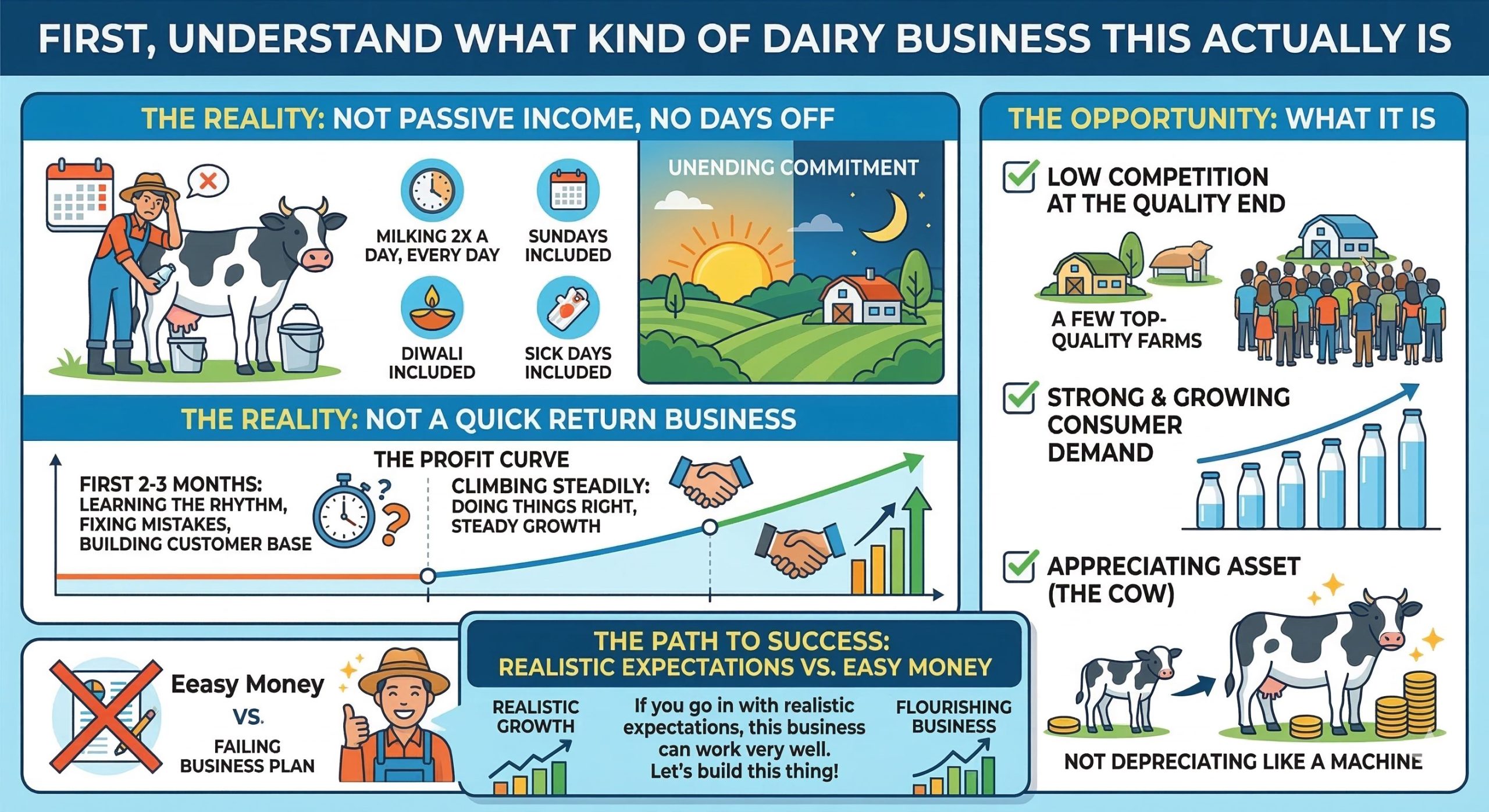
It is not passive income. There is no such thing as a cow that takes care of herself. Milking happens twice a day, every single day. Sundays included. Diwali included. The day your back hurts, and you’d rather stay in bed — included.
It is also not a quick return business. Your first two or three months will be about learning the rhythm, fixing what you got wrong, and building your customer base. The profit curve looks flat at first and then, if you’ve done things right, starts climbing steadily.
What it is — is a business with remarkably low competition at the quality end of the market, strong and growing consumer demand, and an asset (the cow) that appreciates rather than depreciating like a machine would.
If you go in with realistic expectations, the Gir cow farming business plan I’m laying out here can work very well. If you go in expecting easy money, any business plan will fail.
Okay. Let’s build this thing.
Step 1: Decide Your Scale Before You Spend a Rupee
This is where most people get the sequence wrong. They buy the cows first and figure out the rest later.
Don’t do that.
Start with a simple question: How much capital do I have, and how much can I realistically manage?
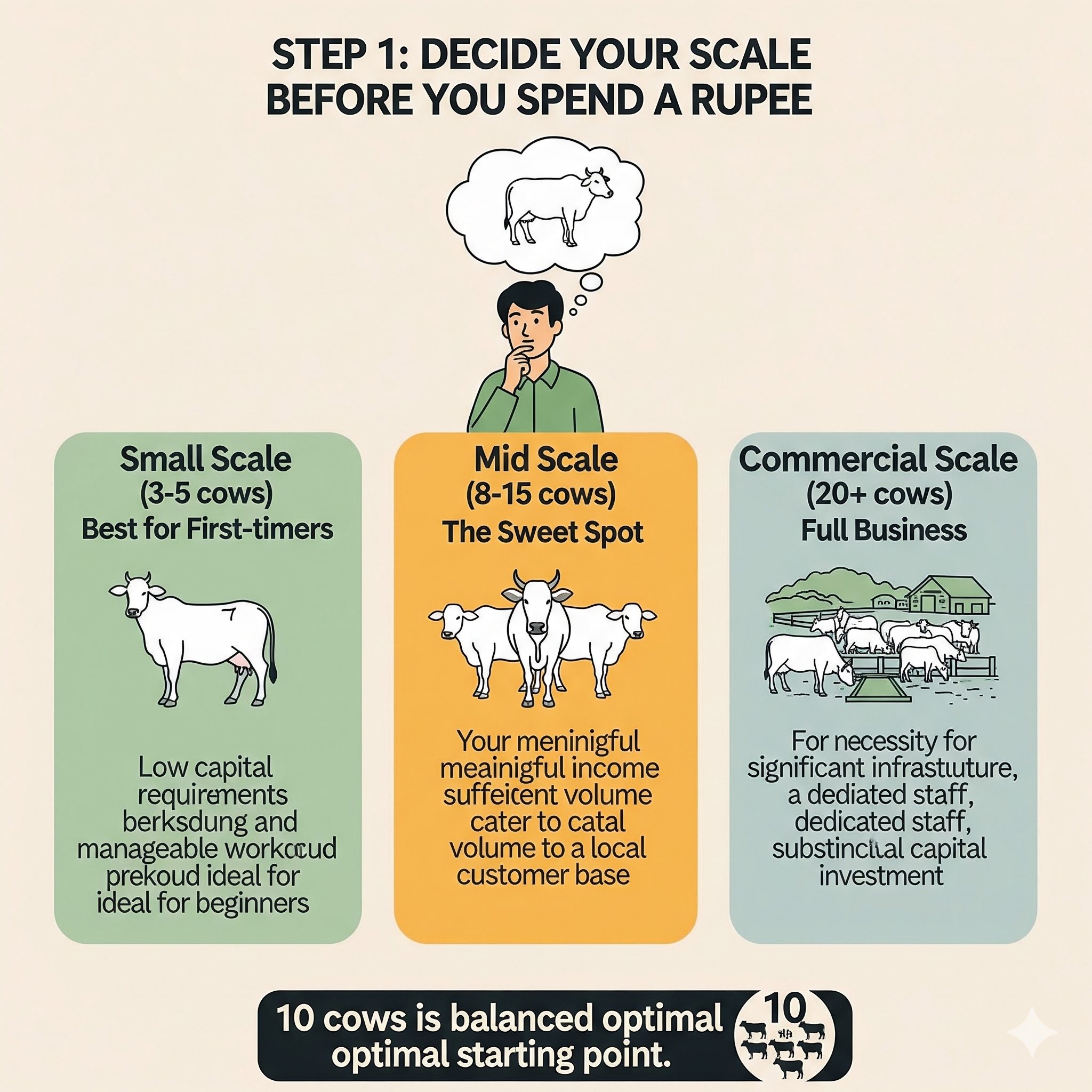
There are three sensible starting scales for Gir cow farming:
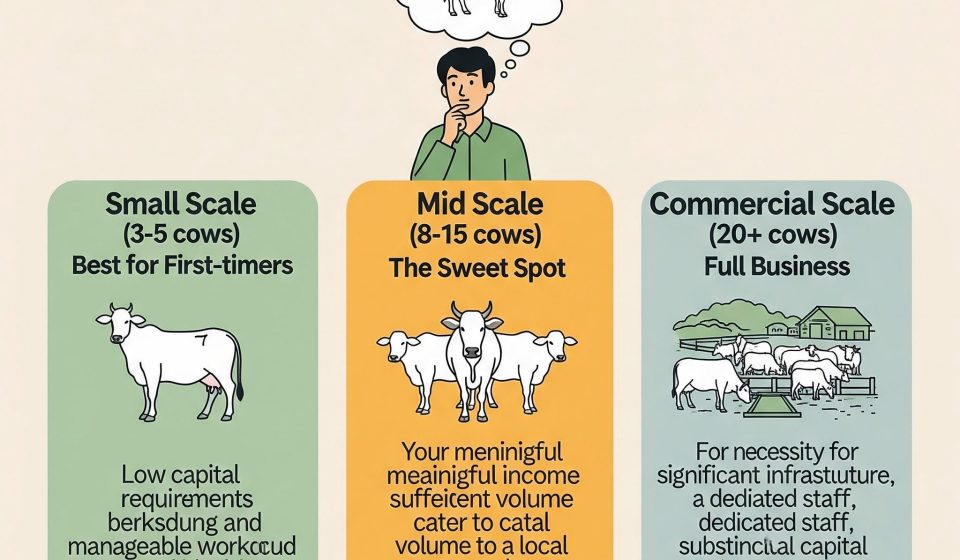
Small Scale — 3 to 5 cows This is where most first-timers should begin. Low capital requirement, manageable workload for one person, and enough volume to test your market without betting everything. You’ll learn what you need to learn without catastrophic downside if something goes wrong.
Mid Scale — 8 to 15 cows This is where the economics really start to make sense. Enough milk volume to supply a small local customer base, justify a part-time helper, and generate meaningful monthly income. Requires solid planning and some prior experience or mentorship.
Commercial Scale — 20 cows and above This is a full business requiring proper infrastructure, hired staff, formal milk processing or distribution, and significant capital. Not a starting point unless you have deep pockets and a partner with actual dairy experience.
For this business plan, I’ll build around 10 cows — specific enough to be useful, scalable up or down based on your situation.
Step 2: The Investment Breakdown (Honest Numbers)
Let’s talk about what you actually need to spend. I’ll give you realistic 2024-25 figures, not optimistic ones.
Land and Shed
You need roughly 1,000 to 1,500 square feet of covered shed space for 10 cows comfortably. If you already own land, great. If not, even a small plot on the outskirts of a town or village works.
Shed construction for 10 cows — basic but proper, with cement flooring, proper drainage, ventilation, and a storage area for fodder — will cost approximately ₹1.5 to ₹2.5 lakhs depending on your state and local material costs. Don’t skimp on drainage. Wet, dirty floors cause hoof problems and mastitis. Both will cost you more than you saved on construction.
You’ll also want a small paddock or open area where cows can move freely. This isn’t a luxury — cows that move around are healthier and produce better.
The Cows
For 10 quality Gir cows in milk, budget ₹7 to ₹10 lakhs depending on where you’re buying and what quality you’re targeting. That’s ₹70,000 to ₹1,00,000 per cow.
I know that sounds like a lot. But remember — you’re buying a productive asset that will give returns for 8 to 10 years and can be sold later at appreciated value. Think of it more like buying a piece of equipment for your business, not a consumable expense.
Don’t try to cut this cost by buying cheap or unverified animals. This is the one place in the whole business plan where cutting corners will definitely hurt you.
Equipment
Basic dairy farming equipment isn’t complicated or expensive:
- Milking buckets and stainless steel storage cans: ₹8,000–₹12,000
- Milk chilling system or refrigerator (for storage): ₹15,000–₹25,000
- Chaff cutter (for processing fodder): ₹12,000–₹18,000
- Fodder storage bins and basic tools: ₹5,000–₹8,000
- Water troughs and plumbing: ₹8,000–₹15,000
Total equipment: ₹50,000 to ₹80,000
If you plan to make ghee or value-added products eventually, add a traditional churner (bilona) — around ₹8,000–₹15,000 for a good one.
Working Capital
This is the most underestimated part of any farming business plan. You need cash reserves to run the operation while you’re building income — fodder costs, labor, vet visits, unexpected expenses.
Budget ₹1.5 to ₹2 lakhs as working capital reserve covering your first 4–6 months of operating costs.
Total Startup Investment Summary
| Item | Estimated Cost |
|---|---|
| Land (if purchasing small plot) | ₹0 – ₹3,00,000 |
| Shed construction | ₹1,50,000 – ₹2,50,000 |
| 10 Gir cows | ₹7,00,000 – ₹10,00,000 |
| Equipment | ₹50,000 – ₹80,000 |
| Working capital reserve | ₹1,50,000 – ₹2,00,000 |
| Total (excluding land purchase) | ₹10,50,000 – ₹15,30,000 |
If you own land already, you’re looking at roughly ₹10.5 to ₹12 lakhs to get a 10-cow Gir farm operational.
Step 3: Revenue Projections — Realistic, Not Wishful
Here’s where business plans often go wrong. People use optimistic numbers and then wonder why reality looks different.
I’ll give you conservative, moderate, and good-case scenarios.
Assumptions:
- 10 cows, average production 10 liters/day/cow
- Total daily production: 100 liters
- Milk sold at ₹70/liter (A2, direct to consumer — achievable in most tier-2 cities and above)
- 300 productive days per cow per year (standard lactation)
Daily Revenue
100 liters × ₹70 = ₹7,000/day
Monthly Revenue (Milk Only)
₹7,000 × 30 = ₹2,10,000/month
Additional Revenue Streams
- Calf sales (10 calves per year, average ₹15,000 each): ₹1,25,000/year or about ₹10,400/month
- Cow dung — fresh dung sales to organic farmers or biogas units: ₹3,000–₹5,000/month
- Gomutra (cow urine) — growing market for organic inputs: ₹2,000–₹4,000/month
Total Monthly Gross Revenue: ₹2,25,000 – ₹2,30,000
Step 4: Monthly Operating Costs
Now let’s be equally honest about what goes out.
Fodder and Feed This is your biggest recurring expense. Each cow needs:
- Green fodder: 25–30 kg/day
- Dry fodder: 4–5 kg/day
- Concentrate feed: 2–3 kg/day (more for high producers)
For 10 cows, monthly fodder cost runs ₹60,000 to ₹80,000 depending on whether you grow some fodder yourself or buy everything. Growing napier grass or sorghum on even half an acre of land can cut this significantly.
Labor One person can manage 5–6 Gir cows alone. For 10 cows, you need help. Budget for one full-time farm worker at ₹12,000–₹18,000/month depending on your state.
Veterinary and Health Routine vaccinations, deworming, occasional illness, emergency vet visits. Budget ₹6,000–₹10,000/month on average. Some months will be zero. Some months more. Average it out.
Utilities and Miscellaneous Water, electricity, repairs, packaging for milk delivery, miscellaneous supplies — ₹5,000–₹8,000/month.
Loan Repayment (if applicable) If you’ve taken a loan for the business, factor in EMI. A ₹10 lakh loan at 7% over 5 years runs about ₹19,800/month.
Monthly Cost Summary
| Expense | Monthly Cost |
|---|---|
| Fodder and feed | ₹60,000 – ₹80,000 |
| Labor | ₹12,000 – ₹18,000 |
| Veterinary | ₹6,000 – ₹10,000 |
| Utilities and misc | ₹5,000 – ₹8,000 |
| Total Operating Cost | ₹83,000 – ₹1,16,000 |
Net Monthly Profit
Revenue: ₹2,25,000 Costs: ₹83,000 – ₹1,16,000 Net Profit: ₹1,09,000 – ₹1,42,000/month
Without loan repayment factored in. With a ₹10 lakh loan EMI, net drops to roughly ₹89,000 – ₹1,22,000/month.
Still very solid for a 10-cow operation.
Step 5: The Sales Strategy (Most Business Plans Skip This Part)
Here’s the uncomfortable truth — producing good milk is only half the battle. Selling it profitably is the other half, and it’s where most new dairy farmers leave serious money on the table.
Option 1: Sell to Local Cooperative or Middleman Easiest. Least profitable. You’ll get ₹35–₹45 per liter at most, and the middleman captures the premium. Fine as a backup channel, terrible as your primary one.
Option 2: Direct to Consumer — The Real Money Selling directly to households, apartments, and small restaurants at ₹70–₹100 per liter is where the Gir cow economics truly shine. Yes, it takes effort to build this customer base. But once you have 80–100 regular customers taking 1 liter a day each, your revenue is stable and your margins are strong.
How to build it: Start with your own network — family, friends, neighbors. Give free samples. Let the milk sell itself. Gir cow A2 milk tastes noticeably different — creamier, richer, with that distinctive yellow tinge from beta-carotene. People notice.
Then expand via WhatsApp groups, local residential society groups, word of mouth. Many successful Gir farmers have built their entire customer base through a single WhatsApp broadcast list.
Option 3: Value-Added Products Ghee. Paneer. Curd. These products multiply your revenue per liter of milk dramatically.
One liter of Gir cow milk makes roughly 50–55 grams of bilona ghee. A kilogram of Gir A2 ghee sells for ₹1,500 to ₹2,500. It takes about 25–28 liters to produce one kilogram of ghee. The math works when you have surplus milk or during periods of lower demand for fresh milk.
Paneer from Gir cow milk also commands a premium in urban markets. Even selling homemade curd at ₹80–₹100 per 500 grams to regular customers adds up.
Option 4: Farm Subscription Model This is newer but growing fast. Customers pay a fixed monthly amount — say ₹2,500 for a liter a day — and you deliver regularly. Predictable revenue for you, convenient for them. Some farms in Pune, Bengaluru, and Hyderabad have built 200–300 subscriber bases this way. It essentially turns your farm into a recurring revenue business.
Step 6: Feed and Fodder Management
I’m giving this its own section because feed cost is the single variable that most affects your profitability — and it’s also the one you have the most control over.
The smartest thing you can do in a Gir cow farming business plan is grow at least 30–40% of your own fodder.
Napier grass is a farmer’s best friend here. Plant it once, harvest every 45–60 days, and it keeps producing for years. On half an acre, you can grow enough napier to significantly reduce your purchased fodder bill. Add a small plot of maize or sorghum for dry fodder, and you’ve taken a real bite out of your biggest expense.
For concentrate feed — don’t go for the cheapest option. A good concentrate mix of cotton seed cake, groundnut cake, mineral mixture, and grain bran keeps milk fat high and cow health good. Cutting concentrate quality to save ₹500 a month can easily cost you ₹2,000 in reduced milk yield and vet bills.
Step 7: Health Management Calendar
A sick cow is an expensive cow. Preventive care is dramatically cheaper than treatment.
Here’s a basic annual health calendar every Gir cow farm should follow:
Every 6 months: FMD (Foot and Mouth Disease) vaccination
Annually: HS (Hemorrhagic Septicemia), BQ (Black Quarter) vaccinations
Every 3 months: Deworming — internal parasites quietly reduce milk yield without obvious symptoms
Monthly: Tick and external parasite check and treatment if needed
Weekly: Hoof inspection, udder check for early mastitis signs
Daily: Watch for changes in eating behavior, milk yield, or temperament. A cow that’s off her feed today might be seriously ill next week if you ignore the signal.
Build a relationship with a local vet before you need one urgently. Know their number. Have basic medicines — fever reducers, wound care, oral rehydration salts — stocked at the farm at all times.
Step 8: Government Schemes and Loans You Should Know About
Starting a Gir cow farm with ₹12 lakhs of your own money is one way. Being smarter about it is another.
NABARD Dairy Entrepreneurship Development Scheme (DEDS) provides back-ended capital subsidies — 25% for general category, 33.33% for SC/ST — on approved dairy projects. On a ₹10 lakh project, that’s ₹2.5 lakhs back in your pocket.
Rashtriya Gokul Mission specifically supports indigenous breed farming with financial assistance, training, and access to quality bulls for breeding.
Kisan Credit Card (KCC) can be used for working capital — fodder, veterinary expenses, labor — at 4% interest after subvention. Practically free money for operational costs.
State schemes vary but many states have additional subsidies for indigenous cattle. Gujarat, Rajasthan, Maharashtra, and UP all have active programs. Visit your district Animal Husbandry office and specifically ask what’s available for indigenous breed dairy farming. Bring ID, land documents, and a basic project outline. The clerks won’t volunteer information — you have to ask the right questions.
Step 9: The Timeline — What to Expect Month by Month
Months 1–2: Setup and settling. Shed ready, cows purchased, basic routines established. Milk yield will be slightly below normal as cows adjust to the new environment. Start building your customer list. Don’t panic about lower yield — it normalizes.
Months 3–4: Finding your rhythm. You now know your cows individually. You know which one is a fussy eater, which one needs extra time at milking, and which one is the herd queen. Customer base starting to build. Revenue is growing but not yet at full potential.
Months 5–6: Stabilization Full production. Customer base established. Systems running. First real profitability visible. This is also when you’ll start identifying what needs to change or improve.
Months 7–12: Optimization Now you’re tweaking. Maybe you start making ghee with surplus milk. Maybe you add 2–3 more cows. Maybe you start a subscription model. The business starts feeling like a business.
Year 2 onwards: Scaling or deepening By now you have data — real production numbers, real costs, real customer feedback. You can make intelligent decisions about whether to scale up, diversify into value-added products, or optimize what you have.
The Mistakes I’ve Seen New Farmers Make
Buying too many cows too soon. Start with what you can manage. Overwhelmed farmers make bad decisions.
Underestimating the summer. May and June are brutal. Fodder prices spike, cow stress rises, milk yield drops. Build a summer contingency into your plan — extra water, shade nets, electrolyte supplements, and a slightly larger cash reserve.
Ignoring the sales side. Cows don’t find their own customers. You have to. Don’t wait until you have full production to start building your customer base. Start from day one.
Cutting vet corners. That deworming you skipped to save ₹200 per cow? It costs you 15% of milk yield for two months. Do the math.
Not keeping records. Write down the daily milk yield per cow. Track feed costs. Note health events. This data is gold when you’re trying to figure out what’s working and what isn’t.
Is Gir Cow Farming Right for You?
It is if you’re willing to show up every single day. If you genuinely like animals — not just the idea of them, but the actual muddy, smelly, early-morning reality of them. If you’re patient enough to build a customer base over months rather than weeks. And if you can treat it like the business it is, not a hobby you’ll get around to when you feel like it.
Rameshbhai from the beginning of this story? He told me recently that the best decision he ever made was getting those six cows. Not because it was easy. Because it was worth it.
The Gir cow farming business plan I’ve laid out here isn’t theoretical. These numbers are real. These timelines are real. The challenges are real too.
But so is the ₹94,000 my neighbor made last month from six cows in a small shed behind his house.
That’s the opportunity sitting right in front of you.
Whether you grab it is entirely up to you.
Frequently Asked Questions: Gir Cow Farming Business Plan
Q1. How much money do I need to start a Gir cow farming business?
Realistically, for a small but proper setup with 5 cows, you’re looking at ₹5 to ₹7 lakhs total — that covers the animals, basic shed construction, equipment, and 3–4 months of working capital. For 10 cows, budget ₹10 to ₹13 lakhs if you already own land. If you need to buy or lease land, add accordingly. The mistake most beginners make is budgeting only for the cows and forgetting everything else — shed, equipment, fodder reserve, unexpected vet bills. Those “other” costs routinely add 30–40% on top of the cattle purchase price. Plan for the full picture from day one.
Q2. How long does it take to break even on a Gir cow farm?
For a 10-cow operation with direct-to-consumer A2 milk sales, most farmers break even somewhere between 10 and 18 months. The wide range depends on how quickly you build your customer base, what you paid for the animals, and whether you’re servicing a loan. Rameshbhai — the neighbor I mentioned — hit break-even at 14 months. He was slower to build customers than he should have been in the beginning. Farmers who aggressively build their sales channel from month one often break even closer to 10–12 months. The cow doesn’t determine your break-even point as much as your sales strategy does.
Q3. Can I start Gir cow farming as a part-time business while keeping my job?
Honestly — with 1 or 2 cows, maybe. With 5 or more, no. Dairy farming has a rhythm that doesn’t bend around office hours. Milking happens at fixed times twice a day. Feeding, cleaning, health monitoring — these aren’t tasks you can batch on weekends. What many working people do successfully is hire one reliable farm hand to manage daily operations and take a supervisory role themselves — visiting mornings and evenings, making decisions, managing accounts and sales. That works. But you need someone trustworthy on the ground full time. Finding that person is often harder than finding the cows.
Q4. How many cows can one person manage alone?
One fit, experienced person can comfortably manage 5 to 6 Gir cows alone — milking, feeding, cleaning, basic health monitoring. Beyond that, quality of care starts slipping. At 10 cows you definitely need one helper. At 20+ cows you need at least 2 dedicated workers plus yourself in a supervisory and management role. Don’t stretch one person beyond their capacity thinking you’ll save on labor costs. Overworked caretakers make mistakes, miss early illness signs, and cut corners. The cost of those mistakes always exceeds the labor savings.
Q5. What is the best fodder to grow for Gir cows?
Napier grass is the top recommendation for most Indian climates — it’s high-yield, nutritious, grows fast, and once established, needs minimal maintenance. CO-3 and CO-4 varieties of napier are particularly popular. For dry fodder, sorghum and maize stalks work well. Leguminous fodder like lucerne (alfalfa) adds protein and is excellent for lactating cows but needs more water and care. A practical approach for a 10-cow farm — plant napier on half an acre and maize on a quarter acre. That alone can cover 40–50% of your green fodder needs and make a meaningful dent in your monthly feed bill. Whatever you grow locally is almost always cheaper and fresher than what you buy.
Q6. What should I feed Gir cows to maximize milk production?
Three components work together. Green fodder — napier, maize, sorghum — forms the base and keeps the digestive system healthy. Dry fodder — wheat straw, paddy straw, groundnut hulls — adds bulk and roughage. Concentrate feed — a mix of cottonseed cake, groundnut cake, grain bran, and mineral mixture — is what really drives milk production. A lactating Gir cow giving 10+ liters needs about 2 to 3 kg of quality concentrate per day, sometimes more for very high producers. The mineral mixture is non-negotiable — calcium, phosphorus, and salt deficiencies quietly reduce yield and cause reproductive problems. Add jaggery occasionally as an energy supplement, especially in summer. And water — always fresh, always available. A cow that’s slightly dehydrated will drop milk yield faster than almost anything else.
Q7. How do I find customers for A2 Gir cow milk?
Start with the people already around you — neighbors, relatives, your children’s school community, local gym members, yoga centers. These people are already health-conscious and often already looking for better milk options. Give free samples for a week. Seriously. The milk sells itself once people taste it. Then build a WhatsApp group for your customers — post daily about the farm, share photos of the cows, talk about what they’re eating. People buying A2 milk are buying a story as much as a product. Give them that story. Apartment resident welfare associations are goldmines — one presentation to a 200-family apartment complex and you could have 30–40 customers overnight. Local organic stores, Ayurvedic clinics, and pediatricians who recommend A2 milk for children are also excellent referral sources.
Q8. Is it better to sell fresh milk or make ghee and other products?
Both have their place and ideally you do both. Fresh milk gives daily cash flow — you produce it today, you sell it today, money comes in regularly. Ghee is a longer cycle but dramatically higher value — ₹1,500 to ₹2,500 per kilogram versus ₹70 per liter for fresh milk. The smart approach is to sell fresh milk as your primary revenue stream and use surplus milk — the extra beyond what your regular customers take — to make ghee or paneer. That way you’re not wasting anything and you’re building a second higher-margin product line. Once your ghee develops a reputation, you’ll find customers specifically seeking it out. Some farms eventually find ghee becomes more profitable per liter of milk than direct milk sales. Start with fresh milk, add products as you grow.
Q9. What are the biggest risks in Gir cow farming and how do I manage them?
Four main risks keep dairy farmers up at night. Disease outbreak — one sick cow can spread illness through the herd fast. Manage it with strict vaccination schedules, quarantine of any new or sick animals, and a vet relationship you can call at any hour. Fodder price spikes — summer and drought years can double feed costs overnight. Manage it by growing some of your own fodder and maintaining a 2-month dry fodder reserve. Customer loss — your anchor customer stops buying, or a competitor undercuts your price. Manage it by never relying on one or two big customers; spread across 50–100 smaller ones. And finally, cow health and death — losing an animal is a real financial hit. Manage it with livestock insurance, which is available and genuinely affordable, and more farmers should use it than actually do.
Q10. Should I take a loan or use personal savings to start?
Both have merit depending on your situation. Using personal savings means no EMI pressure during the early months when income is still building — and those early months can be stressful enough without a loan hanging over you. A loan through NABARD schemes or Kisan Credit Card at subsidized rates (sometimes as low as 4% after government interest subvention) makes real sense if you’re disciplined about the business. The worst approach is taking a high-interest personal loan or borrowing from informal sources at 18–24%. Dairy farming margins don’t support that kind of debt cost. If you go the loan route, target government-backed agricultural loan schemes specifically. And borrow only what you’ve actually budgeted for — not a rupee more, because the temptation to expand too fast with borrowed money is real and dangerous.
Q11. How do I handle the seasonal drop in milk production?
Every dairy farmer faces this. Summer months — April through June — typically see a 15 to 25% drop in yield as heat stress affects the cows. Winter months are usually the most productive. To manage the summer dip, install shade nets over the outdoor area, ensure continuous access to cool water, consider adding electrolyte supplements to drinking water during peak heat, and avoid milking during the hottest part of the day. On the business side, having a small ghee-making operation actually helps here — you can stock ghee made during peak production winter months and sell it during summer when fresh milk volume is lower. Also, don’t promise customers a fixed daily quantity you can’t consistently deliver. Build a small buffer into your supply commitments.
Q12. How do I scale from 10 cows to 25 or 50 cows?
Slowly and deliberately. The farmers who scaled fast and crashed almost always did the same thing — they expanded infrastructure and cattle before their sales channel could absorb the increased production. More cows producing more milk than you can sell is a nightmare. The right sequence is: build the customer base first, then add cows to meet that demand. When your current 10 cows’ production is consistently 80–90% sold at good prices and you have a waiting list of customers, that’s your signal to expand. Add 5 cows at a time, not 20. Let each batch integrate into your operation before adding more. Hire and train staff before you need them urgently, not after. And revisit your business plan numbers with each expansion — costs scale differently than revenue does, and what worked at 10 cows needs recalculating at 25.
Q13. What record-keeping should I maintain for a Gir cow farm?
More than most farmers actually bother with, and less than an accountant would ideally want. At minimum, keep a daily milk register — date, cow name or number, morning yield, evening yield. This single record tells you everything about individual cow health trends and overall farm productivity. Keep a feed purchase log — what you bought, how much, what you paid. Keep a health record per cow — vaccinations, treatments, vet visits, heat cycles, calving dates. Keep a sales register — who bought, how much, what they paid, any dues. And keep a monthly expense summary. None of this needs fancy software. A ₹30 notebook per category works perfectly. The farmers who keep good records make better decisions, catch problems earlier, and have real data when applying for loans or government schemes. It takes 10 minutes a day. It’s worth every one of those minutes.


