
Confidor Insecticide Everything You Need to Know Before You Spray
Let’s Know All About Confidor Insecticide
I’ll never forget the summer my uncle’s cotton crop turned into a disaster.
He’d done everything right. Good soil preparation. Right variety. Timely sowing. But somewhere around week six, the leaves started curling. Slowly at first. Then faster. By the time he called the local agronomist, half the field looked like it had given up on life. The culprit? Sucking pests. Whiteflies and aphids had quietly colonized the entire crop while everyone was busy looking at other things.
The agronomist showed up, walked the field for ten minutes, and said two words: “Confidor lagao.”
Within a week, the crop had turned around. Not completely — some damage was already done — but enough to save a meaningful portion of the harvest. My uncle became a Confidor believer that season. And honestly, so did I.
That experience is what made me want to understand this product properly. Not just “spray this much per acre” — but actually understand what it is, how it works, when to use it, when not to use it, and what mistakes to avoid. Because a tool this powerful deserves to be understood, not just used blindly.
So let’s get into it.
What Exactly Is Confidor?
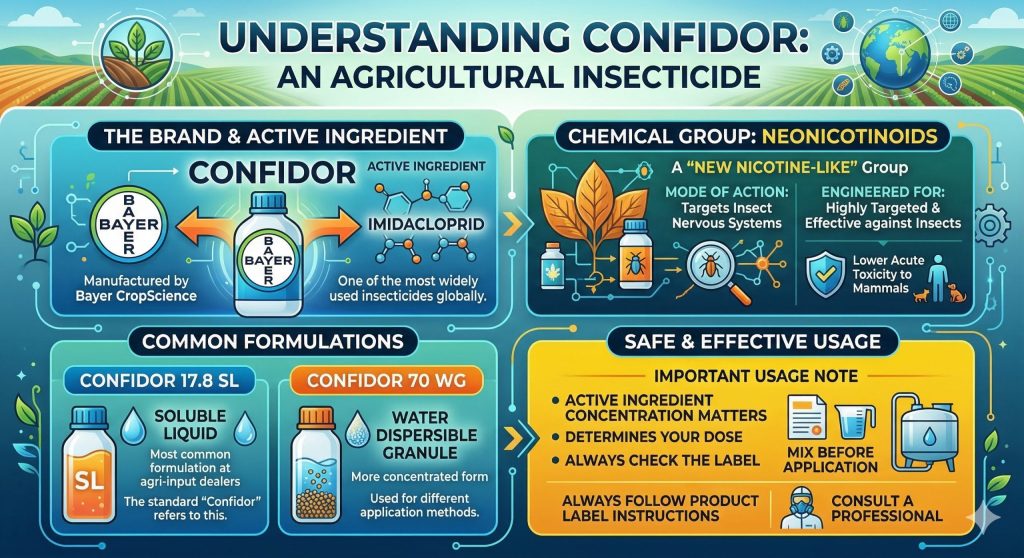
Confidor is a brand name. The actual chemistry behind it is Imidacloprid — one of the most widely used insecticides in agricultural history. Confidor is manufactured and marketed by Bayer CropScience, and it belongs to the chemical group called Neonicotinoids.
That word — neonicotinoid — basically means “new nicotine-like.” These insecticides work similarly to nicotine in how they affect insect nervous systems, but they’ve been engineered to be far more targeted and effective against insects while having lower acute toxicity to mammals.
Confidor is available in multiple formulations. The most common one you’ll find at your local agri-input dealer is Confidor 17.8 SL — that SL stands for Soluble Liquid. There’s also Confidor 70 WG — a Water Dispersible Granule form that’s more concentrated and used differently. When someone just says “Confidor,” they’re usually referring to the 17.8 SL unless specified otherwise.
The active ingredient concentration matters because it determines your dose. Always check the label of whatever you’ve purchased before mixing.
Confidor Composition: What’s Actually Inside
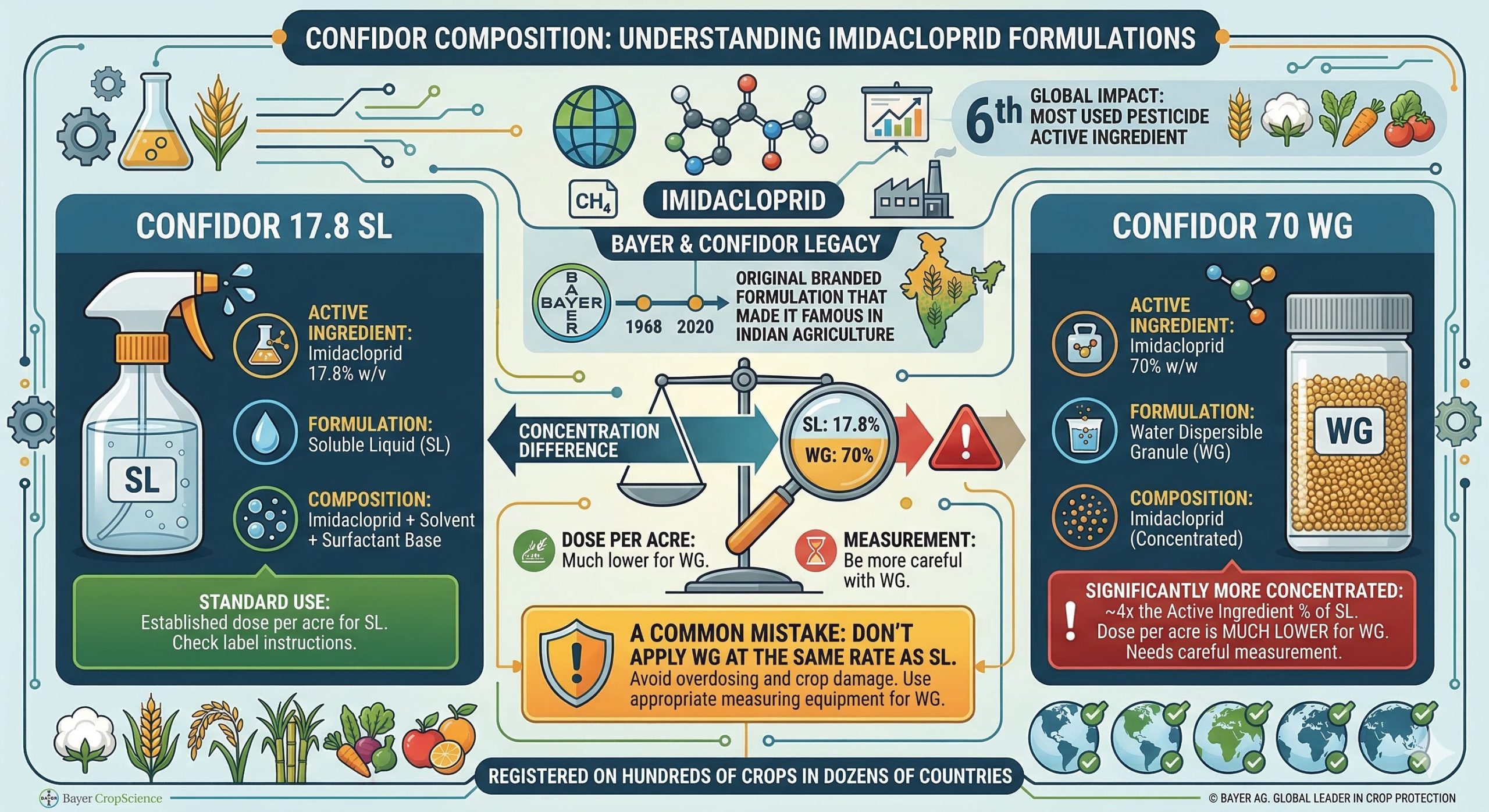
Confidor 17.8 SL:
- Active ingredient: Imidacloprid 17.8% w/v
- Formulation: Soluble Liquid
- Solvent and surfactant base
Confidor 70 WG:
- Active ingredient: Imidacloprid 70% w/w
- Formulation: Water Dispersible Granule
The 70 WG is significantly more concentrated — about four times the active ingredient percentage. This means the dose per acre is much lower for WG, and you need to be more careful with measurement. A common mistake new users make is applying WG at the same rate as SL. Don’t do that.
Imidacloprid is the 6th most used pesticide active ingredient globally. It’s registered for use on hundreds of crops across dozens of countries. Bayer didn’t invent imidacloprid, but Confidor was the original branded formulation that made it famous in Indian agriculture.
How Does Confidor Work?
This is the part most farmers skip, but understanding the mechanism makes you a much better applicator.
Imidacloprid is a systemic insecticide. Systemic means it gets absorbed into the plant’s vascular system — its sap — and moves through the entire plant. Roots, stems, leaves, even new growth that emerges after spraying. This is fundamentally different from a contact insecticide that only kills what it physically touches.
Once inside the plant, imidacloprid works as a nicotinic acetylcholine receptor agonist. In plain language — it jams the insect’s nervous system. Specifically, it binds to nerve receptors that normally receive acetylcholine signals. When imidacloprid locks onto these receptors, it causes continuous nerve firing. The insect essentially goes into nervous system overdrive and dies.
Insects that feed on treated plants — by sucking sap or chewing tissue — ingest the imidacloprid along with their meal. They don’t even have to be directly sprayed. This is why Confidor is so effective against hidden pests like aphids feeding on the undersides of leaves, or whiteflies that scatter the moment you try to spray them directly.
The residual activity of Confidor is another reason farmers love it. A single application can provide protection for 2 to 3 weeks, sometimes longer, depending on crop growth stage and rainfall. You’re not spraying every 4 days like you would with some contact insecticides.
What Pests Does Confidor Control?
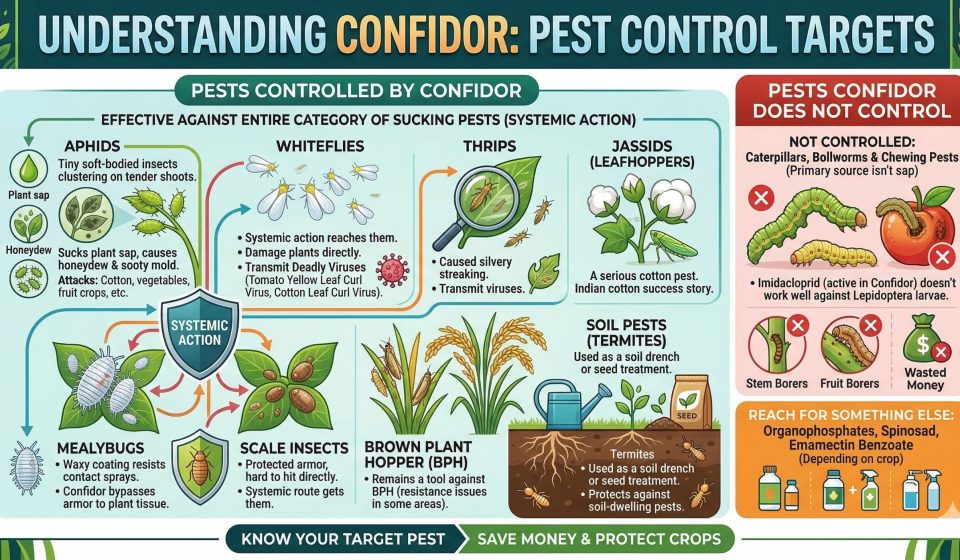
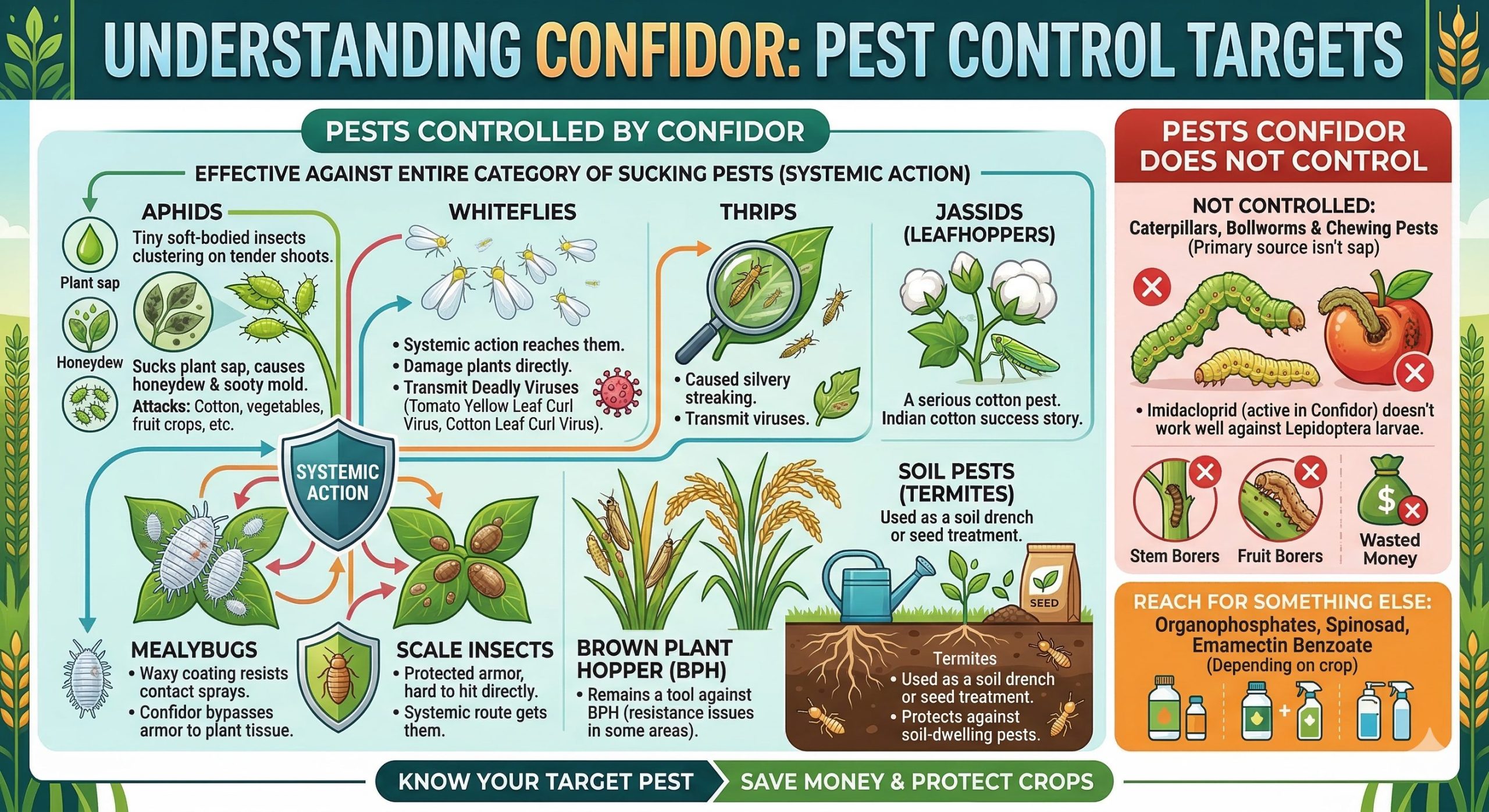
This is where Confidor really shines — it’s effective against the entire category of sucking pests. Let me be specific because “sucking pests” covers a wide range.
Aphids — probably the most common reason farmers reach for Confidor. These tiny soft-bodied insects cluster on tender shoots and undersides of leaves, sucking plant sap and secreting honeydew that leads to sooty mold. Cotton, vegetables, fruit crops — aphids attack almost everything.
Whiteflies — the classic villain in cotton and tomato fields. Whiteflies not only damage plants directly but are vectors for deadly viruses like Tomato Yellow Leaf Curl Virus (TYLCV) and Cotton Leaf Curl Virus (CLCuV). Confidor’s systemic action makes it particularly effective here because whiteflies scatter when disturbed, making direct contact sprays difficult.
Thrips — small but devastating, especially in onion, chilli, cotton, and grape crops. They cause silvery streaking on leaves and can transmit viruses.
Jassids (Leafhoppers) — a serious cotton pest. Confidor was actually one of the first products that gave Indian cotton farmers reliable control over jassids.
Mealybugs — protected by their waxy coating against many contact sprays, but Confidor’s systemic action gets into the plant tissue they’re feeding on.
Scale insects — similar logic to mealybugs. Hard to hit directly, but the systemic route bypasses their armor.
Brown Plant Hopper (BPH) in rice — though resistance has become an issue in some areas, Confidor remains a tool against BPH.
Termites in soil — when used as a soil drench or seed treatment, Confidor protects against soil-dwelling pests, including termites.
What Confidor does NOT control: Caterpillars, bollworms, and other chewing pests that don’t rely on plant sap as their primary food source. Imidacloprid doesn’t work well against Lepidoptera larvae. If you have stem borers or fruit borers, reach for something else — organophosphates, spinosad, or emamectin benzoate, depending on the crop. Using Confidor against caterpillars is wasting your money.
Confidor Uses: Crop-by-Crop Application Guide
Cotton
Cotton is where Confidor built its Indian reputation. Primary targets are jassids, whiteflies, aphids, and thrips.
Dose: 0.5 ml of Confidor 17.8 SL per liter of water for foliar spray. For a standard knapsack sprayer of 15 liters, that’s 7.5 ml of product per tank.
Per acre dose: 100 to 150 ml of Confidor 17.8 SL in 150-200 liters of water.
Apply at the first sign of pest appearance. Don’t wait until infestation is heavy — by then, virus transmission may have already occurred.
Vegetables (Tomato, Chilli, Brinjal, Okra)
Whiteflies and aphids are the primary targets. Tomato growers especially rely on Confidor to prevent whitefly-transmitted viruses.
Dose: 0.3 to 0.5 ml per liter of water for foliar spray.
Important note for vegetables: Observe the pre-harvest interval (PHI). Confidor has a PHI of 7 days for vegetables — meaning stop spraying at least 7 days before harvest. This is non-negotiable from both a regulatory and food safety standpoint.
Rice
Targets brown plant hopper, green leafhopper, and whitefly.
Dose for foliar spray: 0.3 ml per liter of water.
Seedling root dip treatment: Mix 2 ml of Confidor 17.8 SL in 1 liter of water and dip seedling roots for 12 hours before transplanting. This provides systemic protection to young plants during their most vulnerable establishment phase.
Sugarcane
Used primarily as a soil application or furrow treatment at planting to control early shoot borer and termites.
Dose: 400 ml of Confidor 17.8 SL per acre mixed in sand and applied in furrows at planting time.
Mango and Fruit Crops
Targets mango hoppers (one of mango’s most destructive pests), thrips, and mealybugs.
Dose: 0.5 ml per liter for foliar spray. Apply before flowering and after fruit set — avoid spraying during full bloom to protect pollinators.
Grapes
Controls thrips, mealybugs, and leafhoppers.
Dose: 0.3 to 0.5 ml per liter, depending on pest pressure.
Potato and Onion
Controls aphids and thrips, which are both direct pests and virus vectors in these crops.
Dose: 0.5 ml per liter for foliar application.
Soil Application / Drench
For soil pests — termites, soil grubs, fungus gnats in nurseries — Confidor can be diluted and applied as a soil drench around the plant base. Dose varies by situation; typically 1 to 2 ml per liter applied to the root zone.
Confidor Dose Chart: Quick Reference
| Crop | Target Pest | Dose (17.8 SL) | Water Volume |
|---|---|---|---|
| Cotton | Jassids, Whitefly, Aphids | 100–150 ml/acre | 150–200 L/acre |
| Tomato/Chilli | Whitefly, Aphids, Thrips | 0.3–0.5 ml/L | As needed |
| Rice (foliar) | BPH, Leafhopper | 0.3 ml/L | 150 L/acre |
| Rice (seedling dip) | Systemic protection | 2 ml/L water | Dip for 12 hrs |
| Sugarcane | Shoot borer, Termites | 400 ml/acre | Mix in sand |
| Mango | Mango Hopper, Thrips | 0.5 ml/L | As needed |
| Potato/Onion | Aphids, Thrips | 0.5 ml/L | As needed |
| Soil drench | Termites, Soil grubs | 1–2 ml/L | Root zone |
How to Use Confidor: Step by Step
Step 1 — Read the label. Every batch. I know you’ve used it before. Read it anyway. Formulations change. Labels get updated. Two minutes of reading prevents expensive mistakes.
Step 2 — Identify the pest first. Confidor is for sucking pests. If you’re not sure what pest you have, ask your agronomist before spending money on any product.
Step 3 — Measure accurately. Use a proper measuring cylinder. Don’t eyeball it. Overdosing doesn’t give better control — it wastes product, increases cost, and risks phytotoxicity (plant damage) and resistance development.
Step 4 — Mix properly. Fill your sprayer half-full with clean water. Add the measured Confidor. Fill to the required volume. Shake or agitate gently before use. Confidor 17.8 SL mixes easily in water — you shouldn’t see any undissolved particles.
Step 5 — Spray at the right time. Early morning or late evening is ideal. Avoid spraying in peak afternoon heat — evaporation reduces efficacy and increases phytotoxicity risk. Avoid spraying when rain is forecast within 4 hours — you’ll wash the product off before it’s absorbed.
Step 6 — Cover the plant thoroughly. Target the undersides of leaves where aphids and whiteflies congregate. A good spray that coats leaf undersides is worth three mediocre sprays that only hit the tops.
Step 7 — Wear protective equipment. Gloves, mask, goggles. Even relatively lower-toxicity products deserve respect. Wash your hands, face, and any exposed skin after spraying. Change clothes before going indoors.
Confidor Price: What to Expect
Prices vary by location, dealer, and market conditions. As of 2024-25:
Confidor 17.8 SL:
- 100 ml: approximately ₹180 to ₹220
- 250 ml: approximately ₹380 to ₹450
- 1 liter: approximately ₹1,200 to ₹1,500
Confidor 70 WG:
- 100 grams: approximately ₹350 to ₹420
- 250 grams: approximately ₹750 to ₹900
Always buy from an authorized dealer. Counterfeit agrochemicals are a real and serious problem in India. Check the hologram on Bayer products, verify the batch number, and be suspicious of prices that seem significantly below market rate. A fake product not only fails to control pests — it can actively damage your crop.
Confidor and Bees: The Conversation You Need to Have
This section is important and I’m not going to skip it.
Neonicotinoids — the chemical class Confidor belongs to — have been at the center of a global scientific debate about their effects on bee populations. Research has shown that imidacloprid at sub-lethal doses can impair bee navigation, foraging behavior, and colony development. Several European countries have restricted or banned neonicotinoid use in flowering crops for this reason.
In India, bees are critical for the pollination of many of the same crops Confidor is used on — mangoes, vegetables, fruit crops. The regulatory position in India hasn’t reached full restriction yet, but responsible use means:
Never spray Confidor on flowering crops. If your mango trees are in full bloom, wait. If your cotton is flowering, time your application for early morning or evening when bee activity is lowest, ideally during vegetative stage.
Avoid spray drift onto flowering weeds near your field. Bees forage on these too.
This isn’t about being anti-pesticide. It’s about being smart. Losing your pollinator population has long-term consequences for your own farm productivity. Work with nature, not against it.
Resistance Management: The Long Game
Here’s the uncomfortable truth that most pesticide guides don’t tell you plainly.
Imidacloprid resistance is real and growing. Whiteflies, in particular, have developed resistance to imidacloprid in many parts of India where it’s been used intensively for 20+ years. Brown Plant Hopper in rice has shown resistance in several states. When farmers report that “Confidor isn’t working like it used to,” resistance is often the reason.
How to manage this:
Rotate your chemistry. Don’t use Confidor (or any imidacloprid product) more than twice per season. Alternate with products from different chemical groups — for example, Fipronil (Regent), Thiamethoxam (Actara), Spirotetramat (Movento), or Flonicamid (Ulala) depending on the crop and pest.
Use correct doses. Under-dosing is one of the fastest ways to develop resistance. If pests survive sub-lethal doses repeatedly, the survivors reproduce and pass on survival traits.
Don’t use Confidor as a calendar spray. “I spray every 15 days regardless” is a resistance-building practice. Spray based on pest monitoring and economic threshold levels.
Combine with cultural practices. Sticky traps for monitoring, removal of heavily infested plant parts, crop rotation — these reduce your dependence on any single chemistry.
Common Mistakes Farmers Make With Confidor
Mistake 1: Using it against the wrong pests. Spraying Confidor on a caterpillar problem and wondering why it’s not working. Now you’ve wasted money and given the caterpillars time to do more damage.
Mistake 2: Mixing with alkaline water. Imidacloprid degrades in highly alkaline water (pH above 8). If your water source is alkaline, add a mild acidifier (citric acid buffer) to bring pH to 6-7 before mixing. This simple step improves efficacy significantly.
Mistake 3: Spraying in rain or high wind. Rain washes it off. Wind causes drift and uneven coverage. Both reduce efficacy and waste product.
Mistake 4: Overdosing thinking it gives better results. It doesn’t. It increases residue levels, risks phytotoxicity, kills more beneficial insects, and accelerates resistance. Stick to recommended doses.
Mistake 5: Ignoring PHI for vegetables. This is a food safety issue, not just a regulatory one. Respect the 7-day pre-harvest interval.
Mistake 6: Using it season after season without rotation. The fastest road to a field where Confidor does nothing. Rotate. Always.
Mistake 7: Buying from unauthorized sources. Fake Confidor exists. Buy from registered dealers only.
Confidor Safety Information
Toxicity class: Confidor 17.8 SL is classified as Moderately Hazardous (WHO Class II). Respect this classification.
First aid if swallowed: Do not induce vomiting. Wash out mouth. Call a doctor immediately. Show the product label to the doctor.
First aid if skin contact: Remove contaminated clothing. Wash with soap and plenty of water.
First aid if inhaled: Move to fresh air. If breathing is difficult, seek medical help.
Antidote: There is no specific antidote for imidacloprid poisoning. Treatment is symptomatic. Always tell the treating doctor the active ingredient is Imidacloprid.
Storage: Store in original container in a cool, dry, well-ventilated place away from food, feed, and water. Keep out of reach of children. Do not store near heat sources.
Disposal: Do not reuse empty containers. Puncture and bury in a safe location away from water sources. Do not burn.
Alternatives to Confidor: When to Switch
Knowing what to use when Confidor isn’t the right choice makes you a better farmer.
For caterpillars and bollworms: Emamectin Benzoate (Premio, Proclaim), Chlorantraniliprole (Coragen), Spinosad (Tracer).
When whitefly resistance to imidacloprid is suspected: Spirotetramat (Movento), Flonicamid (Ulala), Pyriproxyfen (Juvinal).
For BPH in rice when resistance is an issue: Buprofezin (Applaud), Etofenprox (Trebon), Pymetrozine (Chess).
For mealybugs: Spirotetramat works well as a systemic alternative. Buprofezin is another option.
For organic or reduced-chemical farming: Neem-based products (azadirachtin), insecticidal soaps, and Beauveria bassiana (a fungal bio-pesticide) can manage light to moderate sucking pest pressure.
Final Word: Confidor Is a Tool, Not a Magic Spray
My uncle’s cotton field recovered that season. Confidor did its job. But what he learned — and what I want you to take from this — is that no single product is a silver bullet.
Confidor is genuinely excellent at what it does. For sucking pests on the right crops at the right dose at the right time — it’s one of the best tools available to Indian farmers. That reputation is earned, not manufactured.
But it works best when you understand it. When you know why it’s systemic. When you know which pests it does and doesn’t control. When you know how to rotate it and respect its limitations.
Use it well, and it’ll earn back its cost many times over — just like it did in that cotton field in Gujarat all those years ago.
Have a specific crop or pest situation you’d like to know more about? Drop it in the comments and I’ll try to address it.
Frequently Asked Questions: Confidor Insecticide
Q1. What is Confidor insecticide used for?
Confidor is primarily used to control sucking pests — aphids, whiteflies, thrips, jassids, mealybugs, scale insects, and leafhoppers across a wide range of crops including cotton, vegetables, rice, mango, grapes, sugarcane, and potato. It’s a systemic insecticide, meaning it gets absorbed into the plant’s sap and protects the entire plant from the inside out — not just the surface you spray. This makes it particularly effective against pests that hide on leaf undersides or scatter when disturbed. It is not effective against caterpillars, bollworms, or other chewing pests that don’t primarily feed on plant sap. If someone recommends Confidor for a stem borer problem, they’re giving you the wrong advice.
Q2. What is the composition of Confidor insecticide?
Confidor’s active ingredient is Imidacloprid, a neonicotinoid insecticide. The two most common formulations are Confidor 17.8 SL — which contains 17.8% imidacloprid by volume in a soluble liquid form — and Confidor 70 WG — which contains 70% imidacloprid by weight in a water dispersible granule form. The SL formulation is what most farmers use for general foliar spraying. The WG formulation is more concentrated and used at significantly lower doses. Always check which formulation you have before measuring your dose because the difference in concentration is substantial and mixing them up will either waste product or damage your crop.
Q3. What is the dose of Confidor 17.8 SL per acre?
For most foliar applications, the standard dose of Confidor 17.8 SL is 100 to 150 ml per acre mixed in 150 to 200 liters of water. For individual spray tank mixing, that works out to roughly 0.3 to 0.5 ml per liter of water depending on the crop and pest pressure. Cotton and heavy infestations typically need the higher end of the range. Vegetables and lighter infestations work fine at the lower end. For rice seedling root dip, the dose is different — 2 ml per liter for a 12-hour dip before transplanting. For sugarcane soil application, it’s 400 ml per acre mixed in sand and applied in furrows. The dose changes significantly depending on application method, so never assume one dose fits all situations.
Q4. How long does Confidor take to work?
You’ll typically start seeing results within 24 to 48 hours of application. Because Confidor is systemic, it needs a little time to be absorbed into the plant tissue before pests ingesting the sap are affected. Contact insecticides can knock pests down faster on direct hit, but Confidor’s residual protection lasts much longer — generally 2 to 3 weeks from a single application under normal conditions. Less if there’s heavy rainfall washing off surface residue before absorption is complete, or if the crop is growing very fast and diluting the concentration with new tissue. If you see no improvement after 5 to 7 days, either the pest is resistant, the dose was wrong, or you’re dealing with a pest Confidor doesn’t control.
Q5. Can Confidor be mixed with other pesticides?
Yes, Confidor is generally compatible with many fungicides and pesticides and is commonly tank-mixed to reduce the number of spray applications. It mixes well with products like Mancozeb, Copper fungicides, and many organophosphates. However, avoid mixing with strongly alkaline products — imidacloprid degrades in high pH conditions and you’ll end up with reduced efficacy. Before mixing anything with Confidor, do a small jar compatibility test — mix the two products in a small amount of water and observe for any curdling, precipitation, or separation. If the mixture looks clean and uniform after 30 minutes, it’s generally safe to proceed. When in doubt, check with your agronomist or the Bayer helpline rather than guessing in the field.
Q6. Is Confidor safe for vegetables? What is the pre-harvest interval?
Confidor is registered for use on many vegetables but the pre-harvest interval (PHI) is 7 days — meaning you must stop all Confidor applications at least 7 days before harvesting. This is both a regulatory requirement and a food safety necessity. Imidacloprid residues in food above permissible limits are a genuine public health concern and several countries have strict Maximum Residue Limits (MRLs) for imidacloprid. Farmers selling to export markets or organized retail need to be especially careful because residue testing is becoming more common. For daily-harvest vegetables like okra or cucumber where you’re picking every 2 to 3 days, plan your spray timing very carefully or consider switching to a shorter-PHI product during the fruiting stage.
Q7. Why is Confidor not working on my crop? The pests are still there.
There are several possible reasons and it’s worth going through them systematically. First — are you targeting the right pest? Confidor has zero effect on caterpillars, bollworms, mites, and most chewing pests. If that’s what you have, no amount of Confidor will help. Second — resistance. In areas where imidacloprid has been used intensively for many years, particularly for whiteflies in cotton and BPH in rice, resistance is a real and documented problem. Third — application issues. Was it sprayed during rain or washed off? Was the dose too low? Was the water highly alkaline, degrading the active ingredient? Fourth — expired or counterfeit product. Fake Confidor is unfortunately common. If you’ve ruled out the other reasons, buy from a different authorized dealer and compare. Most “Confidor not working” situations come down to one of these four causes.
Q8. Can I use Confidor for termite control?
Yes, imidacloprid is highly effective against termites and Confidor is used for termite management in both agricultural and non-agricultural settings. For field crops, it’s applied as a soil drench around the plant base — typically 1 to 2 ml per liter of water applied to the root zone. For sugarcane, it’s mixed in sand and applied in furrows at planting to protect young shoots from termite attack. For severe termite infestations in established trees or structures, higher concentration soil treatments are used — this is more specialized work and you’d want professional guidance on rates and method. The systemic nature of imidacloprid means termites feeding on treated roots or wood ingest the chemical even without direct contact with the spray.
Q9. What is the difference between Confidor 17.8 SL and Confidor 70 WG?
Both contain the same active ingredient — Imidacloprid — but at dramatically different concentrations. The 17.8 SL is a liquid containing 17.8% imidacloprid, designed for foliar spray at 100 to 150 ml per acre. The 70 WG is a granule containing 70% imidacloprid — nearly four times more concentrated — used at much lower doses, typically 25 to 40 grams per acre for foliar or soil applications. The WG formulation is often preferred for soil drenching and seed treatment because the granule form is easier to handle accurately at small quantities. The SL is more convenient for general foliar spraying because it dissolves instantly in water. Cost per unit of active ingredient is usually similar between the two; the choice comes down to application method and personal preference. Never substitute one for the other using the same dose — you’ll either drastically under-dose or over-dose.
Q10. Is Confidor harmful to humans and animals?
Confidor 17.8 SL is classified as Moderately Hazardous by WHO (Class II). It is not safe to handle carelessly. Direct skin contact, inhalation during spraying, or accidental ingestion are all harmful. Symptoms of imidacloprid poisoning in humans include dizziness, tremors, vomiting, and in severe cases, respiratory difficulty. There is no specific antidote — treatment is symptomatic. For farm animals, keep livestock away from treated fields for at least 24 to 48 hours after spraying. For fish and aquatic life, imidacloprid is toxic — never allow spray or runoff to reach ponds, streams, or irrigation channels. Bees are particularly sensitive to neonicotinoids including imidacloprid, which is why spraying during crop flowering or near beehives is strongly discouraged. Treat Confidor with the respect any moderately hazardous chemical deserves — proper PPE, careful mixing, and responsible disposal of containers.
Q11. How should I store Confidor insecticide?
Store Confidor in its original sealed container in a cool, dry, well-ventilated location away from direct sunlight and heat sources. Keep it completely separate from food, animal feed, seeds, and drinking water. The storage area should be locked and inaccessible to children and unauthorized persons. Ideal storage temperature is below 35°C — don’t leave it in a vehicle or shed that gets extremely hot in summer. Properly stored Confidor has a shelf life of 2 years from manufacture date, which is printed on the label. Don’t transfer it to unlabeled bottles or food containers — this is a common cause of accidental poisoning in farm households. If you have leftover product at the end of the season, store it correctly rather than disposing of it carelessly — never pour it down drains or into water bodies.
Q12. Are there cheaper generic alternatives to Confidor with the same active ingredient?
Yes, many companies manufacture imidacloprid-based products that are chemically equivalent to Confidor. Common ones available in India include Imida (various brands), Tatamida, Nuprid, Admire, Gauge, and dozens of others. These generics contain the same active ingredient at the same percentage and at the registered dose should give equivalent results. They are typically 20 to 40% cheaper than Confidor. The practical difference is in formulation quality — the inert ingredients, surfactants, and manufacturing standards can affect how well the product mixes, spreads, and gets absorbed. Bayer’s formulation is generally considered high quality and consistent. Many farmers use generics successfully; others prefer the reliability of the original. If you switch to a generic, buy from a reputable company and a registered dealer, verify the imidacloprid percentage matches what you need, and start with a small trial area before treating your entire crop.


