
Nativo Fungicide The Complete Guide Every Farmer Should Read Before the Rainy Season
Three years ago, my grape crop nearly broke me.
Not literally. But close enough.
It was August. The monsoon had been generous that year — maybe too generous. The vineyard looked lush and full, and for about two weeks, I was feeling good about the season. Then the spots appeared. Small at first. Pale yellowish patches on the upper surface of leaves, and if you turned the leaf over, a white downy growth underneath. Downy mildew. And it spread fast. By the time I realized how serious it was, a third of the canopy was affected.
My neighbor Prakashbhai walked over one evening, looked at the vines, and shook his head slowly. Then he said, “Tu Nativo vaparyun?” — Did you use Nativo?
I hadn’t. I’d been using an older copper-based fungicide that I trusted from habit. He pulled out his phone, showed me his vineyard photos from the previous year — clean, healthy leaves through the entire monsoon. His secret was rotating Nativo into his spray program at the right time.
That conversation changed how I approach fungal disease management entirely.
This guide is everything I wish I had known before that August. What Nativo actually is, how it works, what diseases it controls, how to use it properly, and what mistakes to avoid. Whether you’re farming grapes, vegetables, wheat, or fruit crops — read this before the next spray season begins.
What Is Nativo Fungicide?
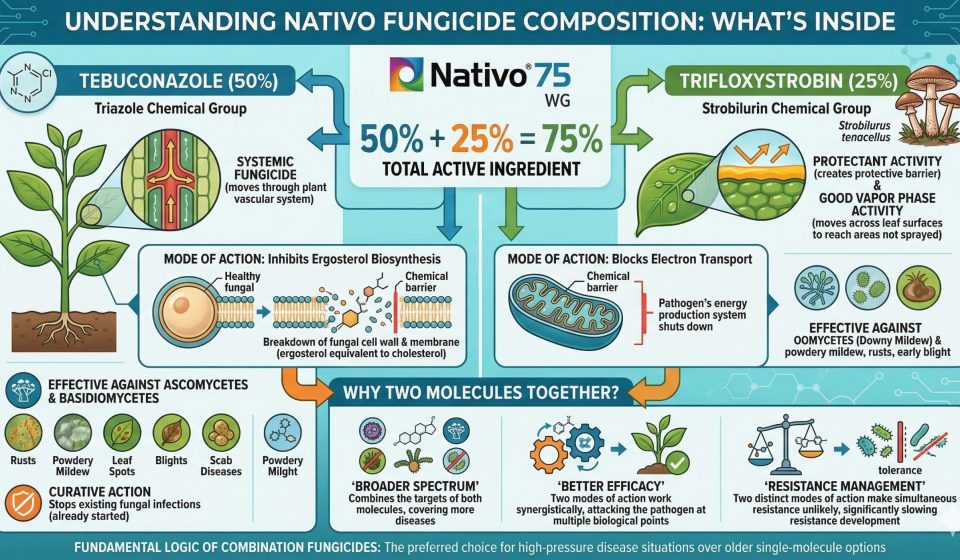
Nativo is a premium fungicide manufactured by Bayer CropScience. It’s what’s called a combination fungicide — meaning it contains not one but two active ingredients that work through different mechanisms. This dual-action approach is what makes Nativo stand apart from older single-molecule fungicides.
The full name you’ll see on the label is Nativo 75 WG — that WG stands for Water Dispersible Granule. It comes as a fine granular powder that dissolves readily in water when you mix it for spraying.
Nativo is registered for use across a wide range of crops in India and is one of the more trusted fungicide names among progressive farmers, particularly those growing high-value crops like grapes, vegetables, and fruits where fungal diseases can cause devastating losses within days.
Nativo Fungicide Composition: What’s Inside
This is where it gets interesting. Nativo 75 WG contains two active ingredients:
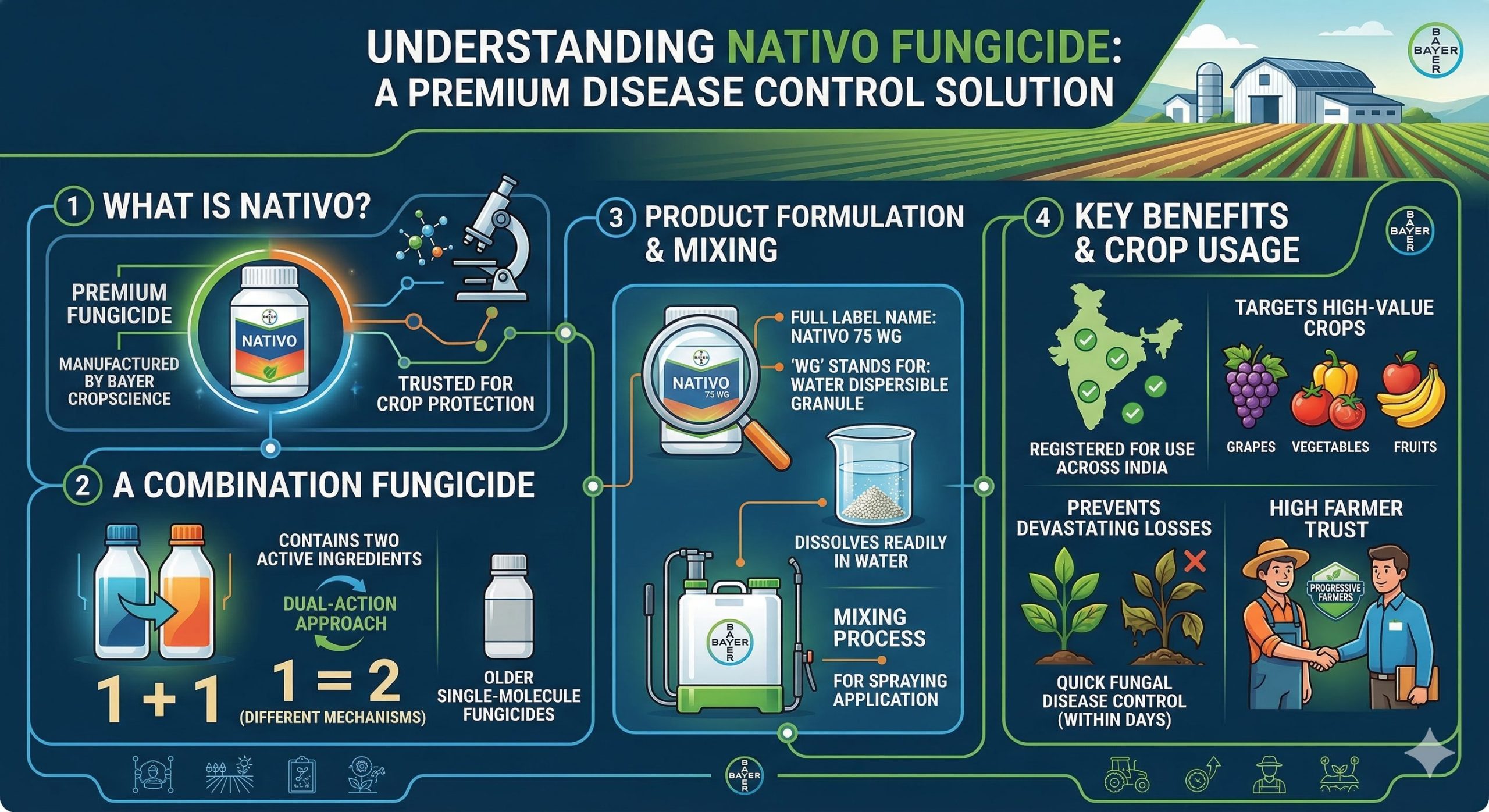
Tebuconazole 50% + Trifloxystrobin 25%
Total active ingredient: 75% (which is what that “75” in Nativo 75 WG refers to)
Let’s understand each one because they’re doing very different jobs.
Tebuconazole (50%)
Tebuconazole belongs to the Triazole chemical group. It’s a systemic fungicide — meaning it gets absorbed into the plant and moves through the vascular system to protect tissue that wasn’t directly sprayed. It works by inhibiting ergosterol biosynthesis in fungal cells. Ergosterol is essentially the structural equivalent of cholesterol in fungal cell membranes — without it, the fungal cell wall breaks down, and the organism dies.
Tebuconazole is particularly effective against fungi in the Ascomycetes and Basidiomycetes groups, which include many of the most economically damaging plant pathogens: rusts, powdery mildew, leaf spots, blights, and scab diseases.
It also has some curative action — meaning it can stop a fungal infection that has already started, not just prevent new ones. This is important because by the time you see disease symptoms, infection has usually been underway for days already.
Trifloxystrobin (25%)
Trifloxystrobin belongs to the Strobilurin chemical group — named after a naturally occurring fungicidal compound found in forest mushrooms (Strobilurus tenacellus, if you want to impress someone at a farmers’ meeting). It works by blocking electron transport in fungal mitochondria — essentially shutting down the pathogen’s energy production system.
Trifloxystrobin has excellent protectant activity — it creates a protective barrier on the plant surface before infection occurs. It also has good vapor phase activity, meaning it can move in the gas phase across short distances on leaf surfaces, reaching spots that weren’t directly sprayed.
Crucially, Trifloxystrobin works against a different set of fungal targets than Tebuconazole — it’s particularly strong against Oomycetes like downy mildew, and also excellent against powdery mildew, rusts, and early blight.
Why Two Molecules Together?
When you combine a Triazole (curative) with a Strobilurin (protectant + curative), you get:
Broader spectrum — the combination covers more diseases than either molecule alone.
Better efficacy — the two modes of action work synergistically, each attacking the pathogen at a different biological point.
Resistance management — a fungal population that might be tolerant to one mode of action is unlikely to simultaneously tolerate a completely different one. Using both together slows resistance development significantly.
This is the fundamental logic of combination fungicides and why products like Nativo have become preferred over older single-molecule options for high-pressure disease situations.
How Does Nativo Work in the Plant?
When you spray Nativo on your crop, two things happen almost simultaneously.
The Trifloxystrobin gets to work on the leaf surface immediately — creating a protective film that prevents new fungal spores from germinating and penetrating the leaf tissue. It’s the shield.
Meanwhile, both molecules start being absorbed into the leaf tissue and moving systemically through the plant. The Tebuconazole in particular moves in the xylem (the plant’s water-conducting vessels), distributing upward through the plant to protect new growth that emerged after spraying.
If there’s already an early infection underway — spores have germinated but visible symptoms haven’t appeared yet — the curative components get to work stopping fungal growth and sporulation before the disease spreads further.
The result is what’s called “top-to-bottom” and “inside-out” protection — which is how Bayer’s literature describes it, and it’s actually an accurate description of what the chemistry does.
Residual protection from a single Nativo application typically lasts 10 to 14 days under moderate disease pressure. In high-humidity monsoon conditions with intense disease pressure, repeat applications every 10 days are often necessary.
What Diseases Does Nativo Control?
This is the practical core of everything. Let me go crop by crop.
Powdery Mildew
Probably Nativo’s most universally applicable use. Powdery mildew appears as white powdery patches on leaves, stems, and sometimes fruit. It thrives in conditions of high humidity with dry leaf surfaces — which sounds contradictory but is accurate. Grapes, vegetables, cucurbits, wheat, mango — almost every crop is susceptible to some form of powdery mildew.
Nativo controls powdery mildew on virtually all susceptible crops. Both active ingredients contribute — Trifloxystrobin prevents new infections, Tebuconazole curatively stops existing ones.
Downy Mildew
The disease that destroyed part of my vineyard. Downy mildew is caused by Oomycete pathogens — technically not true fungi but managed with fungicides. It thrives in cool, humid, wet conditions. Grape downy mildew (Plasmopara viticola) is one of the most serious disease threats in Indian viticulture. Vegetable downy mildews affect cucumbers, onions, and leafy crops.
Trifloxystrobin’s activity against Oomycetes makes Nativo effective here, though for very severe downy mildew pressure, some farmers add a dedicated Oomycete fungicide (like Metalaxyl or Dimethomorph) alongside Nativo.
Early Blight and Late Blight
Early blight (Alternaria) affects tomato, potato, and many vegetables. Late blight (Phytophthora) is the potato and tomato farmer’s nightmare — the disease that caused the Irish Potato Famine historically. Nativo provides good control of early blight. For late blight, it’s effective but works best as part of a rotation with dedicated late blight fungicides.
Anthracnose
A common post-harvest disease of mango, grapes, and various vegetables. Dark, sunken lesions on fruit. Caused by Colletotrichum species. Nativo’s Tebuconazole component is effective against Colletotrichum.
Rust Diseases
Rust fungi are obligate parasites that produce orange-red pustules on leaves. Wheat rust is one of India’s most serious cereal disease threats. Coffee rust has devastated plantations globally. Nativo is highly effective against rust diseases — both active ingredients contribute, but Tebuconazole’s Triazole chemistry is particularly strong here.
Leaf Spot Diseases
Various Cercospora, Alternaria, and Septoria leaf spots across crops, including groundnut, sugarcane, vegetables, and cereals. Nativo controls most of the important leaf spot pathogens.
Scab
Apple scab (Venturia inaequalis) and mango scab. Tebuconazole’s activity against Ascomycetes covers scab pathogens well.
Sheath Blight in Rice
One of rice’s most economically important diseases in humid tropical conditions. Caused by Rhizoctonia solani. Nativo’s systemic components provide good control.
Nativo Fungicide Uses: Crop-by-Crop Application Guide
Grapes
Grapes are probably the crop where Nativo has made the biggest impact in India, particularly in Maharashtra’s Nashik and Sangli districts and Karnataka’s Vijayapura belt.
Target diseases: Downy mildew, powdery mildew, anthracnose, and bunch rot.
Dose: 0.4 to 0.5 grams per liter of water. Per acre, approximately 80 to 100 grams in 200 liters of water.
Timing: Begin preventive sprays before disease appears, ideally at the first sign of high humidity or rain. Don’t wait for symptoms — by then you’re already fighting a rearguard action. Apply at berry formation, bunch closure, and pre-veraison stages, particularly.
Practical tip: Ensure thorough coverage of bunch surfaces, not just leaves. Botrytis and anthracnose enter through the berries themselves.
Vegetables (Tomato, Chilli, Cucumber, Capsicum)
Target diseases: Early blight, late blight (tomato), powdery mildew, downy mildew (cucumber), anthracnose, and leaf spots.
Dose: 0.4 grams per liter of water. Per acre, 80 grams in 200 liters.
Timing: Begin at the first sign of disease or during high-risk weather (prolonged humidity, frequent rainfall). Repeat every 10 to 14 days.
Pre-harvest interval: Observe the PHI of 3 days for vegetables before harvest. This is important especially for fast-cycling crops.
Wheat
Target diseases: Rust (yellow, brown, and black rust), powdery mildew, loose smut, and Karnal bunt.
Dose: 200 grams per acre in 100 to 150 liters of water.
Timing: Flag leaf stage (Zadoks GS 37-39) is the critical spray timing for rust control in wheat. A second spray at heading (GS 55-59) may be warranted in high disease years.
Important: Nativo’s effect on wheat grain filling is a bonus — Tebuconazole has documented plant growth regulatory effects in cereals that improve chlorophyll retention and extend grain filling period. Many wheat farmers report improved thousand-grain weight with Nativo sprays. This is called the “greening effect” and it’s a genuine agronomic benefit beyond just disease control.
Rice
Target diseases: Sheath blight, blast (partial control), brown spot, and false smut.
Dose: 200 grams per acre in 150 to 200 liters of water.
Timing: Sheath blight — apply at tillering when disease first appears. False smut — apply at booting stage (just before panicle emergence).
Mango
Target diseases: Powdery mildew (critical at flowering), anthracnose, and scab.
Dose: 0.4 grams per liter for foliar spray.
Timing: Powdery mildew management is most critical at panicle emergence and flowering. Apply preventively — once powdery mildew covers mango panicles, fruit set is severely compromised.
Important: Avoid spraying during full bloom when pollinators are active on flowers.
Potato
Target diseases: Early blight, late blight, and black scurf (Rhizoctonia).
Dose: 0.4 grams per liter. Per acre, 80 grams in 200 liters.
Timing: Begin sprays 3 to 4 weeks after emergence, before disease appears. Potato late blight can advance from first symptoms to complete crop destruction in 10 to 14 days under favorable conditions. Preventive timing is non-negotiable.
Groundnut
Target diseases: Tikka disease (early and late leaf spot), rust, and collar rot.
Dose: 0.4 grams per liter. Per acre, 80 grams in 200 liters.
Timing: First spray at 30 to 35 days after sowing. Second spray at 50 to 55 days. Third spray if disease pressure continues.
Banana
Target diseases: Sigatoka leaf spot (both yellow and black Sigatoka).
Dose: 0.4 grams per liter in 200 to 250 liters per acre.
Timing: Begin when leaf spot index reaches threshold. In commercial banana plantations, spray programs are intensive — Nativo is typically rotated with other fungicide groups.
Nativo Dose Chart: Quick Reference
| Crop | Target Disease | Dose (per acre) | Water Volume |
|---|---|---|---|
| Grapes | Downy/Powdery Mildew | 80–100 g | 200 L |
| Tomato/Vegetables | Early Blight, Powdery Mildew | 80 g | 200 L |
| Wheat | Rust, Powdery Mildew | 200 g | 100–150 L |
| Rice | Sheath Blight, Brown Spot | 200 g | 150–200 L |
| Mango | Powdery Mildew, Anthracnose | 0.4 g/L | As needed |
| Potato | Early/Late Blight | 80 g | 200 L |
| Groundnut | Tikka, Rust | 80 g | 200 L |
| Banana | Sigatoka | 0.4 g/L | 200–250 L |
How to Use Nativo: Step-by-Step
Step 1 — Identify the disease first. Nativo is broad-spectrum but not everything. Bacterial diseases, viral diseases, and nematode problems won’t respond to any fungicide. Confirm you’re dealing with a fungal disease before spending on Nativo.
Step 2 — Check weather before spraying. Don’t spray if rain is expected within 4 to 6 hours. Nativo needs time to be absorbed before rainfall washes it off. Ideal spraying conditions are calm, dry mornings or evenings.
Step 3 — Measure accurately. Nativo comes as a fine granular powder. Use a proper gram scale or the measuring spoon that sometimes comes with the pack. Don’t estimate by eye — 0.4 grams per liter versus 0.8 grams per liter is a significant difference.
Step 4 — Mix correctly. Fill your spray tank one-third with water. Add the measured Nativo while stirring or agitating. Top up to the required volume and mix thoroughly. Nativo 75 WG disperses readily — you shouldn’t see clumps if water temperature is normal.
Step 5 — Spray thoroughly. Cover upper and lower leaf surfaces. Nativo has some vapor activity but thorough coverage still gives the best results. For grapes and dense vegetable canopies, adjust your nozzle pressure and angle to penetrate the canopy.
Step 6 — Time your spray correctly. Early morning is best. Leaf surfaces are typically dry from overnight temperatures, humidity is lower, and wind is usually calm. Avoid peak afternoon heat — spray droplets evaporate too quickly and the product doesn’t have enough time to be absorbed.
Step 7 — Wear proper protection. Gloves, mask, and eye protection. Wash exposed skin thoroughly after spraying. Change clothes before going indoors.
Nativo Price: What You Should Expect to Pay
As of 2024-25 market rates:
Nativo 75 WG:
- 40 grams: approximately ₹220 to ₹270
- 80 grams: approximately ₹400 to ₹480
- 200 grams: approximately ₹900 to ₹1,100
- 500 grams: approximately ₹2,000 to ₹2,500
Nativo sits in the premium fungicide price range — it’s not cheap. Per acre cost for a single application runs ₹400 to ₹1,100 depending on crop and dose. For high-value crops like grapes, this cost is easily justified by the protection it provides. For lower-margin crops, cost-benefit analysis is important.
Generic combinations of Tebuconazole + Trifloxystrobin are available from various manufacturers at lower price points. The chemistry is the same but formulation quality varies.
Always buy from an authorized Bayer dealer. Verify the hologram and batch number. Counterfeit fungicides are unfortunately common and a fake product will cost you far more than the price of the genuine article.
Resistance Management: Using Nativo Wisely
Strobilurin resistance — particularly in powdery mildew pathogens — is a documented global problem. Trifloxystrobin belongs to the Strobilurin group (FRAC Group 11), which has seen resistance develop in several pathogens worldwide. Tebuconazole belongs to the Triazole group (FRAC Group 3), which also has documented resistance issues in some regions.
Using Nativo responsibly means:
Limit applications to 2 per season maximum. Don’t use Nativo every spray in a season-long program. Use it at critical disease windows and rotate with other fungicide groups between applications.
Rotate with different FRAC groups. After a Nativo spray, switch to a product with a completely different mode of action — Mancozeb (FRAC M3), Cymoxanil (FRAC 27), Metalaxyl (FRAC 4), or Copper-based products. Different chemistry, different target in the fungal cell.
Never reduce the dose. Under-dosing is one of the fastest ways to select for resistant survivors. Use the full recommended rate.
Monitor for reduced efficacy. If you’re following correct protocols and disease is breaking through faster than expected, resistance may be developing in your local pathogen population. Consult your agronomist immediately and switch to unrelated chemistry.
Common Mistakes Farmers Make With Nativo
Mistake 1: Waiting for heavy disease before spraying. By the time you see widespread symptoms, infection was underway 5 to 10 days ago and the pathogen has already sporulated and spread. Nativo has curative activity but it’s not a miracle cure for advanced disease. Apply preventively or at first symptom appearance.
Mistake 2: Using Nativo for bacterial diseases. Bacterial leaf spot, bacterial wilt, fire blight — Nativo has zero effect on these. Fungicides don’t kill bacteria. Know what you’re treating.
Mistake 3: Not rotating chemistries. Using Nativo spray after spray builds resistance pressure. The combination formula helps, but it’s not a substitute for rotating between different FRAC groups.
Mistake 4: Spraying before rain. If the product washes off before being absorbed, you’ve wasted your money and left your crop unprotected at a high-risk moment.
Mistake 5: Poor spray coverage. Nativo applied to the top of the canopy when disease is starting on lower leaves and inner canopy doesn’t help much. Adjust your spray technique for thorough penetration.
Mistake 6: Ignoring the pre-harvest interval. For vegetables the PHI is 3 days. Respect it. Residue violations are a serious issue for farmers supplying supermarkets, exporters, or organized buyers.
Mistake 7: Storing opened packages improperly. Nativo’s WG formulation absorbs moisture if exposed to air and can clump. Seal opened packages tightly in a dry location.
What to Use When Nativo Isn’t the Right Choice
For bacterial diseases: Copper oxychloride, Streptomycin sulfate, Kasugamycin.
For Phytophthora/late blight (when more specific control is needed): Metalaxyl + Mancozeb (Ridomil Gold), Cymoxanil + Mancozeb (Curzate), Dimethomorph.
For Botrytis (grey mold) under high pressure: Cyprodinil + Fludioxonil (Switch), Iprodione.
For Fusarium wilt (soil-borne): Soil drenches with Carbendazim, Thiophanate Methyl, or biological agents like Trichoderma.
For budget-sensitive applications: Mancozeb, Copper fungicides, and Zineb remain cost-effective protectant options for lower-value crops or preventive programs where premium chemistry isn’t justified.
The Nativo Greening Effect: A Bonus Most Farmers Don’t Know About
This deserves its own section because it surprised me when I first learned about it.
Tebuconazole — one of Nativo’s active ingredients — has documented physiological effects on plants beyond just fungal control. In cereals particularly, Triazole fungicides including Tebuconazole have been shown to:
Slow senescence — the natural aging and yellowing of leaves slows down, keeping the crop photosynthetically active longer into grain filling.
Improve chlorophyll retention — leaves stay greener longer, especially flag leaves in wheat which are critical for grain filling.
Strengthen stems — some research shows Triazole applications result in slightly shorter, sturdier stems with reduced lodging risk in wheat.
This isn’t a marketing claim — it’s been documented in agronomic research across multiple countries. Wheat farmers who spray Nativo at flag leaf stage often see a visibly greener, more upright crop compared to untreated plots, even in seasons with low actual disease pressure. The yield benefit from improved grain filling can partially or fully offset the cost of the spray.
I’m not saying spray Nativo just for the greening effect. But knowing it exists helps you understand why Nativo timing recommendations in wheat are tied to growth stage rather than disease sighting.
Final Thoughts: The August That Taught Me About Timing
I got two more years of solid grape seasons after that difficult August. Both years I used Nativo preventively — starting before disease pressure built, rotating with copper-based and Mancozeb sprays between applications.
The vineyard that nearly broke me became one of my better performing blocks.
Not because Nativo is magic. It’s not. It’s a tool — a very good one, used correctly in the right situation. The real change was in my mindset. I stopped reacting to disease and started managing it. I stopped trusting habit (that old copper spray) and started understanding what the chemistry was actually doing.
Nativo works best when you understand it well enough to use it at the right moment, in the right crop, against the right disease, at the right dose, as part of a rotation — not as a panic response after half your crop is already symptomatic.
That’s the difference between a tool and a solution.
Nativo is a tool. You bring the solution.
Frequently Asked Questions: Nativo Fungicide
Q1. What is Nativo fungicide used for?
Nativo is a broad-spectrum systemic fungicide used to control a wide range of fungal diseases across many crops. Its primary targets include powdery mildew, downy mildew, rust diseases, early and late blight, anthracnose, leaf spots, sheath blight in rice, and scab in fruit crops. It’s particularly valued in high-value crops like grapes, vegetables, wheat, mango, potato, and groundnut where fungal diseases can cause devastating losses very quickly. The combination of two active ingredients — Tebuconazole and Trifloxystrobin — gives it both protective and curative action, meaning it works before disease appears and also stops infections that have already begun. It does not control bacterial diseases, viral diseases, or nematode problems — a mistake some farmers make when they see leaf symptoms without properly identifying the cause first.
Q2. What is the composition of Nativo 75 WG?
Nativo 75 WG contains two active ingredients — Tebuconazole 50% and Trifloxystrobin 25% — for a total active ingredient concentration of 75%, which is what the “75” in its name refers to. Tebuconazole is a Triazole fungicide (FRAC Group 3) that works by blocking ergosterol biosynthesis in fungal cell membranes — essentially breaking down the structural integrity of the fungal cell. Trifloxystrobin is a Strobilurin fungicide (FRAC Group 11) that shuts down fungal energy production by blocking electron transport in mitochondria. These two molecules attack the fungal pathogen at completely different biological points, which is why the combination is more effective and more resistant-management-friendly than using either molecule alone.
Q3. What is the dose of Nativo 75 WG per acre?
The dose varies by crop and target disease. For most vegetable crops, grapes, mango, and fruit crops, the standard dose is 0.4 to 0.5 grams per liter of water, which works out to approximately 80 to 100 grams per acre in 200 liters of water. For wheat and rice, the dose is higher — 200 grams per acre in 100 to 150 liters of water for wheat and 150 to 200 liters for rice. Always verify the dose on the product label for your specific crop because application rates are registered crop by crop and the label is the legal document that governs use. Never assume that the dose for grapes is the same as the dose for wheat — it isn’t, and getting it wrong wastes money at best and damages your crop at worst.
Q4. How often should I spray Nativo?
Under normal conditions, one Nativo application provides protection for 10 to 14 days. In high-humidity monsoon conditions with intense disease pressure — the kind of weather that drives powdery mildew and downy mildew explosions — repeat applications every 10 days may be necessary. However, and this is important, you should not use Nativo for every spray in your program. Limit Nativo applications to a maximum of 2 per season per crop and rotate with fungicides from different chemical groups between applications. Strobilurin resistance is a documented global problem and using the same mode of action spray after spray is the fastest way to make your most effective tools stop working. Use Nativo at the highest-risk disease windows and fill the rest of your program with different chemistry.
Q5. Can Nativo be used on flowering crops? Is it safe for bees?
This requires careful thought. Trifloxystrobin — one of Nativo’s active ingredients — belongs to the Strobilurin group which has documented toxicity to bees and beneficial insects at certain exposure levels. Spraying directly on open flowers where bees are actively foraging is not recommended. For crops like mango where powdery mildew management is critical precisely at flowering, the practical guidance is to spray during early morning or late evening when bee activity is lowest, to avoid spraying during peak flowering when flowers are fully open, and to never spray when you can see active bee foraging on the crop. For grapes and vegetables, timing sprays away from open flower stages is similarly advisable. This isn’t about avoiding Nativo entirely in flowering crops — it’s about timing applications responsibly to minimize pollinator exposure.
Q6. What is the pre-harvest interval for Nativo?
The pre-harvest interval varies by crop. For vegetables it is 3 days — stop spraying at least 3 days before harvest. For grapes it is 7 days. For wheat and rice, the PHI is built into growth-stage-based spray timing and harvest typically occurs well after the last recommended spray window. Always check the specific PHI on the product label for your crop because it varies and the regulatory requirement is crop-specific. PHI compliance matters enormously if you’re supplying to supermarkets, export buyers, or any buyer who tests for pesticide residues. Maximum Residue Limits for Tebuconazole and Trifloxystrobin are strictly enforced in export markets — European buyers in particular reject consignments for residue violations that Indian farmers sometimes don’t realize they’re committing.
Q7. Can Nativo control late blight in potato and tomato?
Nativo has activity against late blight caused by Phytophthora infestans but it is not the most specialized tool for this disease. Trifloxystrobin’s activity against Oomycetes gives Nativo some late blight suppression, but for high-pressure late blight situations — particularly in cool humid conditions when the disease can devastate a crop in 10 to 14 days — dedicated late blight fungicides like Metalaxyl + Mancozeb (Ridomil Gold), Cymoxanil + Mancozeb (Curzate), or Dimethomorph are more reliable choices. Many experienced vegetable farmers use Nativo as part of a rotation that includes these dedicated late blight products — Nativo for broad-spectrum control including early blight, then switching to a dedicated late blight product during peak late blight risk periods. This rotation approach gives better overall disease management than relying on any single product.
Q8. Why is Nativo more expensive than other fungicides? Is it worth the cost?
Nativo sits in the premium fungicide segment for two reasons — it’s a patented combination product from a multinational company, and the two active ingredients it contains are themselves higher-cost molecules compared to older chemistry like Mancozeb or Copper fungicides. Per acre application cost runs ₹400 to ₹1,100 depending on crop and dose. Whether it’s worth it depends entirely on what you’re growing and what disease you’re managing. For a grape farmer facing downy mildew in the monsoon, or a wheat farmer trying to protect against rust at flag leaf stage, the return on investment from Nativo is clearly positive — a single protected acre of grapes or wheat pays for the fungicide cost many times over. For lower-margin crops under low disease pressure, Mancozeb or Copper fungicides may be perfectly adequate and significantly cheaper. Evaluate cost against crop value and actual disease risk, not on price alone.
Q9. Can I mix Nativo with other pesticides in the same spray tank?
Nativo is generally compatible with many insecticides and fungicides and tank mixing is commonly practiced to reduce the number of spray passes. It mixes well with products like Lambda-cyhalothrin, Imidacloprid, Chlorpyrifos, and Mancozeb in most situations. However, avoid mixing with strongly alkaline products — both Tebuconazole and Trifloxystrobin can degrade in high pH conditions, reducing efficacy. Also avoid mixing with highly emulsifiable concentrates that can destabilize the WG formulation. The standard compatibility test applies — mix a small quantity of both products in water in a clear jar and observe for 30 minutes. If the mixture curdles, separates, or produces excessive foam, don’t use that combination. When in doubt, spray separately rather than risk losing both products to incompatibility. Always add Nativo to the tank before liquid formulations for best dispersion.
Q10. What is the difference between Nativo and Amistar (Azoxystrobin)?
Both are fungicides containing a Strobilurin active ingredient but they’re not the same product. Amistar contains Azoxystrobin as its sole active ingredient — a single-molecule Strobilurin. Nativo contains Trifloxystrobin plus Tebuconazole — a Strobilurin combined with a Triazole. The practical differences are meaningful. Nativo’s dual-mode-of-action makes it more effective against a broader range of diseases and better for resistance management. Amistar is a protectant-dominant product excellent for preventive programs. Nativo has both protectant and stronger curative activity from the Tebuconazole component. For a farmer choosing between them — Amistar works well in preventive spray programs where disease hasn’t appeared yet. Nativo is the better choice when you need both protection and curative action, or when disease pressure is already building. Rotating between products from different FRAC groups — which these two partially are — is good practice anyway.
Q11. Are there cheaper generic alternatives to Nativo with the same composition?
Yes. Several Indian agrochemical companies manufacture Tebuconazole + Trifloxystrobin combination fungicides at lower price points than Bayer’s Nativo. Products like Custodia (Adama), Achieve (UPL), and various other branded generics contain the same active ingredients at the same 50%+25% ratio. These generics are typically 20 to 35% cheaper than Nativo. The chemistry is identical but formulation quality — how well the granules disperse, how stable the combination is in the tank, how uniformly the active ingredients are distributed in the product — can vary between manufacturers. Many farmers use generics successfully. If you switch, buy from a reputable Indian agrochemical company with a track record, purchase from an authorized dealer, verify the active ingredient percentages on the label match what you expect, and do a small trial before treating your entire crop. A poor-quality generic that fails during a critical disease window costs far more than the money saved on product price.
Q12. Can Nativo be used as a seed treatment?
Tebuconazole — one of Nativo’s active ingredients — is widely used as a seed treatment fungicide in cereals, particularly for smut and bunt control in wheat and barley. However, Nativo 75 WG is registered for foliar application, not seed treatment. There are dedicated Tebuconazole-based seed treatment formulations (like Raxil from Bayer) that are specifically designed and registered for seed treatment use — they have different formulation characteristics that make them safe to apply directly to seeds without damaging germination. Using a foliar fungicide as a seed treatment is not recommended because the formulation, concentration, and surfactant package are different. If you need systemic fungal protection from germination, use a product specifically registered and formulated for seed treatment rather than adapting a foliar product for that purpose.
Questions about a specific crop or disease situation? Leave a comment below, and I’ll try to help.


