
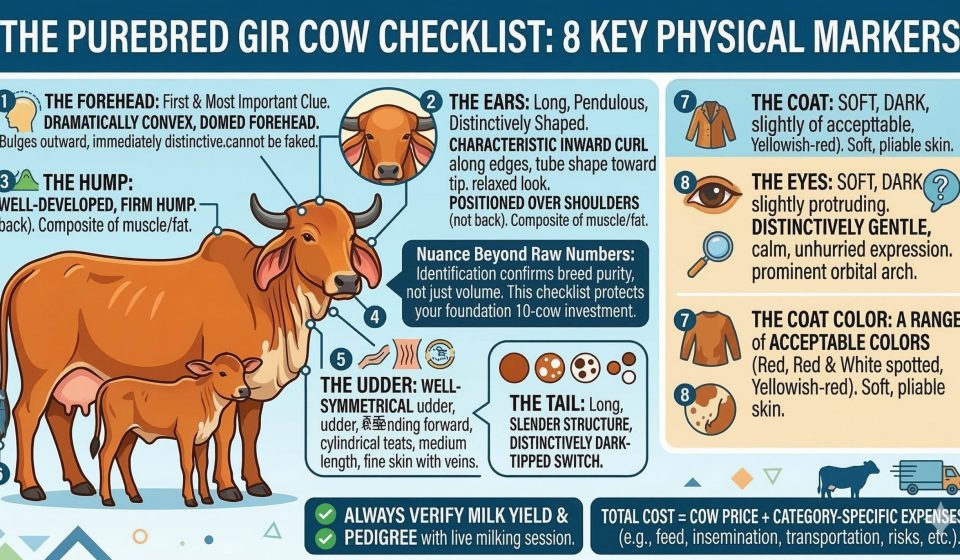
Gir Cow Identification 8 Step Guide How to Spot a Real One Before You Spend Your Money
I got cheated once.
Not badly. Not catastrophically. But enough to sting.
I paid ₹58,000 for what the seller confidently called a “pure Gir cow.” She had a reddish coat, a decent udder, and the seller had all the right words — A2 milk, indigenous breed, Saurashtra bloodline. I was excited. Drove three hours to pick her up. Brought her home feeling like I’d made a smart investment.
Two months later, a farmer friend from Junagadh visited my place. He walked up to her, looked at her for maybe thirty seconds, and then looked at me with that expression. You know the one. The one that says “brother, I have some news for you.”
“She’s a crossbred,” he said quietly. “Good animal. But not pure Gir.”
That visit changed how I approach every cattle purchase since then. I went from someone who trusted sellers and hoped for the best, to someone who knows exactly what to look for before a single rupee changes hands.
This Gir cow identification guide is everything I learned — from that mistake, from farmers who’ve spent decades with this breed, and from agricultural extension officers who’ve examined thousands of animals. Read it before you buy. Seriously.
Why Correct Identification Matters More Than You Think
Let’s be honest about what’s at stake.
A genuine purebred Gir cow produces A2 beta-casein milk — the kind that commands ₹70 to ₹120 per liter in premium markets. A crossbred might produce A1 or mixed protein milk that you can only sell at regular rates of ₹35 to ₹45 per liter. That difference, over a cow’s productive life of 8 to 10 years, is lakhs of rupees.
Beyond milk quality, purebred Gir cattle have better heat tolerance, stronger disease resistance, longer productive lives, and higher resale value than crossbreds. The gap between owning a genuine Gir and owning something that merely looks like one is enormous — financially, practically, and in terms of what you’re building for the long term.
The market knows this. Which is why unscrupulous sellers know it too.
As demand for Gir cattle has exploded over the last decade — driven by the A2 milk movement, urban health consciousness, and government promotion of indigenous breeds — so has the number of crossbreds being sold as purebreds. It’s not always malicious. Sometimes sellers genuinely don’t know their animal’s lineage. But whether the misrepresentation is intentional or innocent, you’re the one paying the price.
So let’s make sure you know what you’re looking at.
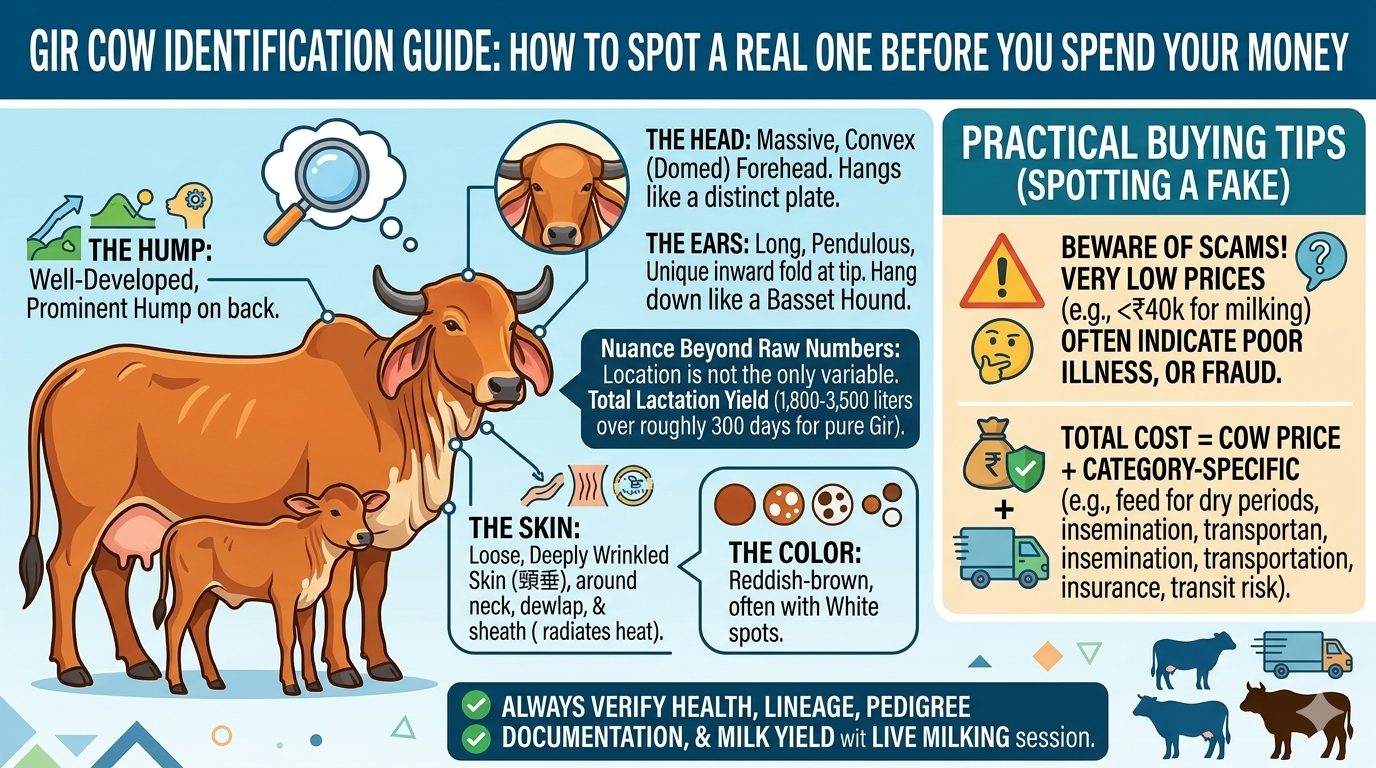
The 8 Key Physical Markers of a Purebred Gir Cow
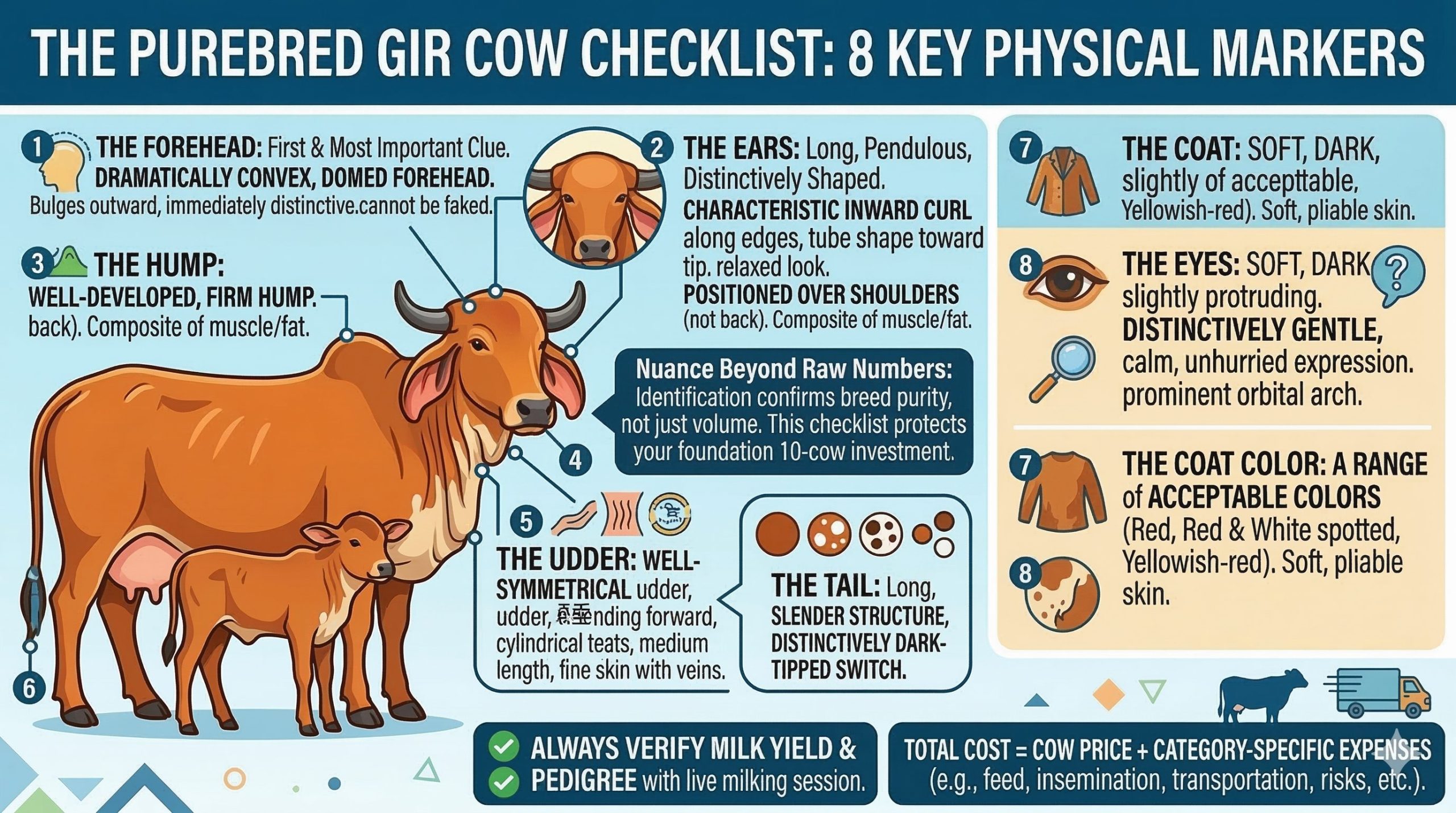
Think of these as a checklist. A genuine Gir cow should pass most of these. Not one or two — most of them. The more markers she has, the more confident you can be.
1. The Forehead — Your First and Most Important Clue
Stop here for a moment because this is the single most reliable identification marker of the Gir breed.
A purebred Gir cow has a dramatically convex, domed forehead. Not slightly curved. Actually domed — bulging outward between and above the eyes in a way that’s immediately visible and quite distinctive. When you look at her face straight on, the forehead protrudes noticeably. When you look at her profile, that dome is unmistakable.
No other Indian cattle breed has this feature so pronounced. Not Sahiwal. Not Red Sindhi. Not Tharparkar. Not any of the common crossbreeds you’ll encounter. This dome is Gir’s signature, and it cannot be faked.
If the forehead is flat — walk away. If it’s only mildly curved — be very cautious. A truly pure Gir has a forehead that makes you look twice.
I always start here. Always. Before I look at anything else.
2. The Ears — Long, Pendulous, and Distinctively Shaped
The Gir cow’s ears are extraordinary. Long — sometimes 40 to 45 centimeters — and pendulous, hanging down heavily on both sides of the face. But it’s not just the length. Look at the shape carefully.
A purebred Gir’s ears have a characteristic inward curl or fold along the edges, particularly toward the tip. Some farmers describe it as a slight tube shape — the ear doesn’t hang completely flat but curls slightly inward as it drops. The tip often points slightly forward or downward.
The ears are also covered in fine, soft hair on the inner surface and are quite mobile — a relaxed Gir cow will hold her ears low and slightly forward, giving her that characteristic gentle, almost sleepy expression.
Crossbreds often have ears that are long but lack that distinctive fold and curl. The shape matters as much as the length.
3. The Coat Color — A Range, Not a Single Shade
People often think Gir cows are always a specific shade of red. That’s not quite right.
The Gir breed actually comes in a range of acceptable colors:
Deep red to reddish-brown — the most classic and most common. Rich, warm, like a ripe pomegranate.
Spotted red and white — patches of red on white or white on red. Quite common in purebred Gir and actually a recognized characteristic of the breed.
Yellowish-red or golden-brown — less common but seen in purebreds, often with a warm golden undertone.
Almost white with red spots — seen occasionally, particularly in older cows.
What you won’t typically see in a purebred Gir: solid black, gray, or very dark brown. These colors suggest other genetics in the mix.
The skin itself is an important secondary indicator. Gir skin is loose, soft, and pliable — it should feel almost silky when you run your hand along her side. This looseness isn’t just cosmetic; it’s functional, helping the animal radiate heat. Tight, firm skin suggests crossbreeding with European breeds.
4. The Hump — Presence and Position
Like all Zebu cattle, the Gir has a hump. But knowing what to look for in the hump tells you more than just “yes it exists.”
In a purebred Gir cow, the hump is well-developed, firm, and positioned over the shoulders — not toward the middle of the back. It’s composed of muscular and fatty tissue, not just a skin fold. When you press it, it feels substantial — not soft and floppy like a poorly-developed hump on a crossbred.
In bulls, the hump is dramatically larger and more pronounced. In cows it’s more modest but still clearly present and well-defined.
A crossbred between Gir and a European breed (like HF or Jersey) will often have a reduced, softer, sometimes asymmetrical hump. A very flat back with almost no hump is a clear indicator of significant European genetics.
5. The Dewlap — Full, Flowing, and Functional
The dewlap is that fold of loose skin hanging from the throat and chest area. In purebred Gir cattle it is full, well-developed, and extends significantly from the throat down toward the chest.
Run your hand under it. It should feel loose and pendulous, not tight against the chest. In older cows the dewlap becomes more pronounced. In younger animals it’s still clearly visible but less dramatic.
This loose skin — dewlap, skin folds around the neck, loose skin over the ribs — is part of the Gir’s heat management system. Together with specialized sweat glands, it helps the animal stay cooler in extreme heat. A tight-skinned animal with a minimal dewlap has likely lost these adaptations through crossbreeding with European genetics.
6. The Eyes — Soft, Dark, and Distinctively Set
People don’t talk about Gir cow eyes enough in identification guides. They should.
A purebred Gir has large, dark, slightly protruding eyes with a distinctly gentle expression. The area around the eyes — the orbital arch — is slightly prominent, giving her face that characteristic soft but alert look. The eyelids are often darkly pigmented, almost like she’s wearing kohl.
There’s something almost meditative about the way a Gir cow looks at you. Calm. Unhurried. Farmers who’ve worked with the breed for years say you can tell a well-bred Gir by her eyes before anything else — there’s a quality of temperament visible in them.
This is subjective, of course. But combined with objective markers, the eyes contribute to a holistic picture of breed purity.
7. The Tail — Long, Fine, and Dark-Tipped
The Gir cow’s tail is long, reaching below the hocks, with a fine, slender structure. The tail switch — the tuft at the end — is typically dark or black, even in lighter-colored animals. This dark tail tip is a consistent marker across the breed.
A short, thick tail or a tail without the characteristic dark switch should make you look more carefully at other markers. It’s not a definitive disqualifier on its own, but it fits the pattern of crossbreeding when combined with other atypical features.
8. The Udder — Structure, Not Just Size
For a dairy animal, udder assessment is critical — both for identification purposes and for evaluating milk production potential.
A purebred Gir cow has a well-developed, symmetrical udder that extends well forward under the belly. The four quarters should be roughly equal in size. The teats should be cylindrical, of medium length, and evenly spaced — not bunched together or pointing outward at odd angles.
The skin of the udder should be fine and soft, often with visible veins running across it in a high-producing cow — those prominent veins indicate good blood supply and milk production capacity.
Importantly — udder size alone doesn’t confirm breed purity. A crossbred can have a large udder. Look at udder structure alongside all the other markers.
Beyond Physical Markers: Other Ways to Verify
Physical examination is essential but not always sufficient, especially for high-value purchases. Here are additional verification methods that experienced buyers use.
Watch the Milking Session
This is non-negotiable for any serious purchase. Visit the farm at milking time — morning is best — and watch the cow being milked from start to finish. Note:
The color of the milk. Genuine Gir cow milk has a natural yellowish-cream tint from higher beta-carotene content. It’s not stark white like commercial milk. If the milk looks completely white and watery, that’s a flag.
The consistency. Gir milk is noticeably thicker and creamier than commercial milk. Tilt the bucket slightly — it should coat the sides slowly, not run off instantly like water.
The volume. Does it match what the seller claimed? A cow the seller says gives 12 liters should visibly produce that amount. Bring a calibrated container if you want to be precise.
Her behavior during milking. A Gir cow that’s been handled well milks calmly. Extreme agitation, kicking, or trying to move away might indicate she’s not used to regular milking — or that she’s been given something to artificially stimulate milk flow for the demonstration.
Check the Calf
If the cow has a calf, examine the calf too. Calves are actually excellent indicators of breed purity because their features are often clearer and less masked by age or condition.
Look for the domed forehead on the calf — it should be visible even in young animals. Check ear shape. Look at the coat color and skin quality. A crossbred calf will often reveal genetic mix that’s less obvious in the mother.
Ask for the Sire Information
Any serious, reputable breeder knows who the father of each calf is. Ask directly — what bull was used, from which farm, is there any documentation?
Genuine Gir breeders are usually proud of their bull lineage. They’ll tell you about the sire’s production record, where he came from, his pedigree if available. Vague answers, deflection, or “I don’t remember” about the sire is a yellow flag.
Request Health and Breeding Records
Reputable farms maintain records — even informal handwritten ones. Ask to see:
- Calving dates and intervals
- Milk production records (daily or seasonal)
- Vaccination history
- Any significant health events
A farmer who can hand you a notebook with three or four years of records is a farmer who takes his animals seriously. That alone doesn’t guarantee breed purity, but it tells you about the seller’s credibility.
Consider a Veterinary Examination
For purchases above ₹80,000 — which is a significant portion of quality purebred Gir transactions — spending ₹500 to ₹1,500 on an independent veterinary examination is entirely reasonable. Ask a vet to assess breed characteristics, check for health issues, examine the udder for mastitis, and review the animal’s overall condition.
Some buyers feel awkward asking for this. Don’t. Any seller with a genuinely good animal will have no objection. Resistance to a vet examination is itself informative.
Common Crossbreeds Sold as Gir — What to Watch For
Knowing what impostors look like is just as important as knowing the real thing.
Gir × HF (Holstein-Friesian) Cross This is the most common misrepresentation. The cross often has a reddish coat that superficially resembles Gir, but the forehead is flat or only mildly curved, the body frame is larger and more angular (HF influence), the skin is tighter, and the hump is reduced or absent. The ears may be long but lack the characteristic Gir curl.
Gir × Jersey Cross Jersey crosses tend to be smaller and rounder. The coat often has a brownish tinge. Ears are shorter. The forehead is flat. The udder can be impressive (Jersey genetics) but the overall body structure doesn’t match purebred Gir characteristics.
Gir × Sahiwal or Red Sindhi Cross These are the trickiest to spot because all three are red-colored indigenous breeds. The key differentiator is still the forehead — Sahiwal and Red Sindhi have flat foreheads. If you’re looking at a reddish cow with long ears but a flat forehead, she’s likely not pure Gir.
A Practical Field Checklist
Take this with you when you go to buy.
Face and Head
- Forehead is clearly convex and domed — not flat
- Ears are long (40cm+), pendulous, with inward curl at edges
- Eyes are large, dark, softly protruding with dark eyelid pigmentation
- Overall facial expression is gentle and calm
Body
- Coat is reddish, red-and-white spotted, or golden-brown — not black or gray
- Skin is loose, pliable, and soft to the touch
- Dewlap is full and pendulous, hanging clearly from the throat
- Hump is well-developed, firm, and positioned over the shoulders
- Body frame is medium to large — not excessively angular
Tail and Legs
- Tail is long, reaching below hocks
- Tail switch is dark or black-tipped
- Legs are strong and straight — no obvious joint problems
Udder (for milking cows)
- Udder is symmetrical with four equal quarters
- Teats are cylindrical, medium length, evenly spaced
- Udder skin is fine and soft with visible veins in producers
- No heat, swelling, or hardness in any quarter (mastitis check)
Behavior
- Calm and cooperative during handling
- No extreme aggression or skittishness
- Normal eating and ruminating behavior observed
Documentation
- Seller can identify the sire
- Milk production records available (even informal)
- Vaccination history available
- Willing to allow milking observation
- No resistance to veterinary examination
What a Real Gir Cow Feels Like to Be Around
I want to end with something that doesn’t fit neatly into a checklist.
There’s an atmosphere around a genuine, well-bred Gir cow that experienced farmers recognize immediately. She moves slowly and deliberately. She doesn’t startle easily. When you approach her, she turns to look at you with those large calm eyes — curious but not anxious. She chews her cud with an unhurried rhythm that makes you slow down just watching her.
My farmer friend from Junagadh — the one who spotted my crossbred in thirty seconds — described it this way. He said, “A real Gir carries herself differently. She knows she belongs somewhere.”
That sounds poetic. But after years of being around both purebred Gir cattle and various crossbreeds, I understand exactly what he means. Breed character is real. You feel it as much as you see it.
The physical markers in this guide will get you 90% of the way there. That last 10% — the atmosphere, the presence, the way she holds herself — comes with experience.
So go to farms. Many farms. Look at animals you’re not even planning to buy. Ask experienced farmers to walk you through what they see. The more Gir cattle you observe, the sharper your eye becomes.
And the next time a seller shows you a “pure Gir” — you’ll know within thirty seconds whether he’s telling the truth.
Just like my friend from Junagadh.
Frequently Asked Questions: Gir Cow Identification Guide
Q1. What is the single most reliable way to identify a purebred Gir cow?
The forehead. Every experienced Gir farmer will tell you the same thing. That dramatically convex, domed forehead is the breed’s most distinctive and least fakeable feature. No common crossbreed or other Indian cattle breed has it in the same pronounced form. When you’re standing in front of a cow and that forehead visibly bulges outward — not slightly curved, actually domed — you’re looking at strong Gir genetics. Flat forehead means walk away, no matter what the seller says. Mildly curved means look very carefully at everything else before deciding. The dome is non-negotiable in a genuine purebred.
Q2. Can a purebred Gir cow have a white coat? I’ve only seen reddish ones.
Yes, white with red spots is an accepted coat variation in the Gir breed — you’ll see it occasionally, particularly in certain bloodlines. The breed standard allows for a range including deep red, red-and-white spotted, golden-brown, and yes, predominantly white animals with red patches. What matters more than coat color is the combination of other physical markers — the domed forehead, the pendulous curled ears, the loose skin, the well-developed hump. A white-coated animal with all those features present is more likely to be purebred than a deep-red animal with a flat forehead and tight skin. Never judge breed purity by coat color alone.
Q3. How do I tell the difference between a Gir cow and a Red Sindhi or Sahiwal cow? They all look reddish.
This is genuinely the trickiest identification challenge because all three are red-coated indigenous breeds. The forehead is your primary differentiator — Gir has that dramatic convex dome while Red Sindhi and Sahiwal both have flat or only mildly curved foreheads. Ear shape is your secondary check — Gir ears are longer and have that characteristic inward curl along the edges that Red Sindhi and Sahiwal ears don’t. Body size helps too — Gir is generally larger and heavier than Red Sindhi, which is a more compact animal. Sahiwal is blockier and rounder in build compared to Gir’s deeper chest and stronger frame. When in doubt, the forehead plus ear combination together will almost always distinguish a Gir from these other breeds.
Q4. I’m buying a Gir cow online without visiting the farm. How do I verify breed purity from photos and videos?
Honestly — you can’t do it reliably, and that’s the honest answer. Photos can be flattering, angles can hide flat foreheads, and lighting can make coat colors look different. That said, if you absolutely must make an initial assessment from media, ask the seller for specific things. A straight-on face video showing the forehead clearly. A profile shot showing the ear shape and length. A close-up of the ear tip showing the curl. A full body video walking the animal so you can assess the hump and overall build. Even with all of that, treat it as a preliminary screening only — never complete a significant purchase without physically visiting the farm or sending a trusted experienced person to inspect on your behalf. The cost of a train ticket to visit is trivial compared to the cost of buying the wrong animal.
Q5. The seller says his cow is “75% Gir” — is that worth buying?
It depends entirely on what you need her for. A 75% Gir cross — typically Gir bred back onto a Gir crossbred — will show many Gir physical characteristics and may produce A2 or mixed A1/A2 milk depending on the other breed in the mix. She’ll likely be more heat-tolerant and disease-resistant than a 50-50 cross. However she won’t have the full A2 milk guarantee of a purebred, won’t command the same resale value, and won’t pass consistent purebred characteristics to her calves. For a small farmer who just wants a hardy, decent-producing cow and isn’t building a premium A2 milk brand, a high-percentage Gir cross at a lower price point can be practical. For anyone building a serious A2 dairy business, only verified purebreds make sense. Know your goal before deciding.
Q6. What does Gir cow milk actually look like compared to regular milk? Can I use that to verify I’m getting genuine Gir milk?
Yes, visual inspection of fresh milk is a useful verification step. Genuine Gir cow milk has a natural yellowish-cream tint — not stark white — from higher beta-carotene content. It’s noticeably thicker and creamier than commercial milk. When you pour it into a clear glass and tilt it, it coats the sides slowly rather than running off quickly. Fresh Gir milk also has a distinctive natural aroma — slightly sweet and rich, nothing artificial about it. The cream rises quickly when the milk sits undisturbed. If the milk shown to you looks completely white, thin, and watery with no cream line forming — that’s not what you’d expect from a genuine high-fat Gir cow. Use this as a supplementary check during the milking observation, not as a standalone test.
Q7. How can I tell a Gir cow’s age just by looking at her?
Teeth are the most reliable aging method and it’s worth learning the basics. A cow with all baby teeth is under two years old. By age two to two-and-a-half, the central pair of permanent incisors comes in — larger and more rectangular than baby teeth. By three to three-and-a-half years, the second pair appears. The full set of eight permanent incisors is complete by around four to four-and-a-half years. After that, aging becomes less precise — you look at tooth wear, spacing, and the degree of gum recession. Beyond eight years, teeth show significant wear and may have gaps. A seller claiming a cow is four years old but showing fully worn, gapped teeth is misrepresenting her age. Learning to read teeth takes practice but even basic knowledge helps you catch obvious misrepresentations.
Q8. The cow I’m looking at has a good forehead and ears but seems very thin. Should I still buy her?
Thinness in a cow that otherwise has good breed characteristics deserves careful investigation before you dismiss or accept her. Some reasons for thinness are temporary and manageable — recent calving, transportation stress, a period of inadequate feed, or recovery from a minor illness. If the seller can explain the thinness with a convincing reason and the cow’s eyes are bright, her coat has some shine, she’s eating and ruminating normally, and a vet examination finds no underlying disease — a thin cow with good genetics can be a buying opportunity at a lower price. However, thinness combined with dull eyes, rough coat, lethargy, or abnormal droppings suggests health problems that may be serious and expensive to treat. Never buy a visibly unwell animal hoping she’ll recover. Get a vet opinion first, always.
Q9. Is there any government registration or certification system I can use to verify a purebred Gir cow?
Yes, though the system isn’t as widespread or consistently applied as it should be. The National Bureau of Animal Genetic Resources (NBAGR) in Karnal maintains breed registries for indigenous cattle including Gir. INAPH — the Information Network for Animal Productivity and Health — maintains production records for registered animals. Some progressive breeders, particularly in Gujarat, register their animals and can provide documentation linking a specific cow to her registered parents. The Gir Gaushala network and organizations like the Saurashtra Gir Breeders Association also maintain records for registered herds. In practice, most small farmers don’t have this documentation — but larger established breeders and government Goshalas often do. If a seller claims to have registered purebred animals, ask to see the registration paperwork and verify the ear tag number against the records. Don’t take the seller’s word alone.
Q10. My Gir cow calf doesn’t have a very prominent dome on its forehead. Does that mean she’s not purebred?
Not necessarily — the domed forehead in Gir cattle becomes more pronounced with age. In very young calves, particularly in the first few weeks of life, the dome may not be dramatically obvious yet. It develops and becomes more prominent as the skull grows. By three to four months old the characteristic shape should be clearly visible. By the time the animal is a year old it should be unmistakable in a purebred. So if you’re looking at a week-old calf and the forehead seems mild, don’t panic. Look at the mother’s forehead, check the ear shape on the calf (which is a more reliable early marker), and observe coat color and skin quality. If all those check out and the forehead is showing even early signs of the dome shape, you’re likely fine. Re-examine at three to four months to confirm.
Q11. How do I check for mastitis before buying a cow?
Mastitis is inflammation of the udder — often caused by bacterial infection — and it’s one of the most common and costly health problems in dairy cattle. Missing it at purchase time is an expensive mistake. Here’s a basic field check anyone can do. First, visually inspect all four quarters of the udder — they should be roughly equal in size with no visible swelling, redness, or hardness in any quarter. Then gently press each quarter from the base — the cow should not react with pain or try to kick. Strip a few streams of milk from each teat into a dark-colored container or onto a dark surface — healthy milk should be uniform, white to cream-colored, with no clots, strings, flakes, or blood. Watery milk with visible particles from any quarter indicates mastitis. For a more reliable test, ask the seller to do a California Mastitis Test — a simple strip test that any serious dairy farmer should have available. If they don’t have one or refuse to do the test, factor that into your decision.
Q12. I visited a farm and I’m still not sure if the cow is purebred. What should I do?
Trust your uncertainty. If you’ve gone through the physical markers, watched the milking, and you’re still not confident — that’s valuable information. Don’t let seller pressure, sunk cost of the visit, or excitement override genuine doubt. You have a few options. Bring an experienced Gir farmer with you on a second visit — someone who has worked with the breed for years and whose judgment you trust. This is probably the most practical solution and most experienced farmers are willing to help a genuine buyer. Alternatively, hire an independent vet or animal husbandry officer to conduct a formal breed assessment. Or simply walk away and keep looking. There are genuine purebred Gir cows available in the market. The right animal with the right seller will give you confidence, not confusion. Patience at the buying stage saves enormous heartache later.


