
Gir Cow vs Sahiwal Cow Which One Should You Actually Choose?
Let me start with a conversation, Gir Cow vs Sahiwal Cow, I had at a cattle fair in Rajasthan last year.
Two farmers were standing near the water trough, both eyeing the same pen of indigenous cattle. One was from Punjab, had been raising Sahiwal for fifteen years. The other was from Gujarat, who swore by his Gir cows like they were family members. I stood between them for about forty minutes, listening to what became a genuinely passionate debate.
The Punjab farmer said, “Sahiwal is the queen of Indian dairy. Calm, steady, reliable. Nothing beats her.”
The Gujarat farmer smiled and said, “Your queen hasn’t tasted Gir milk. Neither have your customers.”
Neither of them was wrong. That’s the thing.
Both Gir and Sahiwal are elite indigenous Indian cattle breeds. Both produce A2 milk. Both are heat-tolerant, disease-resistant, and far better suited to Indian conditions than any imported breed. But they are genuinely different animals — in origin, temperament, milk composition, body structure, and which farming situations they suit best.
This article is going to settle that debate properly. Not by declaring a winner — because honestly, there isn’t one — but by giving you enough real information to decide which breed fits your situation.
The Origin Story: Where They Come From
Understanding where a breed comes from tells you a lot about what it was built for.
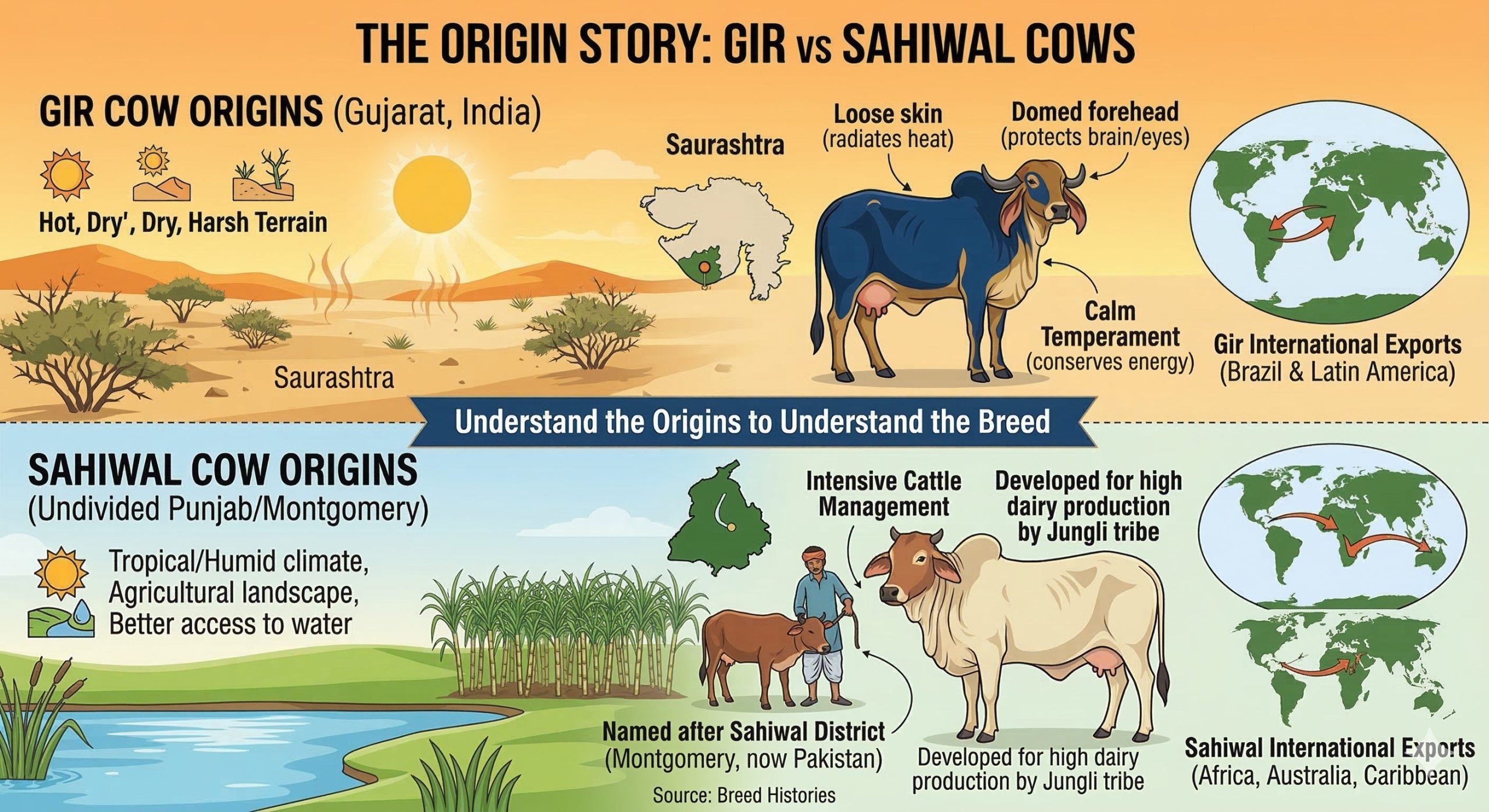
The Gir cow comes from the Gir forest region of Saurashtra, Gujarat. Hot, dry, sometimes harsh terrain. The breed developed over thousands of years in conditions where water wasn’t always abundant, temperatures regularly crossed 45°C, and the cattle had to be both productive and resilient. That environment shaped everything about her — the loose skin that radiates heat, the domed forehead, the calm temperament that conserves energy.
The Sahiwal cow comes from the Montgomery district of undivided Punjab — an area that today falls mostly in Pakistan, around the Sahiwal district (which is how she got her name). The climate there is different — still hot, but with a more agricultural landscape, better access to water, and a long tradition of intensive cattle management by the Jungli tribe who developed the breed specifically for dairy production.
Both breeds have been in their respective regions for centuries. Both have been exported internationally — Gir to Brazil and across Latin America, Sahiwal to Africa, Australia, and the Caribbean. When a breed gets exported to multiple continents and thrives there, that tells you something about its quality.
Physical Appearance: Spotting the Difference
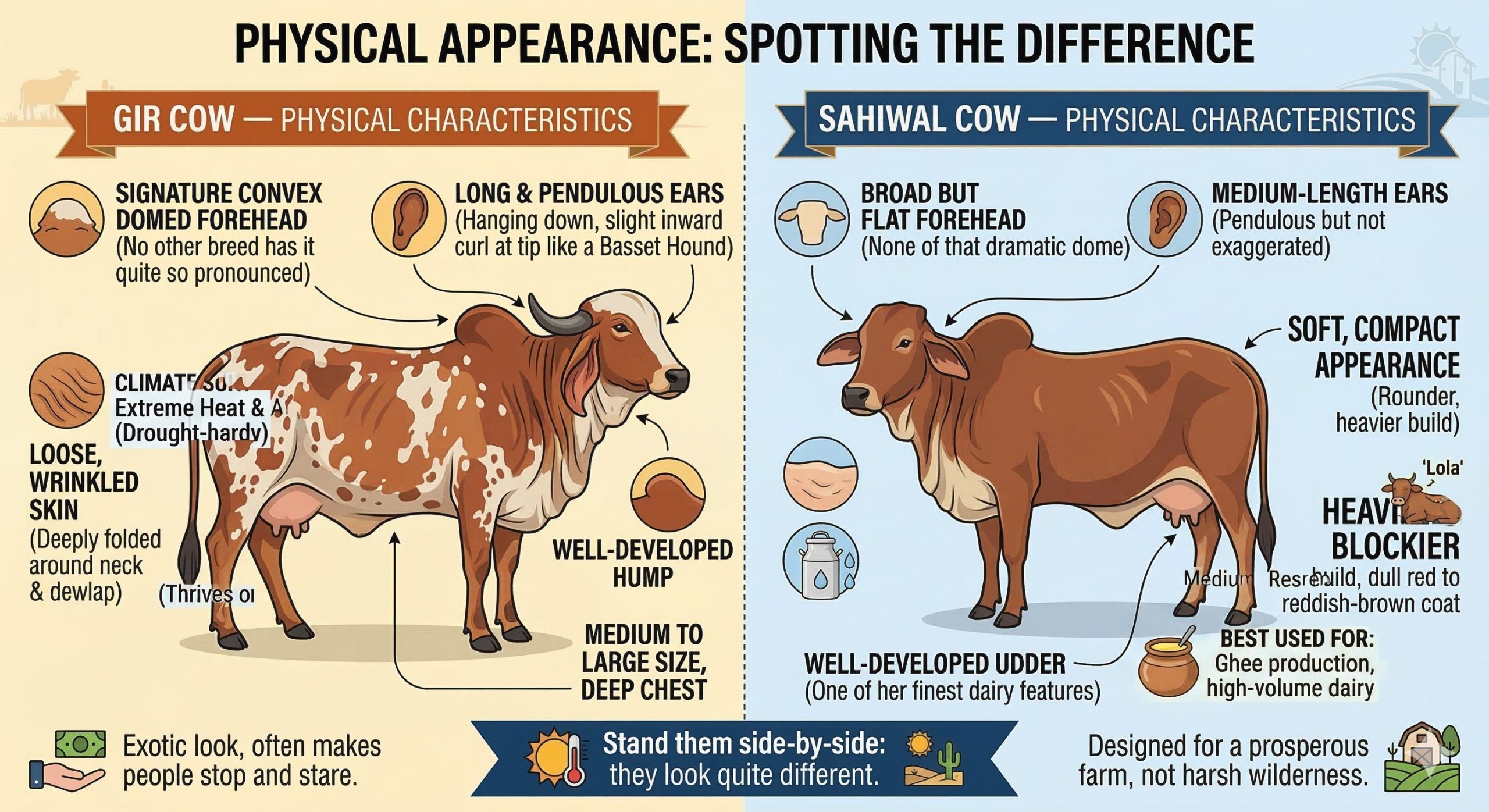
Stand them side by side, and you won’t confuse them. They look quite different.
Gir Cow — Physical Characteristics
The Gir is immediately recognizable. That convex, domed forehead is her signature — no other breed in India has it quite so pronounced. Her ears are long and pendulous, often with a slight inward curl at the tip, hanging down almost like a Basset Hound’s ears. The skin is loose and wrinkled around the neck and dewlap. Her coat ranges from red to spotted red-and-white, sometimes with a yellowish tinge. The hump on her back is well-developed. She’s medium to large in size, with a deep chest and strong legs built for walking terrain.
She looks, honestly, a little exotic. First-time visitors to a Gir farm often stop and stare.
Sahiwal Cow — Physical Characteristics
The Sahiwal is softer in appearance. Rounder. More compact. Her coat is typically reddish-brown to dull red, sometimes fading to almost buff or yellowish-brown. The skin is also loose but not as dramatically wrinkled as the Gir. Her forehead is broad but flat — none of that dramatic dome. The ears are medium-length, pendulous but not as exaggeratedly long as the Gir’s. Her build is heavier and blockier, with a well-developed udder that experienced farmers often point to as one of her finest features.
If the Gir looks like she’s been designed for a harsh wilderness, the Sahiwal looks like she was designed for a prosperous farm. Which, in a sense, is exactly right.
Milk Production: The Number Everyone Wants
This is where most people start the comparison. Fair enough. It’s a dairy operation after all.
Gir Cow Milk Production
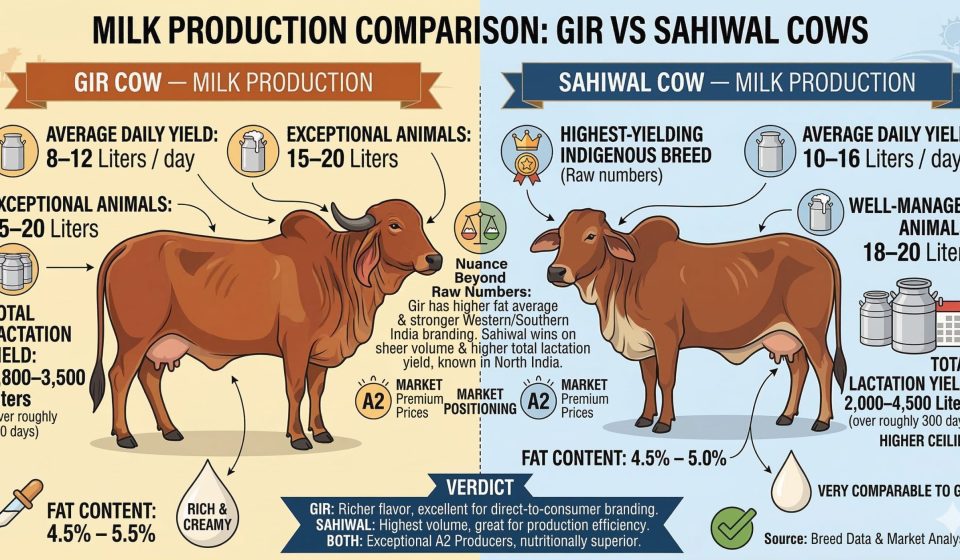
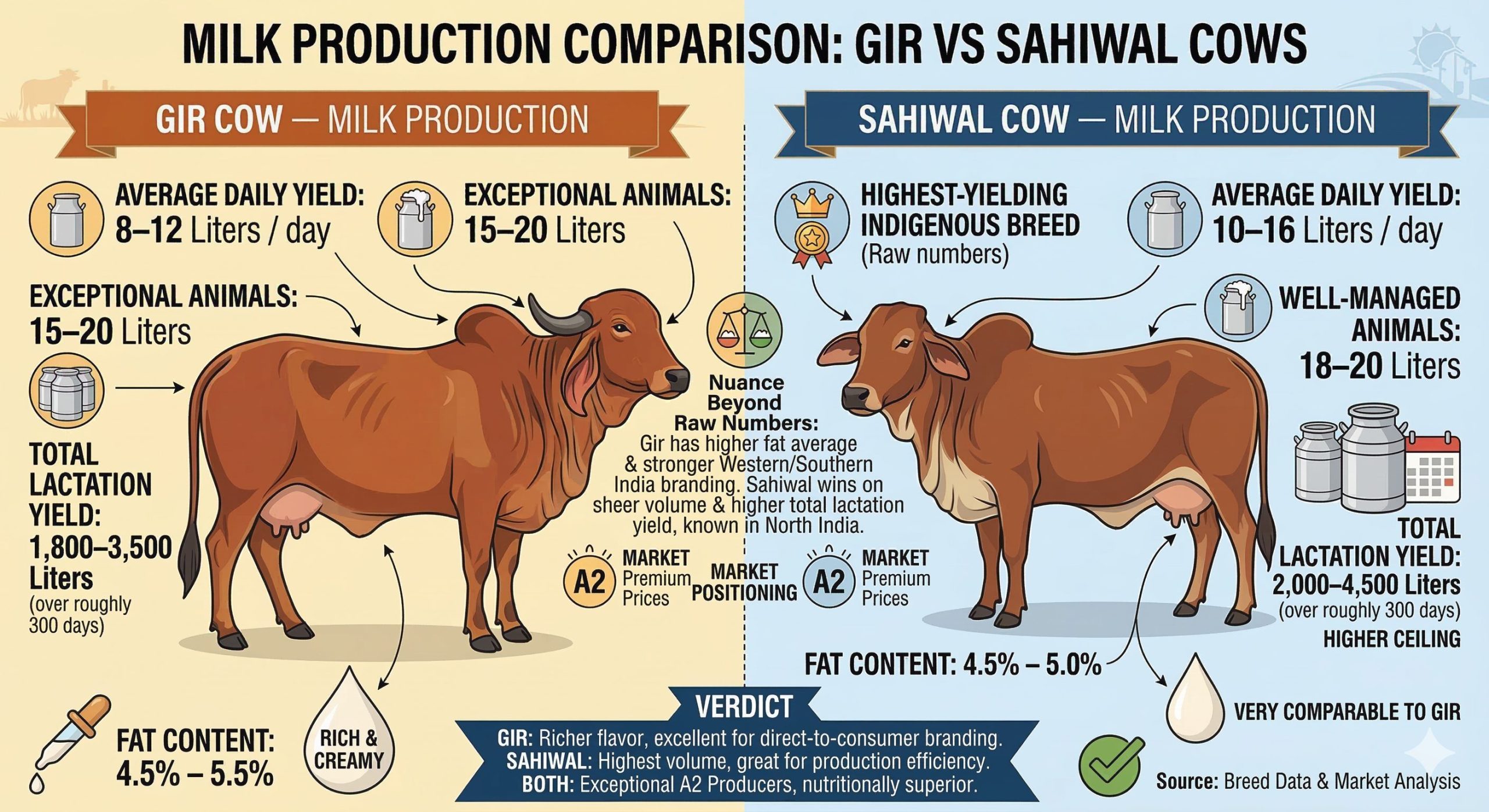
A good Gir cow produces 8 to 12 liters per day under standard farm conditions. Exceptional animals with strong pedigrees can hit 15 to 20 liters. Total lactation yield over roughly 300 days sits between 1,800 and 3,500 liters, depending on the individual animal and management quality.
Fat content: 4.5% to 5.5% — rich, creamy, noticeably thick.
Sahiwal Cow Milk Production
The Sahiwal is India’s highest-yielding indigenous breed by raw numbers. A good Sahiwal produces 10 to 16 liters per day. Well-managed animals regularly hit 18 to 20 liters. Total lactation yield ranges from 2,000 to 4,500 liters — higher ceiling than Gir in most documented cases.
Fat content: 4.5% to 5.0% — very comparable to Gir, slightly lower on average at the top end.
So Sahiwal wins on volume?
On paper, often yes. But here’s the nuance that raw numbers miss.
Gir milk has a slightly higher average fat percentage and tends to have more beta-carotene, giving it that characteristic yellowish tinge. Both are A2 milk. Both are nutritionally superior to commercial crossbred milk. In blind taste tests among consumers, Gir milk is often described as richer and more flavorful — which matters when you’re building a direct-to-consumer premium milk business.
In terms of market positioning, both command A2 premium prices. The Gir has slightly stronger brand recognition in western and southern India right now — partly because of aggressive marketing around “Gir cow A2 milk” over the last decade. Sahiwal is better known in northern India, particularly Punjab, Haryana, and UP.
Temperament: What It’s Actually Like to Work With Them
Numbers on paper don’t tell you what it feels like at 5 AM when you’re trying to milk a stressed cow.
Gir Cow Temperament
Gir cows are famously calm. Docile. Almost meditative in their manner. They move slowly, react quietly, and generally tolerate human handling very well. New farmers often comment that Gir cows seem almost instinctively cooperative.
One important nuance — Gir cows have a strong maternal bond. They can be protective of their calves in the first few days after calving. And they do better with milking when the calf is present or at least nearby — the calf’s presence stimulates better milk letdown in many Gir cows. Some farmers work with this naturally; others find it complicates their milking routine.
Sahiwal Cow Temperament
Sahiwal cows are also known for being gentle and easy to handle. Farmers in Punjab describe them as cooperative, patient, and low-stress to work with. They’re perhaps slightly more adaptable to intensive dairy management systems where the calf is separated earlier — a management style more common in commercial operations.
Both breeds are genuinely good-natured compared to exotic breeds or aggressive crossbreeds. If you’ve ever tried milking a stressed Holstein that kicks, you’ll appreciate just how pleasant both of these animals are.
Edge: Roughly equal. Gir has a slight edge in raw docility; Sahiwal adapts slightly better to more intensive commercial management styles.
Heat and Climate Tolerance
Gir Cow
Built for heat. Genuinely thrives in temperatures that would devastate European breeds. The loose skin, the developed sweat glands, the efficient metabolism — all of it is optimized for hot, dry conditions. She does very well across most of India, though extreme cold in high-altitude regions requires proper shelter.
Sahiwal Cow
Also highly heat-tolerant — she comes from a hot climate after all. But her tolerance is slightly more oriented toward hot-and-humid conditions compared to Gir’s hot-and-dry adaptation. Sahiwal performs excellently across the Indo-Gangetic plains — UP, Bihar, Punjab, Haryana — and does well in most of peninsular India too.
In extreme dry heat — Rajasthan, Kutch, parts of Maharashtra — Gir has a slight edge. In humid heat — coastal areas, eastern India — Sahiwal is equally comfortable.
Edge: Gir for extreme dry heat. Sahiwal for humid conditions. Both vastly superior to any exotic breed in Indian summer.
Disease Resistance
Both breeds carry the natural disease resistance advantages of indigenous Zebu cattle — better tick resistance, stronger immunity to tropical diseases, more efficient stress response compared to Bos taurus (European) breeds.
Gir cattle have a particularly strong reputation for resistance to tick-borne diseases, which is part of why Brazilian ranchers fell in love with them — the tick pressure in Brazil’s tropical zones is brutal, and Gir cattle handle it far better than European breeds.
Sahiwal also shows excellent disease resistance, with particular strength against trypanosomiasis — which is why she’s been extensively used in Africa where the disease is prevalent.
For Indian farming conditions, both breeds are similarly robust. Neither requires the intensive health management that crossbred or exotic cattle demand.
Edge: Effectively equal for Indian conditions. Both are significantly lower maintenance than HF or Jersey crossbreeds.
Body Weight and Size
Gir Cow: Adult females weigh 385 to 475 kg. Bulls 550 to 650 kg. Medium to large frame.
Sahiwal Cow: Adult females weigh 300 to 400 kg. Bulls 450 to 550 kg. Medium frame, more compact.
The Sahiwal is noticeably smaller and lighter than the Gir. This has practical implications. She eats slightly less — which means slightly lower feed costs. But she also produces less on average, so the feed efficiency works out roughly similarly when you calculate milk per kg of feed consumed.
For farmers with limited fodder resources, the Sahiwal’s smaller size can be an advantage. For farmers who also value the animal’s resale or beef value (in states where applicable), the larger Gir frame has an edge.
Lifespan and Productive Life
Gir Cow: 12 to 15 years lifespan. Productive milking life of 8 to 10 years. First calving around 36 to 40 months.
Sahiwal Cow: 12 to 14 years lifespan. Productive milking life of 8 to 10 years. First calving slightly earlier — around 32 to 36 months.
The Sahiwal reaches reproductive maturity somewhat earlier than the Gir. That means a slightly faster return on investment if you’re buying young heifers. The Gir takes her time growing up but then delivers a long, productive career.
Both are dramatically longer-lived and more productive over their lifetimes than high-intensity crossbreeds that often burn out by age 5 or 6.
Edge: Sahiwal for earlier first calving and faster initial ROI. Gir for comparable long-term productive life.
Price Comparison
Gir Cow Price: ₹40,000 to ₹1,50,000 depending on quality, age, location, and production record. Premium pedigreed animals can exceed this.
Sahiwal Cow Price: ₹35,000 to ₹1,20,000 for quality animals. Top pedigreed Sahiwal from registered farms can reach ₹1,50,000+.
On average, Gir cows command a slightly higher market price in most Indian states right now — partly driven by stronger consumer brand recognition around “Gir cow A2 milk” and partly because demand in western and southern India specifically pulls Gir prices up.
In Punjab and Haryana, the dynamic flips slightly — Sahiwal is more locally available, better understood, and sometimes more competitively priced for comparable quality.
Which States Suit Which Breed Better?
This is practical geography, not theory.
Gir Cow — Best suited for: Gujarat, Rajasthan, Maharashtra, Madhya Pradesh, Karnataka, Tamil Nadu, Andhra Pradesh, Telangana. Basically western, central, and southern India. Also increasingly popular in UP and Bihar.
Sahiwal Cow — Best suited for: Punjab, Haryana, Uttar Pradesh, Bihar, Uttarakhand, Himachal Pradesh, West Bengal. The Indo-Gangetic plains and northern India generally. Also does well in Madhya Pradesh and parts of Maharashtra.
There’s significant overlap in the middle of the country. In states like UP, MP, and Maharashtra, both breeds perform well and both have active markets.
Head-to-Head Comparison Table
| Parameter | Gir Cow | Sahiwal Cow |
|---|---|---|
| Origin | Gujarat, India | Punjab (undivided), India |
| Average Milk/Day | 8–12 liters | 10–16 liters |
| Peak Milk/Day | 15–20 liters | 18–22 liters |
| Milk Fat % | 4.5–5.5% | 4.5–5.0% |
| Milk Type | A2 | A2 |
| Body Weight (female) | 385–475 kg | 300–400 kg |
| Lifespan | 12–15 years | 12–14 years |
| First Calving Age | 36–40 months | 32–36 months |
| Temperament | Very docile | Docile |
| Heat Tolerance | Excellent | Excellent |
| Disease Resistance | Excellent | Excellent |
| Price Range | ₹40,000–₹1,50,000 | ₹35,000–₹1,20,000 |
| Best Climate | Dry heat | Humid/plains |
| Best Region | West, South India | North India |
| Feed Requirement | Moderate-High | Moderate |
| Brand Recognition | Very High | High (North India) |
The Real Question: Which One Is Right for You?
Here’s how I’d think through this decision.
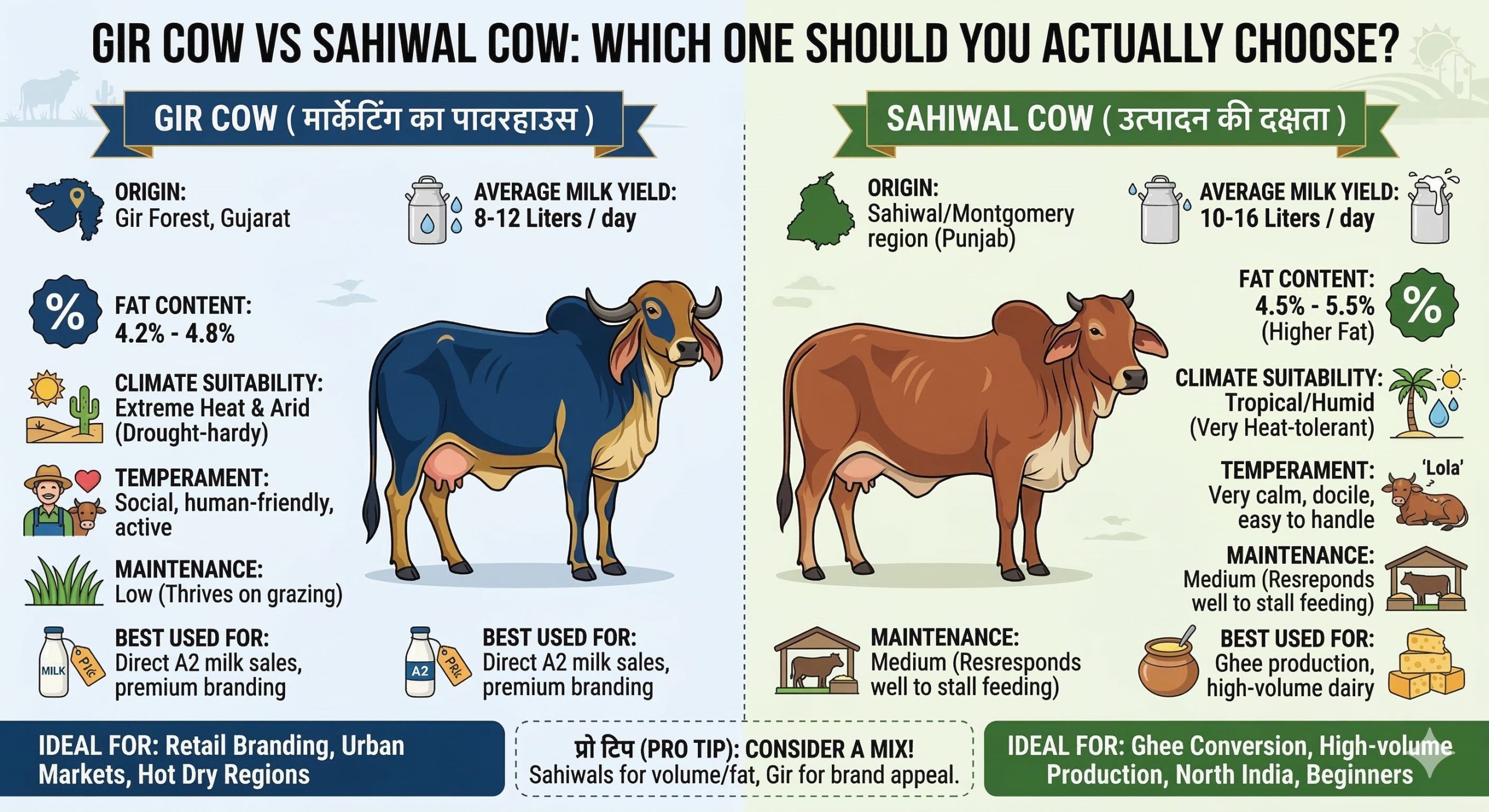
Choose Gir if: You’re in Gujarat, Rajasthan, Maharashtra, or South India. You’re building a premium A2 milk brand where “Gir cow milk” as a label carries marketing weight in your market. You want an animal with strong consumer recognition and are willing to pay slightly more upfront for that brand equity. You’re in a hot, dry region where Gir’s specific adaptations give her an edge.
Choose Sahiwal if: You’re in Punjab, Haryana, UP, Bihar, or the northern plains. You want slightly higher raw milk volume with comparable fat content. You prefer an animal that reaches first calving a few months earlier, giving you faster initial returns. Your market knows and values Sahiwal milk specifically.
Choose either if: You’re in the overlap zone — MP, eastern Maharashtra, UP — and both are equally available. In that case, visit farms for both breeds, compare animals at similar price points, and go with the one whose individual characteristics and seller transparency impress you more. A great Sahiwal beats a mediocre Gir any day, and vice versa.
What the Farmers Actually Say
I’ve asked this question to enough farmers across enough states to have a sense of the ground reality.
Farmers in Gujarat don’t think about this comparison much. Gir is home, Gir is default, Gir is identity. They’re not wrong to feel that way.
Farmers in Punjab feel exactly the same about Sahiwal. She’s theirs. They know her generations deep.
The farmers who have actually kept both breeds — and there are some, particularly in Maharashtra and MP — tend to say something interesting. The Sahiwal is slightly easier to manage commercially because she’s less particular about her calf during milking. The Gir produces richer milk and has stronger market appeal in urban premium segments. For a farm selling bulk to cooperatives, Sahiwal might be marginally more practical. For a farm doing direct A2 milk sales to health-conscious urban customers, Gir’s brand recognition gives a business edge.
That’s not a definitive answer. But it’s an honest one.
Final Word
Both the Gir and Sahiwal are magnificent animals. Both represent centuries of careful breeding by Indian farmers who knew exactly what they were doing. Both produce genuine A2 milk that’s nutritionally superior to what most urban Indians currently drink. Both will outlast and outperform crossbreeds in Indian conditions over a 10-year horizon.
The Punjab farmer at that cattle fair was right about his Sahiwal.
The Gujarat farmer was right about his Gir.
The real mistake would be choosing either of them poorly — buying a crossbred mislabeled as purebred, skimping on feed, ignoring health management, or failing to build a sales channel that captures the premium these animals deserve.
Buy well. Feed well. Sell smart.
The breed matters less than how you run the farm.
But between you and me — if I were farming in Gujarat, I’d have Gir. If I were farming in Punjab, I’d have Sahiwal.
And I’d sleep well either way.
Frequently Asked Questions: Gir Cow vs Sahiwal Cow
Q1. Which cow gives more milk — Gir or Sahiwal?
On average, the Sahiwal edges ahead on raw volume. A good Sahiwal regularly produces 10 to 16 liters per day while a good Gir typically sits at 8 to 12 liters. But here’s what that comparison misses — Gir milk has a slightly higher average fat percentage, which means more cream, more ghee yield, and arguably richer nutritional value per liter. If you’re selling bulk milk by volume to a cooperative at a flat rate, Sahiwal’s higher output is a real advantage. If you’re selling premium A2 milk directly to consumers at ₹70 to ₹100 per liter, the difference in daily liters matters less than the quality and brand story you’re selling. Calculate revenue per cow per month, not just liters per day.
Q2. Is Gir cow milk better than Sahiwal cow milk?
Both are genuine A2 milk — that’s the most important thing, and on that front they’re equal. The difference is in the details. Gir cow milk tends to have slightly higher fat content (4.5–5.5% vs Sahiwal’s 4.5–5.0%) and is often described as richer and creamier in taste. The yellowish tint in Gir milk from higher beta-carotene content is something consumers notice and often associate with quality. Sahiwal milk is also excellent — nutritious, full-fat, genuinely A2 — just slightly less dramatic in appearance and taste. For making bilona ghee specifically, many farmers prefer Gir milk because the higher fat translates to slightly better ghee yield. For everyday drinking and cooking, both are outstanding compared to commercial milk.
Q3. Which breed is better for beginners — Gir or Sahiwal?
Both are beginner-friendly compared to exotic breeds, but if I had to pick one for an absolute first-timer, I’d lean toward Sahiwal. She’s slightly more adaptable to varied management styles, reaches milking age a few months earlier, and is a bit less particular about the calf-presence-during-milking dynamic that some Gir cows have. That said, if you’re in Gujarat, Maharashtra, or South India where Gir is more locally available and breeders are more experienced, go with Gir — local availability and seller expertise matter more than breed-specific beginner friendliness. The breed you can get good support and mentorship for in your region is the better choice for a beginner, regardless of which one looks better on paper.
Q4. Can Sahiwal cows survive in hot climates like Rajasthan or Gujarat?
Yes, absolutely. Sahiwal is a Zebu breed with strong heat tolerance — she handles Indian summers far better than any HF or Jersey crossbreed. That said, she was developed in the Punjab plains which are hot but not as extreme-dry as Rajasthan’s Thar desert or Gujarat’s Kutch region. In those truly harsh dry-heat environments, Gir has a slight natural edge because she literally evolved there. For most of Rajasthan’s agricultural belt and most of Gujarat outside the extreme desert zones, Sahiwal manages perfectly well. Just ensure adequate shade, continuous fresh water, and electrolyte supplementation during peak summer months — same care you’d give any dairy animal in extreme heat.
Q5. Which breed produces better quality ghee — Gir or Sahiwal?
Gir has a slight edge here, and most farmers who’ve made ghee from both will tell you the same. The higher fat percentage in Gir milk means you get marginally more ghee per liter — roughly 50 to 55 grams per liter versus 45 to 50 grams from Sahiwal. Over 25 liters needed to make one kilogram of ghee, that difference adds up. Gir cow ghee also tends to have a deeper yellow color from higher beta-carotene, which consumers strongly associate with purity and quality — and which allows premium pricing. Both produce genuinely good ghee that’s vastly superior to commercial ghee. But if ghee production is your primary business focus rather than fresh milk sales, Gir milk gives you a slightly stronger product to market.
Q6. Which cow is cheaper to maintain — Gir or Sahiwal?
Sahiwal has a modest advantage here simply because of her smaller body size. A Sahiwal cow weighing 320 to 380 kg needs slightly less total fodder than a Gir cow weighing 420 to 470 kg. The difference isn’t dramatic — maybe ₹3,000 to ₹5,000 per month per cow in feed costs depending on your fodder sourcing. For a 10-cow operation that gap becomes more meaningful. However, if the Sahiwal is producing more milk, the feed-to-milk-output ratio may actually be similar or even favor Sahiwal. The honest answer is that both breeds are far more economical to maintain than HF crossbreeds, and the difference between Gir and Sahiwal maintenance costs is small enough that it shouldn’t be the deciding factor in your breed choice.
Q7. Which breed has better resale value in India?
Right now, Gir has stronger resale value in most Indian markets outside the northern plains — driven largely by the premium A2 milk brand narrative that’s been built around Gir cows specifically in western and southern India. A quality Gir cow purchased for ₹80,000 today can reasonably resell for ₹90,000 to ₹1,10,000 in two years in Maharashtra or Karnataka as demand continues growing. In Punjab and Haryana, Sahiwal holds its value well in local markets. The broader national trend currently favors Gir’s brand recognition, but Sahiwal’s resale fundamentals are equally sound in its home region. Both breeds appreciate in value over time rather than depreciate — unlike crossbreeds whose value often drops with age. That asset appreciation is one of the genuine financial advantages of indigenous breeds that most farmers underestimate.
Q8. Is Sahiwal cow milk also A2? Many people only talk about Gir when discussing A2 milk.
Yes — Sahiwal is absolutely an A2 breed. All indigenous Indian cattle (Bos indicus breeds) produce A2 beta-casein milk. The reason Gir dominates the A2 conversation in India right now is largely marketing and timing — several early A2 milk brands in urban markets chose to build their identity specifically around Gir cows, and that positioning stuck in consumer minds. Sahiwal milk has identical A2 protein characteristics and is equally digestible. If you’re farming in Punjab or UP and someone tells you Sahiwal milk isn’t “real A2 milk” — that’s simply wrong. Both breeds produce genuine A2 milk. The marketing narrative has just run faster for Gir in certain markets.
Q9. How do Gir and Sahiwal compare for crossbreeding programs?
Both are used extensively in crossbreeding, though for different purposes. Gir bulls have been famously used in Brazil to create the Girolando breed — a Gir-Holstein cross that dominates Brazilian dairy farming and produces impressive yields while retaining tropical hardiness. In India, Gir is increasingly used in government crossbreeding programs to improve indigenous herds. Sahiwal is widely used across Africa, Australia, and the Caribbean in crossbreeding programs specifically for tick resistance and heat tolerance. In Indian government programs, Sahiwal bulls are commonly used to improve the dairy productivity of nondescript cattle in northern India. If you’re interested in crossbreeding rather than purebred farming, both offer excellent genetics — choose based on which traits you’re trying to bring into your herd.
Q10. My farm is in Uttar Pradesh. Which breed should I choose?
UP sits right in the overlap zone where both breeds perform well, so you have genuine flexibility. Here’s how I’d think about it. If your target market is urban consumers in Lucknow, Varanasi, or Agra who are specifically seeking A2 milk and you want to build a premium brand, Gir’s stronger urban consumer recognition gives you a marketing edge. If you’re supplying to local cooperatives, bulk buyers, or rural markets where volume matters more than brand story, Sahiwal’s slightly higher production and lower feed cost per unit of milk may work better. Also consider availability — good Sahiwal stock is more accessible in UP than quality Gir, which often needs to be sourced from Gujarat at added transportation cost. A great locally-sourced Sahiwal will almost always outperform a mediocre Gir transported from far away.
Q11. Can I keep both Gir and Sahiwal cows together on the same farm?
Yes, and some farmers deliberately do this. Mixed herds allow you to compare performance directly under identical conditions, diversify your breed risk, and cater to different customer preferences simultaneously — some customers specifically ask for Gir milk, others don’t care as long as it’s A2. There’s no management conflict between the two breeds. They’re both docile, both Zebu cattle, and they integrate into mixed herds without significant issues. The main practical challenge is record-keeping — you need to track each cow’s production, health, and feed individually to understand which breed is performing better on your specific farm. If you’re undecided between the two breeds and have the capital, starting with three or four of each is actually a smart way to let your own farm conditions answer the question for you.
Q12. Which breed is more suitable for organic or natural farming?
Both are excellent fits for organic farming — arguably better than any other cattle option available to Indian farmers. Their lower disease susceptibility means fewer chemical treatments. Their compatibility with locally-grown fodder means less dependence on purchased inputs. Their dung and urine quality is genuinely valued in organic farming circles — Gir cow dung and gomutra in particular have strong demand in the panchagavya and natural farming communities associated with practitioners like Subhash Palekar’s Zero Budget Natural Farming movement. Sahiwal dung is equally valuable for composting and biogas. If you’re specifically targeting the natural farming or organic certification market, either breed works beautifully. Gir has slightly stronger name recognition in that specific community right now, but Sahiwal is equally capable of anchoring a natural farming operation.


